Stop Legal Harassment

Court access · Free expression · Accountability

Category: Legal Resources

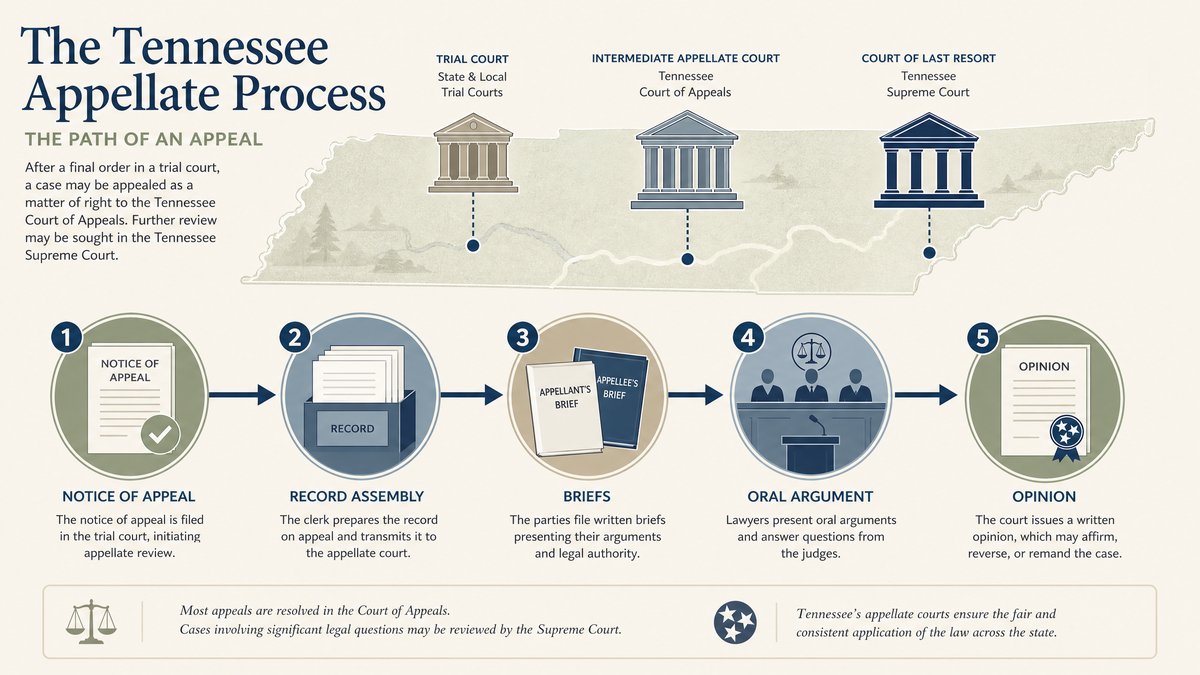
  • From Notice of Appeal to Opinion: A Map of the Tennessee Appellate Process

    From Notice of Appeal to Opinion: A Map of the Tennessee Appellate Process

    From Notice of Appeal to Opinion: A Map of the Tennessee Appellate Process

    This article provides a high-level map of the appellate process in Tennessee. It is not a substitute for the rules, the specific court’s orders, or legal advice in an individual case.

    Beginning an Appeal

    An appeal as of right ordinarily begins with a Notice of Appeal. Tennessee Rule of Appellate Procedure 3 addresses the availability and method of initiating an appeal, and Rule 4 addresses the time for filing. In many civil and criminal matters, the notice must be filed within 30 days after entry of the judgment or order appealed from. Appellate deadlines can be jurisdictional or otherwise consequential, so parties should consult the applicable rule and qualified counsel rather than rely on a general explainer.

    Right hand in a suit sleeve placing a paper into a wooden tray at a counter window, with manila folders, pen, and notebook on the desk.
    A hand sliding a document through a wooden counter tray, illustrating the initial filing step in an appellate process overview.

    Building the Record

    Appellate courts decide cases from the record developed below; they do not conduct a new trial. Rule 24 governs the content and preparation of the record, which may include relevant filings, exhibits, and a transcript or statement of the evidence. The record matters because arguments on appeal must be supported by what is properly before the appellate court.

    Briefs

    Once the record is prepared, the parties submit briefs. Rule 27 describes the elements of a brief, including issues presented, a statement of the case, citations to the record and legal authority, and the requested relief. A brief is not simply a recap of events. It is an argument about legal error, standard of review, and the effect of the claimed error on the judgment.

    Four manila file folders with blue, yellow, green and red tabs in a row on a wooden table linked by a dotted line; blurred interior beyond.
    Illustration showing sequential file folders linked by a dotted line to represent stages in an appellate timeline.

    Oral Argument

    In some cases the court hears oral argument under Rule 35. The argument allows judges to question counsel about the record, the controlling law, and the practical implications of competing positions. A decision may also be made on the written materials when the court does not hear oral argument.

    Opinion and Judgment

    After considering the record and the parties’ arguments, the appellate court issues an opinion or other disposition. Rule 38 addresses entry of judgment and distribution of the opinion and judgment. The result may affirm, reverse, modify, vacate, remand, or otherwise dispose of the trial court’s decision. An appellate opinion should be read carefully: its reasoning, holdings, and instructions on remand may be narrower than a headline suggests.

    Hands holding and marking printed pages at a wooden table with laptop, stacked documents, books, and a magnifying glass.
    Marked pages, reference books, and a magnifying glass illustrate the detailed document review stage when preparing appellate briefs.

    Reading an Appellate Opinion Responsibly

    • Identify the court, date, and procedural posture.
    • Read the issue presented and the standard of review.
    • Distinguish the court’s holding from background facts and party arguments.
    • Check whether the opinion is a final published decision, an order, or a later procedural development.
    • Link to the official opinion and docket when reporting it publicly.

    For readers, the important habit is to follow the document trail. An appellate opinion may identify related filings, a trial-court decision, and a further review petition. Those documents can help clarify what the court actually decided, what questions remain open, and whether later proceedings changed the posture of the matter.

    Disclaimer

    This article is general information, not legal advice. Appellate procedures and deadlines depend on the governing rules and case-specific facts.

    Wood desk by a window with a neat stack of printed pages, a buttoned manila envelope, three books, and a brass desk lamp.
    The stack of printed papers, sealed envelope, and books on a desk visually echo the article’s discussion of the final document stage in the appellate process.

    Sources

    Related reading: Tennessee appellate access to arguments and opinions.
  • Court-Data Claims: Five Checks Before You Publish a Trend

    Court-Data Claims: Five Checks Before You Publish a Trend

    Court-Data Claims: Five Checks Before You Publish a Trend

    Court data can illuminate important public issues, but it can also mislead when a count, rate, or chart is stripped of its source and context. Before publishing a claim about a legal trend, reporters should identify what is being measured, how the numbers were collected, and what alternative explanations may exist.

    1. Identify the Source and Coverage

    Start with the original data source. A statewide annual report, a county court management system, an appellate docket, and a commercial legal database do not measure the same things. Determine the court, time period, case type, and geographic coverage. A filing count in one county should not be presented as a statewide development without evidence that the sample is representative.

    Person with glasses and ponytail at a courtroom table using a laptop showing rows of data; notebook, calculator and a magnifying glass on folders.
    Illustration of reviewing digital records and paper files at a courtroom table, underscoring the need to cross-check court data before publishing trends.

    2. Ask How the Data Was Collected

    Case-management systems may use different categories, coding rules, and closure practices. A change in a category label or reporting workflow can create an apparent increase or decrease that reflects administration rather than a real-world shift. The National Center for State Courts emphasizes the importance of reliability and integrity in case-file information. Journalists should ask whether missing entries, duplicate records, or changed definitions could affect a conclusion.

    3. Add Legal and Institutional Context

    Numbers do not explain themselves. A rise in filings can follow a new statute, a revised court rule, a fee change, an enforcement initiative, or a high-profile event. A decline in active cases may reflect settlements, dismissals, transfers, or altered reporting practices. Readers deserve context about the legal and administrative conditions surrounding a data point.

    A hand points at a tab on one of several open manila file folders spread across a wooden desk, near a magnifying glass, pencils and a notebook.
    Shows reviewing file folders and tabs to represent checking docket chronology and organization before publishing a court-data trend.

    4. Avoid Overstating What the Numbers Show

    Correlation is not causation. An increase in two variables does not prove that one caused the other. A statewide average may also conceal large differences among counties, courts, or case types. Report the denominator where possible, describe limitations, and use precise language: “the records show,” “the data suggests,” or “the count increased during this period” may be more accurate than a broad causal conclusion.

    5. Cross-Check Before Publishing

    Compare a proposed trend with official reports, public dockets, written methodology, and knowledgeable sources such as court administrators or researchers. For Tennessee-specific statistics, begin with the Administrative Office of the Courts and the underlying public records. When a data set is incomplete, say so. Transparency about limits is not a weakness; it helps readers evaluate the claim fairly.

    Woman leaning over a wooden table using a magnifying glass to inspect paper folders next to a box of color-coded file folders
    Person examines paper folders with a magnifying glass, illustrating careful review of records and attention to sample-size checks.

    A Quick Editorial Checklist

    • Can readers access the original source or methodology?
    • Does the time frame match the claim?
    • Are the court type, case type, and geography clearly stated?
    • Could a rule, policy, or data-collection change explain the result?
    • Have you distinguished a documented fact from an inference?

    Good court-data reporting links the public to the underlying evidence and avoids turning a partial record into a definitive narrative. That practice supports accountability while preserving the nuance that legal systems require.

    Disclaimer

    This article provides general information about reporting on court data and is not legal, statistical, or professional advice.

    A woman and a man sit at a wooden table in a formal room, pointing to and reading papers beside a laptop, folders, and a magnifying glass.
    Two people review documents and source materials, symbolizing the final verification and cross-checking step before publishing data trends.

    Sources

    Related reading: fair reporting and public-interest journalism.

  • Legal Aid, Court Self-Help, and the Line Between Information and Legal Advice

    Legal Aid, Court Self-Help, and the Line Between Information and Legal Advice

    Legal Aid, Court Self-Help, and the Line Between Information and Legal Advice

    Navigating the legal system can be difficult without prior experience or representation. Tennessee legal-aid organizations and court self-help resources can help people locate information and understand basic procedures, but it is important to understand the limits of those services and the difference between general legal information and personalized legal advice.

    What Legal-Aid Organizations Do

    Legal-aid organizations provide free or low-cost civil legal assistance to people who meet their eligibility requirements. Programs commonly focus on matters that affect housing, family stability, consumer issues, benefits, employment, or safety. In Tennessee, Legal Aid of East Tennessee and the Legal Aid Society of Middle Tennessee and the Cumberlands are among the organizations that offer civil legal services in their service areas.

    Woman and man at a wooden table in a library; woman holds a manila folder open toward the man while a binder, papers, and pens sit on the table.
    Two people examine documents at a public help table, a visual reference for discussions about where information ends and legal advice begins.

    Eligibility and available representation vary by organization, income, location, case type, staffing, and funding. A person seeking assistance should contact the organization directly and explain the issue accurately. A legal-aid provider may offer representation, a referral, educational materials, or an explanation of available services; it may also be unable to accept a matter.

    What Court Self-Help Resources Provide

    The Tennessee courts’ Self-Help Center provides public resources designed to help people understand court processes, locate forms, and find general information. These resources can be useful for people who are representing themselves. They may explain where a case is filed, what a court form requests, or how to locate a court’s published rules.

    Blank forms and blue pamphlets in clear holders on a wood desk with a lamp, pen cup, touchscreen kiosk, and a blurred person at a counter.
    An information desk with pamphlets, forms and a touchscreen kiosk shows informational materials public venues make available to assist visitors.

    Self-help materials cannot decide what an individual should do in a particular case. Court employees and other non-lawyers generally cannot apply legal rules to a person’s private facts, recommend litigation strategy, predict an outcome, or tell someone which claim or defense to pursue. Those restrictions help preserve neutrality and guard against the unauthorized practice of law.

    Information Versus Advice

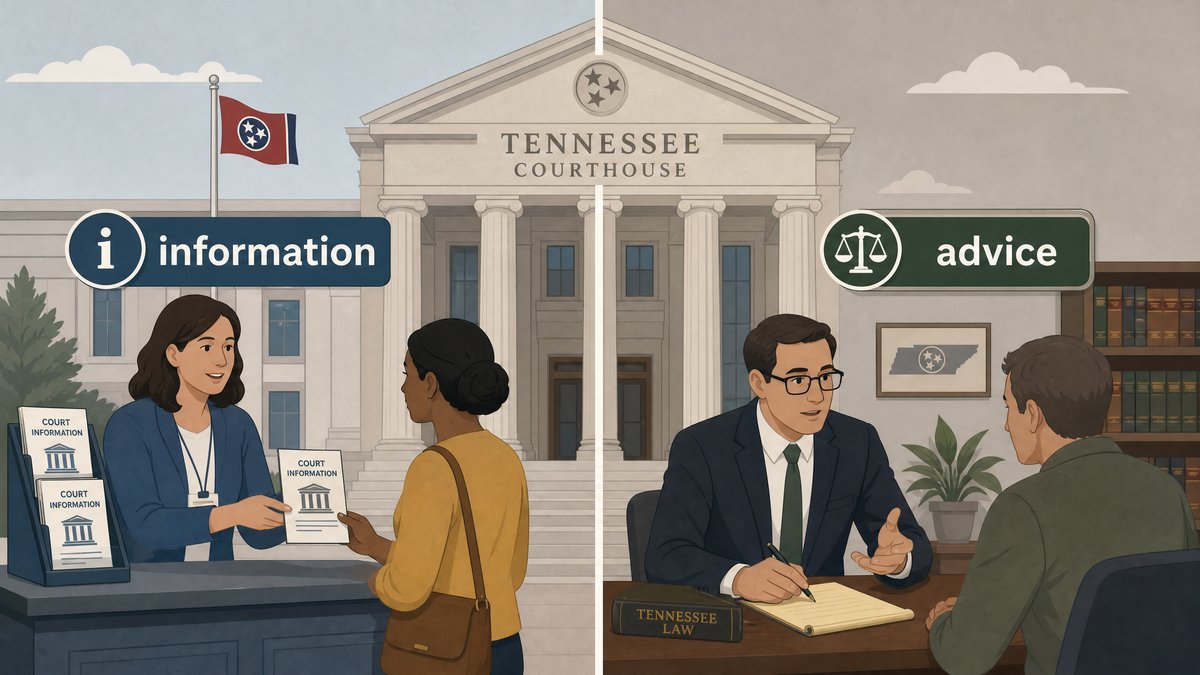
    Legal information is general and descriptive. It can include the text of a statute, a court rule, a filing deadline shown in a notice, a blank form, or an explanation of procedural terms. Legal advice applies law to a person’s specific circumstances and recommends a course of action. Advice may include evaluating the strength of a claim, deciding whether to sign an agreement, choosing a legal strategy, or interpreting how a rule affects a particular dispute.

    Woman at a wooden table filling out stacked, lined forms with a pen while another person sits blurred across the room near bookshelves.
    A person completes paper forms at a table while another sits across, illustrating the paperwork involved in court self-help and legal aid.

    The distinction matters. A reliable public resource can explain how to find a complaint or order, but it should not tell a reader how to litigate their individual case. Readers who need tailored advice should consult a licensed attorney or a qualified legal-aid provider.

    A Responsible Way to Use Public Resources

    • Start with the court or legal-aid organization’s official website.
    • Read the scope of any self-help material and note whether it applies to your court or case type.
    • Keep copies of documents and notices, but avoid relying on a generic article as a substitute for individualized counsel.
    • Ask a licensed lawyer or qualified legal-aid provider for advice about significant deadlines, rights, or strategy.

    Access-to-justice resources are valuable precisely because they provide accurate, neutral information. Using them with a clear understanding of their limits helps people make more informed choices while respecting the role of qualified legal counsel.

    Disclaimer

    This article provides general information and is not legal advice. It does not create an attorney-client relationship. People with questions about their own circumstances should consult a licensed attorney or an appropriate legal-aid provider.

    An older woman wearing glasses and a lanyard gestures to book-filled shelves behind a wooden counter while a younger woman holds a folder
    A conversation at a wooden reference counter connects to the article’s discussion about distinguishing general information from specific legal advice.

    Sources

    Related reading: tracking local courts and government records.

  • A Responsible Vocabulary for Reporting Litigation Abuse

    A Responsible Vocabulary for Reporting Litigation Abuse

    A Responsible Vocabulary for Reporting Litigation Abuse

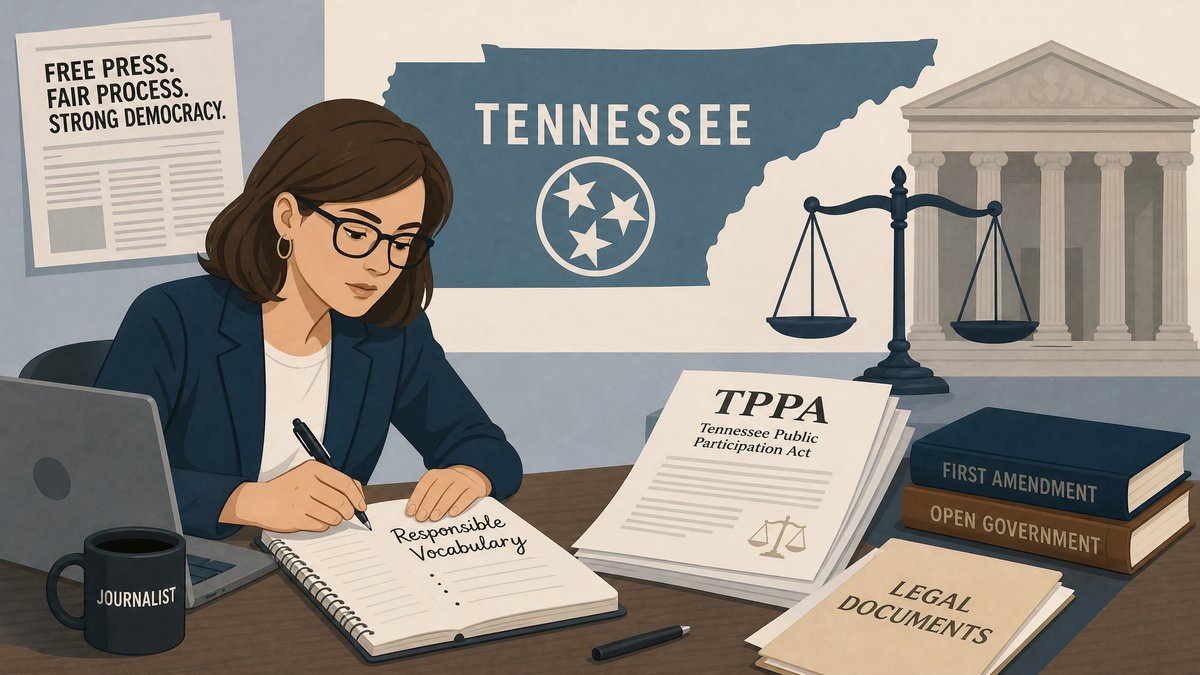
    Public discussion of litigation can become imprecise quickly. A filing may be frustrating, expensive, or unsuccessful without being legally abusive. Journalists, advocates, and readers should therefore use legal labels carefully and connect them to what the public record actually shows.

    Start With the Record, Not the Label

    Before describing conduct as “frivolous,” “abusive,” or “retaliatory,” review the available complaint, motion, response, order, and docket entries. Attribute the claim to its source: “the defendant argued,” “the complaint alleges,” or “the court found.” A court filing is evidence that a party made an allegation; it is not, by itself, proof that the allegation is true.

    Man with glasses pointing to a printed page while a woman writes in a notebook at a wooden table with folders, books, and mugs.
    A careful document review and note-taking scene underscores the article’s point about precise language and verification in reporting litigation.

    This distinction is especially important when private people are involved. A careful report identifies the procedural posture, distinguishes a party’s position from a judicial ruling, and gives meaningful context about what has and has not been decided.

    “Abusive Civil Action” Has a Statutory Meaning

    Tennessee’s Abusive Civil Actions law, Tennessee Code Annotated title 29, chapter 41, uses a defined term that is narrower than everyday criticism of a lawsuit. The chapter addresses specified civil-action relationships and provides a framework for courts to consider allegations that litigation is being used abusively. It should not be cited as a catch-all rule for every contentious dispute.

    For reporting purposes, the sound formulation is not “this is an abusive civil action” unless a court has made that determination. A more accurate description is: “The party asked the court to apply Tennessee’s Abusive Civil Actions law,” followed by a link or citation to the motion and the disposition.

    Person at a wooden desk by a window writing in a lined notebook, with stacks of papers, a manila folder, magnifying glass, pens and a calendar.
    Illustration of methodical note-taking and organized documents, used here to represent careful source verification and record review.

    “Abuse of Process” Is Also a Specific Claim

    Abuse of process is a common-law tort, not a general synonym for aggressive litigation. Tennessee appellate decisions describe it as the use of legal process to obtain a result the process was not intended to accomplish. The focus is on how a legal tool was allegedly used, not simply on whether the underlying lawsuit ultimately succeeded.

    That is why a responsible article should avoid treating a case dismissal as automatic proof of abuse of process. The applicable elements, evidence, and court findings matter. When the issue is still pending, describe the claim as an allegation and identify the filing in which it appears.

    Rule 11 and the Tennessee Public Participation Act

    Tennessee Rule of Civil Procedure 11 addresses representations made to a court and permits sanctions in defined circumstances. The Tennessee Public Participation Act, often described as Tennessee’s anti-SLAPP law, establishes a procedure intended to protect the exercise of certain rights of free speech, petition, and association. These are separate legal mechanisms with their own requirements, deadlines, burdens, and remedies.

    Wood desk with manila folders, magnifying glass, lamp and a navy notebook; a hand holds a pen poised to write.
    Stacked folders, a magnifying glass and a closed notebook visually underscore the editorial consideration of public records versus private claims in reporting.

    Neither mechanism is a journalistic shortcut. A motion invoking Rule 11 or the Tennessee Public Participation Act tells readers what a party has requested; the court’s order tells readers what the court decided. The two should never be conflated.

    Practical Newsroom Guardrails

    • Use “alleged,” “argued,” or “according to the filing” for unresolved assertions.
    • Quote or link to the controlling order when describing a judicial finding.
    • Do not infer motive merely from a person’s decision to file a case.
    • Explain the procedural stage and include material responses or rulings.
    • Ask for comment when reporting allegations about identifiable people or organizations.

    Precision is not a limitation on accountability reporting. It is what makes accountability reporting credible. The most useful stories show readers what the documents say, what the governing law covers, and what a court has actually done.

    Disclaimer

    This article provides general legal information and journalism, not legal advice. It does not assess any reader’s specific facts or create an attorney-client relationship.

    Rear view of a person with a hair bun writing in a notebook on a wooden bench while several others sit facing the front of a formal courtroom.
    A note-taking observer in a courtroom underscores the article’s emphasis on using careful, neutral language when describing litigation scenes.

    Sources

    Related reading: Tennessee Public Participation Act anti-SLAPP basics.

  • How to Read a Tennessee Supreme Court Opinion From Start to Finish

    How to Read a Tennessee Supreme Court Opinion From Start to Finish

    How to Read a Tennessee Supreme Court Opinion From Start to Finish

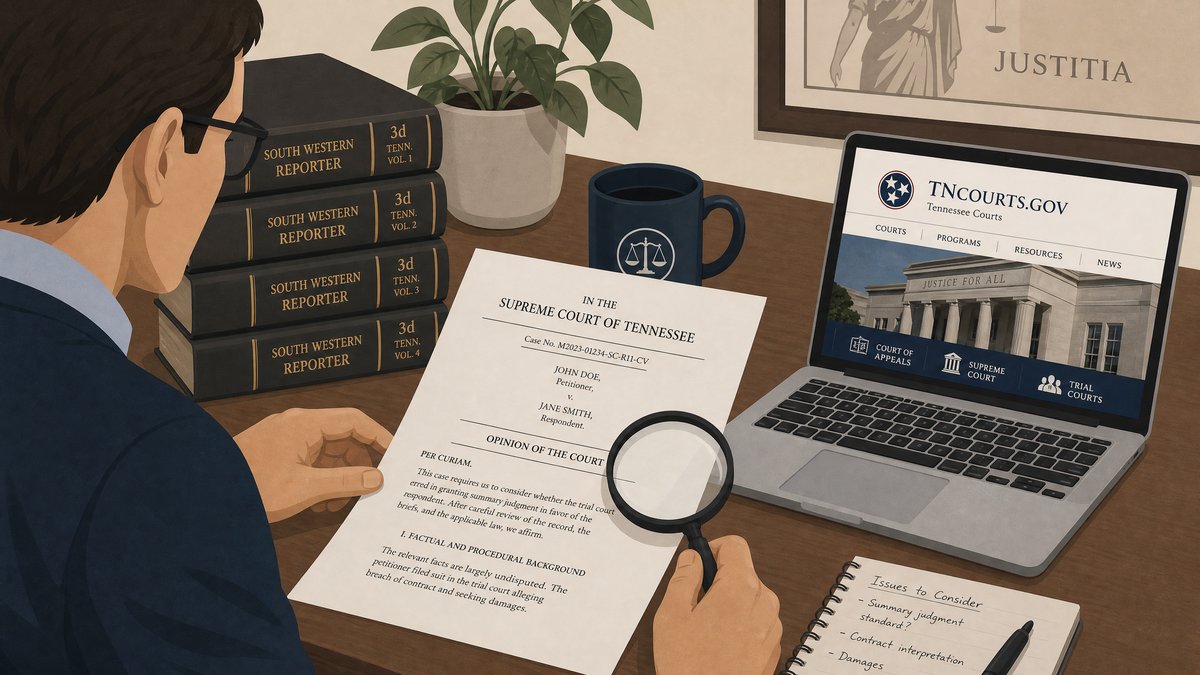
    Understanding a Tennessee Supreme Court opinion can seem daunting, but by breaking it down into its core components, any interested citizen can gain valuable insight into the state’s highest legal decisions. These opinions are not merely legal documents; they explain how the law is applied to complex situations and can shape Tennessee law for future cases.

    The Anatomy of an Opinion: Key Sections

    While each opinion is unique, many Tennessee Supreme Court decisions follow a recognizable structure. Familiarizing yourself with these sections is the first step to effective reading.

    Right hand holding a pen over printed pages with highlighted passages and marginal notes, beside a coffee mug and stacked books on a desk.
    Close-up of annotated printed pages with highlighted passages and margin notes, illustrating one way readers mark key passages when reading an opinion.

    1. Case Caption and Preliminary Information

    At the beginning of an opinion, look for the case caption. It identifies the parties, docket number, and filing date. Opinions commonly identify the authoring justice and provide context about the court or tribunal from which the case arrived.

    2. Summary or Introductory Overview

    Some decisions begin with an overview that helps readers identify the dispute, procedural history, and principal holding. Treat introductory material as an orientation tool, then read the actual opinion and disposition carefully before drawing conclusions about what the Court decided.

    3. Factual Background and Procedural History

    The opinion generally describes the relevant factual background and procedural history: the events that led to the litigation and the path through the lower courts. Pay attention to whether the court is recounting an allegation, a stipulated fact, or a finding. A court’s account of a party’s allegation does not automatically establish its truth.

    Open book with colored page tabs and faint printed lines on a wooden desk, two blue pencils, a magnifying glass, and a checklist card.
    An open, tabbed reference book beside a magnifying glass and checklist suggests a methodical approach to mapping an opinion’s structure.

    4. Legal Issues Presented

    This section identifies the legal questions the Court must answer. Finding these questions early helps readers understand the scope of the decision and avoid treating the opinion as a broad ruling on issues the Court did not decide.

    5. Analysis and Holding

    The main opinion contains the Court’s legal analysis. The justices examine statutes, constitutional provisions, and earlier cases, then apply those authorities to the record. The holding is the legal conclusion that resolves the issues before the Court. Read the reasoning as well as the headline outcome: the reasoning often explains the decision’s future relevance.

    6. Concurring and Dissenting Opinions

    A justice who agrees with the outcome but not all of the majority’s reasoning may write a concurring opinion. A justice who disagrees may write a dissenting opinion. These separate writings are informative but do not carry the same precedential force as the majority opinion.

    Person with hair in a bun typing on a laptop at a wooden library table next to an open reference book, yellow notepad, pen and brass lamp.
    Person taking notes while using print and digital sources, illustrating how to consult both formats during close reading and citation work.

    7. Disposition

    The final disposition states what happens to the lower-court judgment. Common terms include:

    • Affirm: the lower-court decision stands.
    • Reverse: the lower-court decision is overturned.
    • Vacate: the lower-court decision is nullified.
    • Remand: the matter is sent back for further proceedings consistent with the opinion.

    Tips for Effective Reading

    • Read actively and note the issue, rule, reasoning, and disposition.
    • Distinguish what the Court held from background discussion or party arguments.
    • Check whether the opinion is a majority, concurring, or dissenting writing.
    • Use the official Tennessee Courts opinion page to locate the complete document and related materials.
    • Avoid treating a legal opinion as advice about a different person’s facts.

    By approaching Tennessee Supreme Court opinions systematically, readers can better understand the public record and the judicial process without overstating what an individual decision means.

    Disclaimer

    This article provides general legal information and journalism, not legal advice. It does not assess any reader’s specific facts or create an attorney-client relationship.

    Hands holding a pencil, marking an open book with three sticky tabs, next to a stack of books, a lamp, and a notebook on a table.
    An editorial illustration of note-taking and citation-checking, showing a reader marking an open reference book with sticky tabs and a pencil.

    Sources

    Related reading: reading Tennessee appellate opinions.
  • Corrections, Source Protection, and Transparent Legal Journalism

    Corrections, Source Protection, and Transparent Legal Journalism

    Corrections, Source Protection, and Transparent Legal Journalism

    Legal reporting influences public understanding of courts, government, and individual cases. That makes accuracy, transparent sourcing, and a meaningful corrections practice essential. These principles do not turn a newsroom into a court, and they do not replace legal representation; they help readers understand what is known, what is alleged, and what remains unresolved.

    Corrections Are Part of Accuracy

    Even careful reporting can contain mistakes. In legal journalism, a misspelled name, misstated hearing date, or imprecise description of an order can cause real confusion. A responsible correction should say what was wrong, provide the corrected information, and be placed where readers can find it. The Society of Professional Journalists’ Code of Ethics calls on journalists to acknowledge mistakes and correct them promptly and prominently.

    Woman writing on a yellow notepad at a wooden table while a silhouetted person gestures across from her; closed laptop and lamp in a dim room.
    A person taking notes while another remains silhouetted in a dimly lit room, evoking the balance between source protection and transparency in journalism.

    A correction policy should distinguish between a factual correction, a clarification, and a post-publication update. It should preserve the original publication date, identify the date of the change when material, and avoid quietly rewriting an article in a way that obscures the public record.

    Source Protection and Tennessee Law

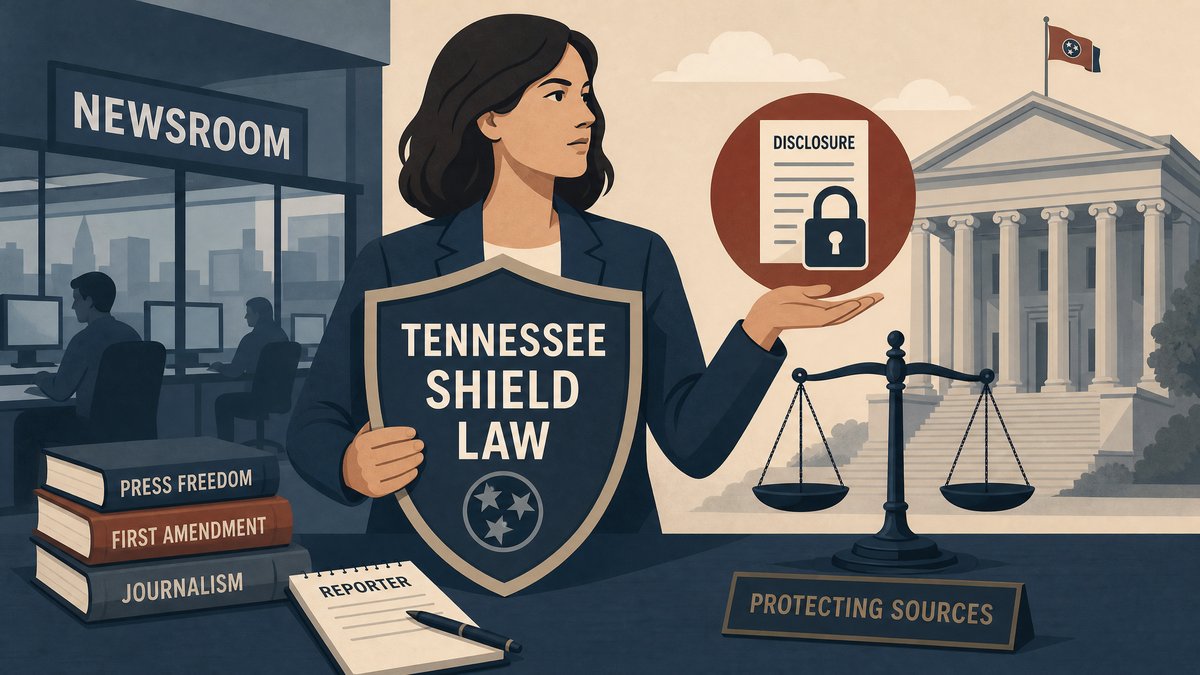
    Source protection is a core issue in investigative reporting, especially where individuals may fear retaliation for providing information. Tennessee’s reporter shield statute, Tenn. Code Ann. § 24-1-208, provides significant protection for persons engaged in gathering information for publication or broadcast. The law covers sources and certain information gathered for publication, but it has limits and exceptions. Whether the statute applies in a specific dispute depends on the facts and procedural setting.
    Stack of papers with a red rectangular stamp, a magnifying glass, a black fountain pen and a closed book on a wooden desk, columns blurred behind
    A stack of stamped documents, a magnifying glass and a pen evoke editorial review and careful scrutiny relevant to corrections and source protection.

    For that reason, a newsroom should never promise absolute confidentiality casually. Before offering confidential treatment, it should understand what information it can responsibly protect, how it will store material, and when legal counsel may be necessary. Confidential sources should be used only when the public-interest value and the need for anonymity are clear.

    Transparency in Legal Reporting

    Transparency begins with attribution. Readers should be able to see whether a factual statement comes from a complaint, court order, transcript, public-record request, interview, or another source. Articles should distinguish between allegations, evidence, findings, and final legal conclusions. A complaint may allege conduct; it does not itself prove it. A dismissal may resolve a claim; it does not necessarily establish every factual assertion made during the case.
    Empty wood-paneled courtroom with rows of benches, raised bench and podium with microphone, tall windows, and a translucent shield-shaped graphic.
    A translucent shield graphic over an otherwise empty courtroom visually suggests themes of source protection, confidentiality, and legal transparency.

    Transparency also means explaining limits. Courts may seal records, restrict access to particular proceedings, or leave parts of a dispute unresolved. When reporting relies on anonymous sources, the story should describe why anonymity was granted without revealing the source’s identity. When a person or institution is the subject of material criticism, a newsroom should seek and fairly describe an opportunity to respond.

    A Practical Editorial Checklist

    • Link to or identify the primary court record whenever possible.
    • Use precise attribution, especially for allegations and procedural filings.
    • Correct material errors clearly and promptly.
    • State what remains unknown or unverified.
    • Explain why an anonymous source was necessary, if one is used.
    • Keep editorial independence separate from sponsorship, advocacy, or personal interests.

    These practices make legal journalism more useful and more fair. They also help readers evaluate reporting on its evidence rather than on rhetoric alone.

    Disclaimer

    This article provides general information about legal journalism practices and is not legal advice. It does not evaluate a particular dispute or create an attorney-client relationship.

    Person's hands typing on a laptop at a wooden desk with an open notebook, magnifying glass, checklist pad and desk lamp.
    Staged editorial workspace illustrating tools for drafting disclosure checklists and organizing notes about source protection and ethics.

    Sources

    Related reading: Tennessee reporter shield law.

  • The Fair-Report Privilege: What Tennessee’s High Court Said in Burke v. Sparta

    The Fair-Report Privilege: What Tennessee’s High Court Said in Burke v. Sparta

    The Fair-Report Privilege: What Tennessee’s High Court Said in Burke v. Sparta

    The Tennessee Supreme Court has issued a significant ruling in the case of Jeffery Todd Burke v. Sparta Newspapers, Inc., providing a crucial, and notably narrow, interpretation of the fair report privilege. This decision, handed down on December 5, 2019, clarifies the boundaries of this journalistic protection, particularly in the context of interactions between reporters and government officials, and carries substantial implications for media organizations operating within the state.

    At the heart of the dispute was the question of whether the fair report privilege extends to nonpublic, one-on-one conversations between a newspaper reporter and a government official. The case involved alleged defamatory statements published by Sparta Newspapers, which had initially secured a summary judgment in its favor from a lower court. This initial ruling suggested a broader application of the privilege, encompassing such private interactions.

    A reporter takes notes during an open Tennessee government meeting beside a visible public record folder and courthouse setting.
    The fair-report privilege is anchored in reporting on public proceedings and officially released governmental information.

    The Supreme Court’s Narrow Interpretation

    However, the Tennessee Supreme Court reversed the lower court’s summary judgment, unequivocally stating that the fair report privilege does not extend to these types of nonpublic, one-on-one discussions. Even if the government official in question is a public information officer, the privilege, as interpreted by the state’s highest court, does not apply to such private exchanges.


    The Court clarified that the fair report privilege is applicable exclusively to public proceedings or official government actions that have been made public. This distinction is paramount. It means that for a journalist to invoke the fair report privilege as a defense against defamation claims, the reported information must originate from an open, public governmental process or a formally released public record. Private conversations, regardless of the official capacity of the source, fall outside this protective umbrella.

    A public court file and open government records appear beside a private, closed-door conversation to illustrate the difference in source context.
    Public records and proceedings differ fundamentally from private one-on-one conversations when assessing the privilege’s scope.

    This ruling underscores the principle that the privilege is designed to protect the accurate reporting of public governmental affairs, ensuring transparency and public access to official actions. It is not intended to shield reporting based on private disclosures, even if those disclosures come from a government representative.

    Implications for Journalism in Tennessee

    The decision in Burke v. Sparta serves as a critical reminder for journalists in Tennessee regarding the scope of their protections. It necessitates a careful consideration of the source and context of information when reporting on government matters. Relying on private conversations with officials, even those designated as public information officers, for potentially defamatory content without a corresponding public record or proceeding, now carries increased risk.

    A journalist compares a public meeting agenda, official court record, and reporting notes at a careful legal research desk.
    Careful reporting begins with confirming that information comes from accessible public events or official records.

    The Supreme Court’s ruling effectively tightens the criteria for applying the fair report privilege, compelling journalists to ensure that their reporting on governmental activities is directly tied to publicly accessible events or documents. This could lead to a greater emphasis on attending public meetings, reviewing official records, and seeking information that has been formally disseminated or presented in a public forum.

    Following its reversal of the summary judgment, the Tennessee Supreme Court remanded the case for further proceedings. This means the case will return to a lower court to address the alleged defamatory statements, now without the broad application of the fair report privilege that was initially granted.

    In conclusion, the Burke v. Sparta decision marks a significant moment for legal journalism in Tennessee. It establishes a clear, albeit narrow, boundary for the fair report privilege, reinforcing its application to public governmental actions and proceedings while excluding private, one-on-one interactions. Journalists and media organizations must adapt their practices to this clarified legal landscape to ensure their reporting remains within the bounds of this critical protection.

    A Tennessee courtroom and reporter’s notebook frame a clear boundary between open public proceedings and private communication.
    Burke v. Sparta emphasizes a defined boundary: the privilege protects reporting tied to public governmental actions and records.

    Primary Sources

    Note: This article provides public-interest journalism and general information about Tennessee legal processes. It is not legal advice. If you have a specific legal question, consult a qualified attorney.

    Related reading: reporting on pending cases and fair-report privilege.

  • How Tennessee Courts Handle Voluntary Dismissal Under Rule 41.01

    How Tennessee Courts Handle Voluntary Dismissal Under Rule 41.01

    How Tennessee Courts Handle Voluntary Dismissal Under Rule 41.01

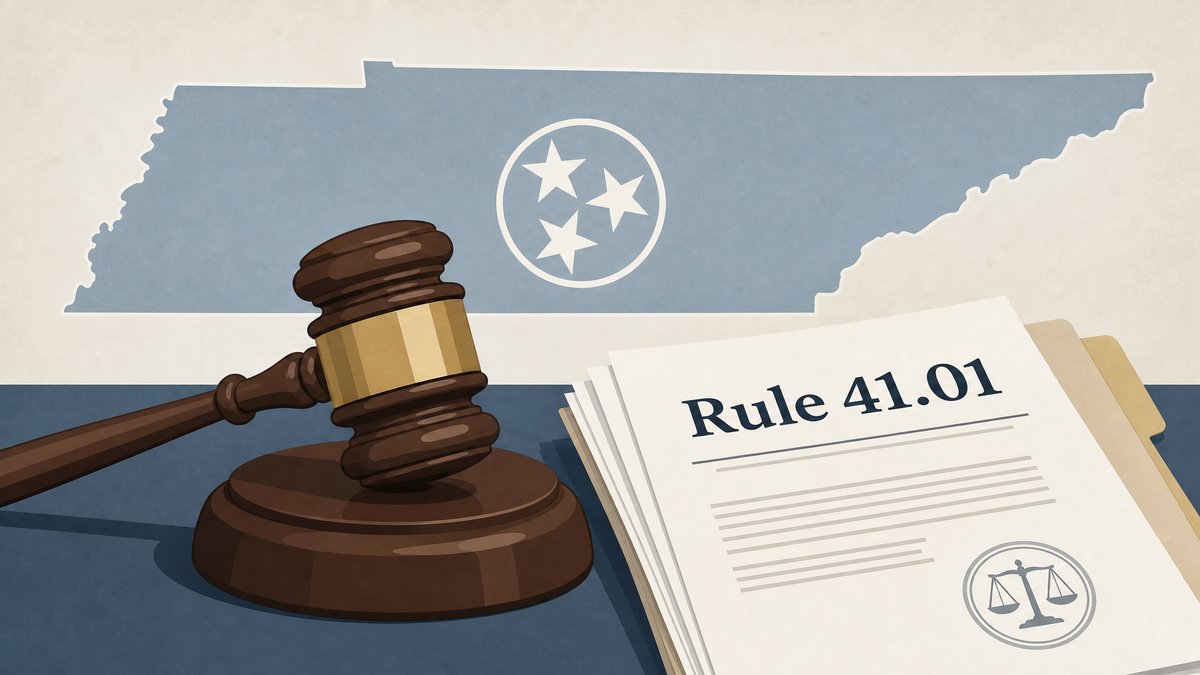
    A voluntary dismissal—often called a nonsuit in Tennessee—allows a plaintiff to end a civil action before the court reaches the merits. It can be an important procedural event, but it does not necessarily mean that a claim was proved, disproved, or permanently abandoned. Tennessee Rule of Civil Procedure 41.01 sets the framework, and the docket entry or written order matters when readers are trying to understand what happened.

    An organized Tennessee civil-case file with a signed court order, docket sheet, and courthouse in the background.
    A voluntary dismissal is best understood through the notice, docket, and signed court order.

    What Rule 41.01 Generally Allows

    Rule 41.01 gives a plaintiff a right to take a voluntary nonsuit in specified circumstances, subject to the rule’s text and to other applicable rules or statutes. The rule identifies several ways a dismissal may be taken, including a written notice served on the parties or an oral notice in open court. The timing rules matter. In a jury case, for example, the rule speaks to the period before the jury retires and before a court ruling on a directed-verdict motion.

    In practical terms, the written record is essential. The rule requires an order of voluntary dismissal to be signed by the court and entered by the clerk. A docket entry, filed notice, and signed order may therefore tell different parts of the procedural story. A reader should not describe a case as concluded merely because a party announced an intention to dismiss; check whether an order was entered and whether it states the dismissal’s effect.

    Legal filing papers, a calendar, and a Tennessee courthouse illustrate the procedural steps of a Rule 41.01 nonsuit.
    Rule 41.01 sets procedural conditions for a voluntary nonsuit.

    “Without Prejudice” and “With Prejudice”

    A dismissal without prejudice generally leaves open the possibility that a claim may be refiled, subject to statutes of limitation, the Tennessee savings statute, any court order, and other defenses. A dismissal with prejudice generally has a more final effect, because it operates as an adjudication that prevents the same claim from being brought again. Those phrases are not interchangeable and should be quoted accurately from the order rather than inferred from a news report or a docket shorthand.

    Two distinct legal case folders and an open court order illustrate the difference between dismissal outcomes.
    The wording of the entered order matters when describing a dismissal’s effect.

    The Two-Dismissal Rule

    Rule 41.01 also contains what is commonly called the two-dismissal rule. Under the rule, a notice of dismissal may operate as an adjudication on the merits when a plaintiff has twice dismissed an action based on or including the same claim. Whether that rule applies in a particular dispute can depend on the identity of the claim, the history of prior cases, and the applicable procedural record. It is not appropriate to assume from a single docket entry that the rule resolves a case permanently.

    A chronological Tennessee case-file archive with two case folders and a docket timeline.
    Prior case history and the procedural record matter when evaluating a two-dismissal question.

    Counterclaims and Other Limitations

    A plaintiff’s dismissal of its own claim does not automatically eliminate a defendant’s properly asserted counterclaim. Rule 41.01 addresses that possibility and allows a defendant to elect to proceed on a counterclaim in certain circumstances. Other rules—such as rules governing class actions, derivative actions, or receiverships—can also create additional requirements. That is one reason a general explainer cannot determine the result in an individual case.

    How to Read a Nonsuit on a Public Docket

    • Locate the filed notice and the signed dismissal order, not only the docket label.
    • Check whether the order says “with prejudice” or “without prejudice.”
    • Look for a counterclaim, pending motion, or other remaining claim.
    • Do not equate a voluntary dismissal with a factual finding by the court.
    • Use careful attribution: “the plaintiff voluntarily dismissed the action,” rather than claiming that the underlying allegations were established or disproved.

    Disclaimer

    This article provides general information about Tennessee civil procedure and is not legal advice. The effect of a dismissal can depend on case-specific facts, orders, and deadlines. Consult a qualified attorney about a particular matter.

    Source

    Tennessee Rule of Civil Procedure 41.01: Voluntary Dismissal—Effect Thereof

    Related reading: TPPA and voluntary-dismissal ruling.

  • What Tennessee Rule 11 Can and Cannot Do About Frivolous Filings

    What Tennessee Rule 11 Can and Cannot Do About Frivolous Filings

    What Tennessee Rule 11 Can and Cannot Do About Frivolous Filings

    In the intricate landscape of legal proceedings, the integrity of filings is paramount to ensuring fairness and efficiency. Tennessee Rule of Civil Procedure 11 serves as a critical mechanism designed to uphold this integrity by deterring frivolous lawsuits and filings. This explainer delves into the scope and limitations of Tennessee Rule 11, outlining its provisions and the types of sanctions available to address abuses of the legal process.

    A carefully organized court filing with a pen, evidence folder, and Tennessee courthouse in the background.
    Rule 11 begins with accountability for the papers presented to the court.

    The Foundation: Signature and Certification Under Rule 11.01

    At its core, Tennessee Rule of Civil Procedure 11 mandates accountability from all participants in the legal system. Specifically, Rule 11.01 requires every attorney or unrepresented party to sign all pleadings, motions, and other papers submitted to the court. This signature is not merely a formality; it constitutes a certification that the signatory has read the document and, to the best of their knowledge, information, and belief formed after reasonable inquiry, that the filing is:

    • Well-grounded in fact: Meaning there is factual support for the claims or defenses presented.
    • Warranted by existing law: Indicating that the legal arguments are supported by current statutes, precedents, or other authoritative legal principles.
    • A good faith argument for the extension, modification, or reversal of existing law: Allowing for legitimate attempts to evolve legal principles, provided such arguments are made in good faith.

    This certification process is crucial for maintaining the ethical standards of legal practice and ensuring that legal actions are pursued with a reasonable basis.

    Legal materials and indexed records being reviewed carefully before a court filing is signed.
    A signature certifies that a filing has been reviewed and supported after reasonable inquiry.

    Prohibited Conduct: Improper Purpose Under Rule 11.02

    Beyond factual and legal grounding, Rule 11.02 addresses the intent behind legal filings. It explicitly outlines representations to the court that prohibit filings presented for any improper purpose. Such improper purposes include, but are not limited to:

    • Harassment: Using the legal system to annoy or distress another party.
    • Causing unnecessary delay: Employing tactics solely to prolong litigation without legitimate reason.
    • Needlessly increasing the cost of litigation: Engaging in actions that drive up expenses for other parties without justification.

    This provision underscores the rule’s aim to prevent the misuse of legal procedures for strategic advantages unrelated to the merits of the case.

    An orderly legal filing workspace with a motion file, calendar, evidence documents, and courthouse columns.
    Rule 11 addresses filings made for a proper legal purpose, not delay, harassment, or needless cost.

    The Teeth of the Rule: Sanctions Under Rule 11.03

    When a violation of Rule 11.02 occurs, Rule 11.03 empowers the court to impose appropriate sanctions. These sanctions are designed to deter future misconduct and can vary depending on the nature and severity of the violation. Available sanctions include:

    • Nonmonetary directives: Such as reprimands, mandatory legal education, or other corrective actions.
    • Penalties paid into court: Fines directed to the court rather than an opposing party.
    • Payment of reasonable attorneys’ fees and expenses to the movant: Compensating the party that brought the Rule 11 motion for their costs incurred due to the frivolous filing.

    However, Rule 11.03 also specifies important limitations on the imposition of monetary sanctions. Monetary sanctions cannot be awarded against a represented party for a violation of Rule 11.02(2), which pertains to the legal warrant of a filing. Furthermore, if the court initiates the sanction process on its own, monetary sanctions cannot be imposed unless an order to show cause is issued before a voluntary dismissal or settlement of the claims made by or against the party to be sanctioned. These limitations ensure that sanctions are applied judiciously and do not unduly penalize parties for their attorneys’ legal misjudgments or interfere with the resolution of disputes.

    A judge’s gavel, balanced scales, court order, and organized legal files illustrating measured Rule 11 sanctions.
    Sanctions are designed to deter misconduct while remaining subject to important limits.

    Scope and Limitations: What Rule 11 Can—and Cannot—Do

    Tennessee Rule 11 is a powerful tool for promoting responsible litigation, but it has distinct boundaries:

    • What it CAN do: Rule 11 effectively deters attorneys and parties from submitting filings that lack factual or legal basis or are intended for improper purposes. It provides a mechanism for courts to enforce professional conduct and ensure that legal resources are not wasted on meritless claims. The availability of sanctions, including the recovery of attorneys’ fees, offers a tangible disincentive against frivolous actions.
    • What it CANNOT do: Rule 11 is not a panacea for all forms of litigation misconduct. It primarily targets issues related to the factual and legal sufficiency of filings and the intent behind them, rather than broader ethical violations or discovery abuses, which are addressed by other rules. Moreover, its limitations on monetary sanctions, particularly against represented parties for certain violations and in cases of voluntary dismissal or settlement, mean it cannot always fully compensate victims of frivolous litigation or be used as a punitive measure in every instance. It is a tool for maintaining the integrity of the papers filed, not a comprehensive solution for all litigation problems.

    In conclusion, Tennessee Rule of Civil Procedure 11 plays a vital role in fostering a fair and efficient legal system by holding litigants and their attorneys accountable for the veracity and intent of their submissions. While robust in its ability to deter and sanction frivolous filings, understanding its specific scope and limitations is essential for both legal practitioners and the public.

    Primary Sources

    Note: This article provides public-interest journalism and general information about Tennessee legal processes. It is not legal advice. If you have a specific legal question, consult a qualified attorney.

    Related reading: Tennessee TPPA and abuse-of-process guide.

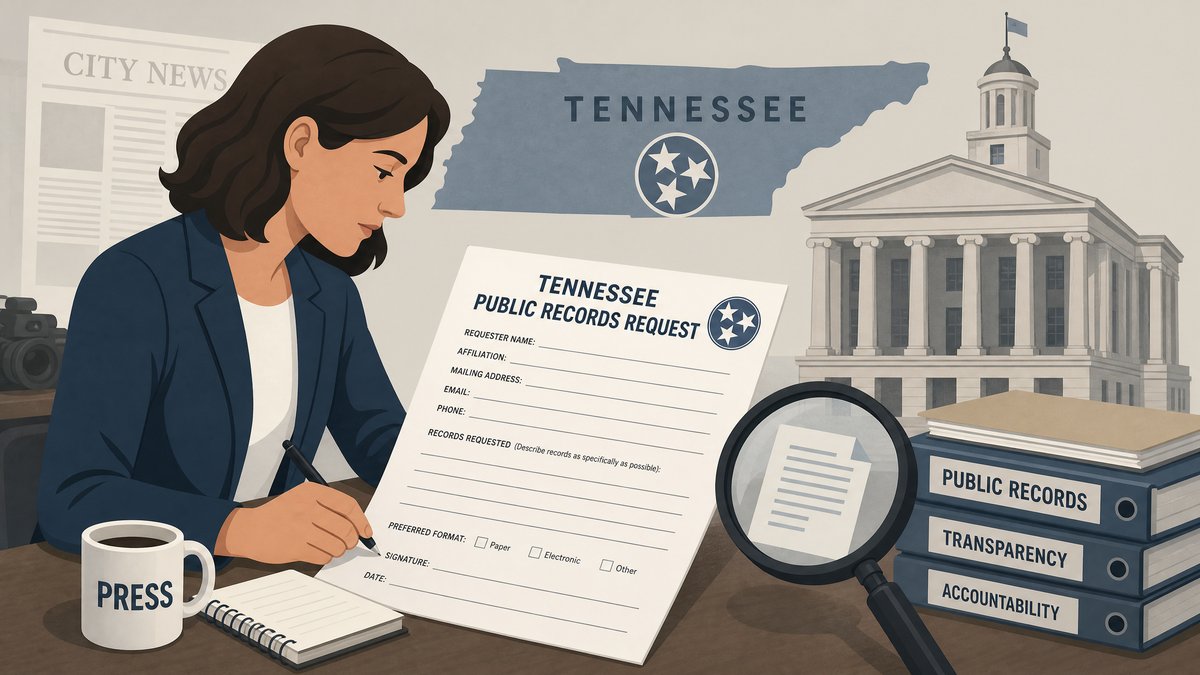
  • How to Make a Focused Tennessee Public-Records Request

    How to Make a Focused Tennessee Public-Records Request

    How to Make a Focused Tennessee Public-Records Request

    In a democratic society, transparency and accountability are paramount. For the citizens of Tennessee, the Tennessee Public Records Act serves as a vital instrument in upholding these principles, granting individuals the right to inspect and copy public records. Understanding how to effectively utilize this act, particularly by crafting a focused public records request, is crucial for ensuring governmental entities uphold their obligations and for citizens to exercise their fundamental rights.

    The Tennessee Public Records Act broadly defines public records to include all documents, papers, letters, maps, books, photographs, microfilms, electronic data, and other materials made or received by any governmental entity. This expansive definition ensures that a wide array of information is accessible to the public, fostering an informed citizenry.

    A neatly organized Tennessee public-records request packet with a laptop, magnifying glass, and the State Capitol in the background.
    A focused request helps an agency identify the records being sought.

    Crafting a Focused Request: Precision is Key

    While the right to access public records is clear, the responsibility lies with the requestor to make a sufficiently detailed request. A common misconception is that governmental entities are required to compile information or create new records in response to a request. This is not the case. Instead, requests must be specific enough to allow the governmental entity to identify and locate the particular records being sought. For instance, instead of asking for “all information about a project,” a focused request would specify “all emails, contracts, and meeting minutes related to the [Specific Project Name] between [Start Date] and [End Date].”

    The emphasis on specificity is not merely bureaucratic; it ensures efficiency and prevents undue burden on governmental resources. By clearly articulating what records are desired, citizens facilitate a smoother and quicker response process, ultimately benefiting both parties.

    A records-request planning desk with a date-range calendar, document folders, and a checklist for narrowing a Tennessee request.
    Specific document types and date ranges make a request easier to process.

    Understanding Costs and Response Times

    Accessing public records in Tennessee is generally designed to be accessible. Inspection of public records is typically free of charge. However, governmental entities are permitted to charge reasonable fees for copies of records. These charges are intended to cover the actual cost of materials and labor involved in producing the copies. Before fulfilling a request that involves charges, the governmental entity is obligated to provide the requestor with an estimate of these costs. This allows citizens to make informed decisions about proceeding with their request.

    Governmental entities also have clear obligations regarding response times. Upon receiving a public records request, they must respond within seven business days. This response can take one of three forms: providing the requested records, denying the request with a clear legal basis for the denial, or providing a written explanation of the time reasonably necessary to produce the records. This structured response framework ensures that requests are not ignored and that citizens receive timely communication regarding their inquiries.

    A Tennessee public-records response workflow with a calendar, documents, a cost estimate, and a courthouse in the background.
    Clear expectations about timing and costs support a more informed request.

    Who Can Request Public Records?

    It is important to note that the rights granted under the Tennessee Public Records Act are specifically extended to citizens of Tennessee. Governmental entities may, therefore, require proof of identification to verify the requestor’s eligibility. This provision helps ensure that the act serves its intended purpose of empowering the state’s own citizens with access to their government’s records.

    A Tennessee public-records file beside a privacy shield, identification card, and courthouse, illustrating access considerations.
    Access is strongest when public records and privacy protections are considered together.

    Important Considerations

    This article provides general information about the Tennessee Public Records Act and should not be construed as legal advice. Readers should consult with a legal professional for specific guidance regarding their individual situations. The information presented is based on current statutes and policies, which are subject to change. It is crucial to ensure all citations to Tennessee Code Annotated are accurate and up-to-date at the time of publication.

    Primary Sources

    Note: This article provides public-interest journalism and general information about Tennessee legal processes. It is not legal advice. If you have a specific legal question, consult a qualified attorney.

    Related reading: court and government records checklist.