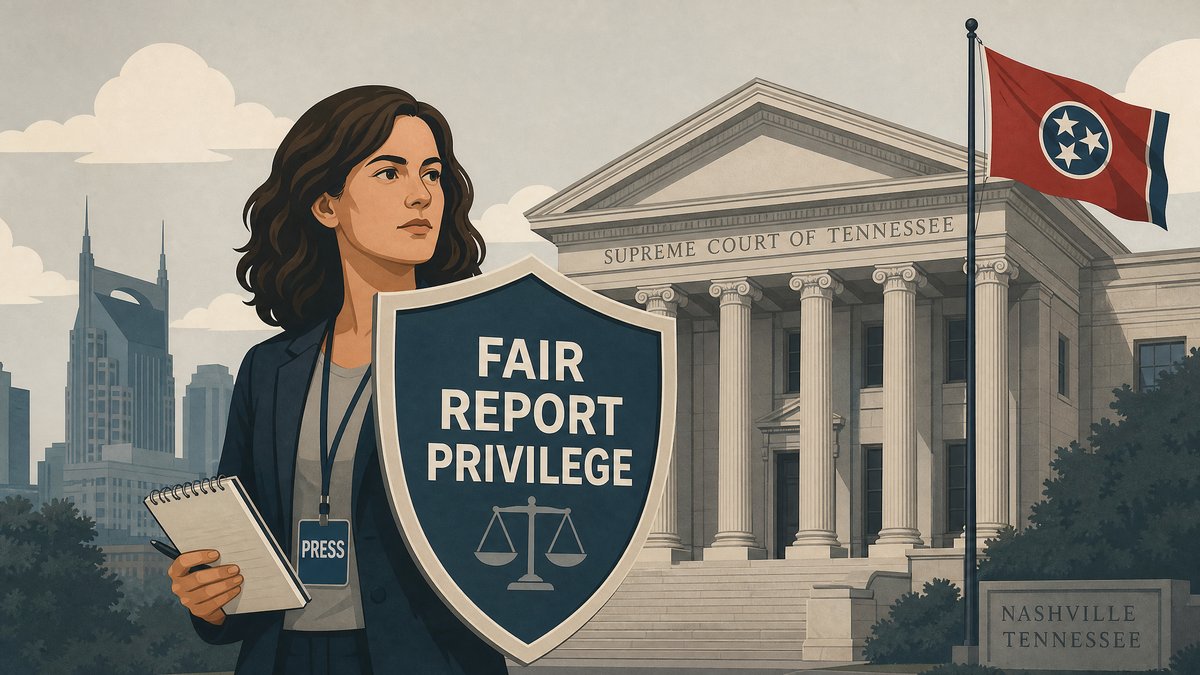
The Fair-Report Privilege: What Tennessee’s High Court Said in Burke v. Sparta
The Tennessee Supreme Court has issued a significant ruling in the case of Jeffery Todd Burke v. Sparta Newspapers, Inc., providing a crucial, and notably narrow, interpretation of the fair report privilege. This decision, handed down on December 5, 2019, clarifies the boundaries of this journalistic protection, particularly in the context of interactions between reporters and government officials, and carries substantial implications for media organizations operating within the state.
At the heart of the dispute was the question of whether the fair report privilege extends to nonpublic, one-on-one conversations between a newspaper reporter and a government official. The case involved alleged defamatory statements published by Sparta Newspapers, which had initially secured a summary judgment in its favor from a lower court. This initial ruling suggested a broader application of the privilege, encompassing such private interactions.

The Supreme Court’s Narrow Interpretation
However, the Tennessee Supreme Court reversed the lower court’s summary judgment, unequivocally stating that the fair report privilege does not extend to these types of nonpublic, one-on-one discussions. Even if the government official in question is a public information officer, the privilege, as interpreted by the state’s highest court, does not apply to such private exchanges.
The Court clarified that the fair report privilege is applicable exclusively to public proceedings or official government actions that have been made public. This distinction is paramount. It means that for a journalist to invoke the fair report privilege as a defense against defamation claims, the reported information must originate from an open, public governmental process or a formally released public record. Private conversations, regardless of the official capacity of the source, fall outside this protective umbrella.

This ruling underscores the principle that the privilege is designed to protect the accurate reporting of public governmental affairs, ensuring transparency and public access to official actions. It is not intended to shield reporting based on private disclosures, even if those disclosures come from a government representative.
Implications for Journalism in Tennessee
The decision in Burke v. Sparta serves as a critical reminder for journalists in Tennessee regarding the scope of their protections. It necessitates a careful consideration of the source and context of information when reporting on government matters. Relying on private conversations with officials, even those designated as public information officers, for potentially defamatory content without a corresponding public record or proceeding, now carries increased risk.

The Supreme Court’s ruling effectively tightens the criteria for applying the fair report privilege, compelling journalists to ensure that their reporting on governmental activities is directly tied to publicly accessible events or documents. This could lead to a greater emphasis on attending public meetings, reviewing official records, and seeking information that has been formally disseminated or presented in a public forum.
Following its reversal of the summary judgment, the Tennessee Supreme Court remanded the case for further proceedings. This means the case will return to a lower court to address the alleged defamatory statements, now without the broad application of the fair report privilege that was initially granted.
In conclusion, the Burke v. Sparta decision marks a significant moment for legal journalism in Tennessee. It establishes a clear, albeit narrow, boundary for the fair report privilege, reinforcing its application to public governmental actions and proceedings while excluding private, one-on-one interactions. Journalists and media organizations must adapt their practices to this clarified legal landscape to ensure their reporting remains within the bounds of this critical protection.
Primary Sources
- Jeffery Todd Burke v. Sparta Newspapers, Inc. (Tennessee Supreme Court Opinion)
- Jeffery Todd Burke v. Sparta Newspapers, Inc. (PDF of Opinion)
Note: This article provides public-interest journalism and general information about Tennessee legal processes. It is not legal advice. If you have a specific legal question, consult a qualified attorney.
Related reading: reporting on pending cases and fair-report privilege.
Leave a Reply