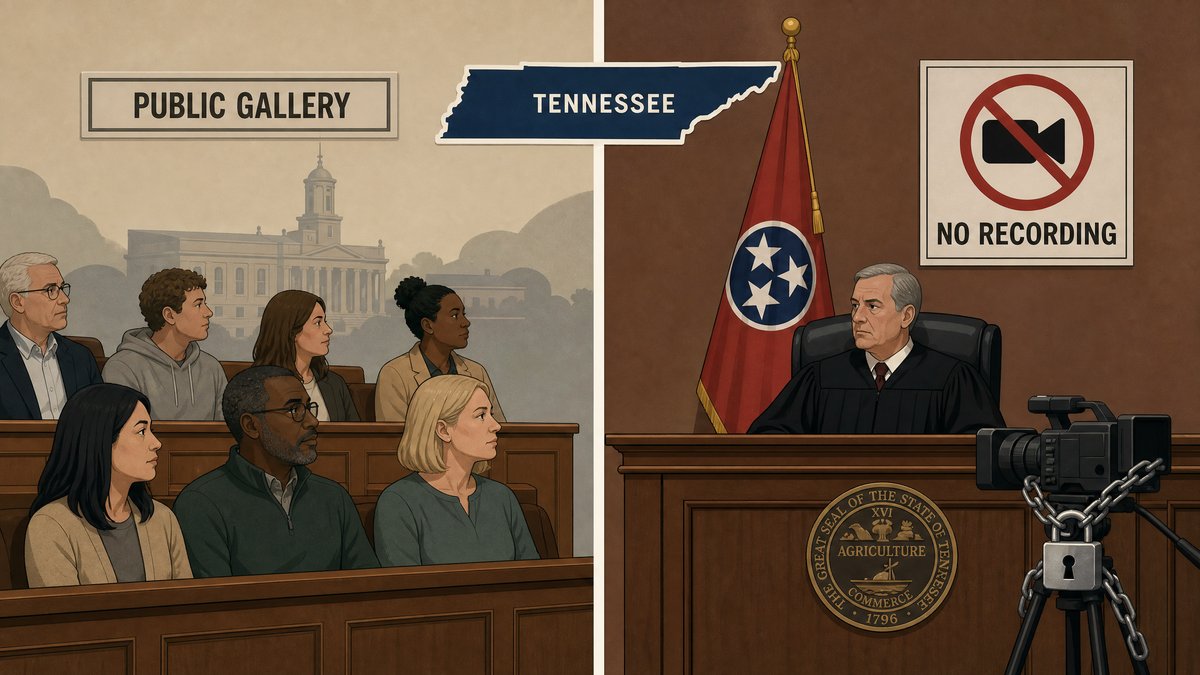
Open courts and public confidence are closely linked. People evaluate courts not only by what the rules say about transparency, but also by what they experience when they try to observe a hearing or review a case file. In Tennessee, the judiciary publishes guidance and rules that explain how access is supposed to work. Understanding those official sources helps separate the legal framework for access from logistics that can shape a person’s day at the courthouse. That distinction helps connect the theme of Tennessee open courts public confidence to what people actually encounter.
What “open” means in practice
In Tennessee, openness is implemented through published procedures. For in-court observation and any recording, the judiciary provides a public explanation of how news coverage requests are handled and what limits may apply. The Tennessee Courts’ page on media attendance and recording describes expectations for decorum, the process for seeking permission to photograph or capture audio/video, and the trial judge’s authority to manage coverage in a specific case (official Tennessee guidance on media attendance and recording). For court records, a centralized Supreme Court Rules index points readers to the rules that govern access to judicial records and the procedures that apply in trial and appellate courts (Tennessee Supreme Court Rules index for access to judicial records).
Proceedings: attending and recording
Observing a court session and recording it are not the same thing. Cameras and recording generally must be requested and approved under the court’s rules; the presiding judge decides requests in light of the needs of the case and the administration of justice. The statewide guidance also addresses practical expectations—such as maintaining decorum and following placement or equipment directions—that support order and fairness in the courtroom (statewide media coverage guidance on requests and decorum). These principles reflect a balance: the public’s interest in seeing how courts work, and the court’s responsibility to ensure proceedings are fair, dignified, and efficient.
Transparency also depends on records access. The Supreme Court Rules index provides a roadmap to rules that govern judicial records, including where to find the operative procedures and recognized exceptions (official index of court rules on records access). When you review a file, it helps to separate categories of documents: a complaint or motion is a filing by a party that states allegations or requests; it is not a judicial finding. An order or judgment is the court’s decision on a question presented; it reflects what a judge actually ruled. Dockets and minute entries help trace when events occurred. Keeping these distinctions in mind can reduce confusion about what the court has—or has not—decided.
Why judicial control supports trust
Public confidence depends on both visibility and fairness. The judiciary’s media-coverage guidance explains that judges have authority to manage recording and coverage to protect the integrity of proceedings and the rights of participants. That authority includes setting conditions on equipment and placement, and limiting recording when necessary under the rules (guidance describing judicial discretion for coverage). Clear, publicly available standards help observers understand that case-by-case decisions flow from written, statewide rules rather than ad hoc preferences.
Access rules versus access experiences
Even when rules are clear, real access can feel different because of ordinary logistics. Courthouse screening, full dockets, space constraints, and the need to avoid disruptions can affect where members of the public sit, how long they wait, or whether recording is feasible on a given day. Those circumstances do not change the rules, but they can color a person’s experience of “openness.” Planning ahead—arriving early, understanding that schedules can shift, and confirming whether equipment is allowed—can make the experience more consistent with expectations.
Putting the official sources to work
The best way to align expectations with reality is to start from the official sources and plan around them. Before attending a proceeding or seeking to record it, review the statewide guidance on news coverage and its conditions so you know how to make a request and what constraints may apply (Tennessee Courts guidance for media attendance and recording). When you need records, begin at the Supreme Court Rules index to locate the governing rules and understand any procedures and exceptions that may apply (Tennessee Supreme Court Rules index for judicial records access).
Building and maintaining public confidence
Open courts are not just a slogan; they are a set of operating commitments reflected in written rules and public-facing procedures. The availability of statewide guidance on recording, and a consolidated index of rules about records, equips the public and press to engage with the courts in ways that respect both transparency and other legal interests. It also gives judges and court staff shared reference points for decisions that inevitably must account for the facts and needs of individual cases. Separating rules from experiences helps set reasonable expectations. A crowded calendar or a denied recording request does not necessarily signal “closed courts” if the outcome follows the written framework. Conversely, knowing the official procedures can make it easier to ask informed questions through appropriate channels. Over time, repeated use of the published guidance and rules can make access more predictable—and predictability is a cornerstone of public trust.
This article provides general information, not legal advice. Court rules, records, and legal consequences depend on the facts, the forum, and current law; consult a qualified lawyer for advice about a specific situation.
General-information disclaimer: This article is provided for journalism and general information only. It is not legal advice and does not create an attorney-client relationship.
Annual statistical reports can look straightforward: a few charts, a handful of totals, and a short list of definitions. In practice, consistency is difficult. Headline numbers use specific labels. Different sections count different things. And without a repeatable method for extracting and documenting the figures, two readers can reach different totals from the same page. This article lays out a clear, step-by-step, reproducible way to read Tennessee Judiciary annual-report case-load figures using only the judiciary’s official publications.
Start with the source and name it precisely
Always begin by identifying the exact report you are using and saving a link to it. For Tennessee, the judiciary publishes annual statewide statistics in a single PDF. The current publication is the Official 2025 Tennessee Judiciary Annual Report, available here: Official 2025 Tennessee Judiciary Annual Report (PDF). When you cite or compare totals, record the report’s exact title as it appears on the PDF and keep the link with your notes. If you later revisit your work—or a reader asks for your method—you can retrace every step to the same page and the same line.
Know the unit of time: fiscal-year labeling controls
Annual statistics in Tennessee are organized by fiscal year, which is reflected in the report title and throughout its tables and charts. Use only the fiscal-year period shown in the document you are reading and avoid mixing figures from different years. If you need to compare across years, download each relevant PDF from the judiciary’s archive to ensure that like is compared with like. To locate reports across years, start from the judiciary’s central index: Tennessee Judiciary Statistical Reports page.
Annual reports typically group the statewide judiciary by court level. Before you copy any figure, confirm which court’s case-load section you are in and keep your notes tied to that section. As an example, the 2025 report includes a Supreme Court case-load section that reports the following counts: 673 appeals filed, 673 finalized, 26 opinions, 673 orders, and a stated 100% clearance rate. These figures appear in the Supreme Court portion of the annual report: Supreme Court case-load figures in the 2025 report PDF. Each court level has its own workflow and labels. Pulling a “total filings” number from one court and a “total dispositions” number from another court will not show a meaningful rate or trend.
Read the labels exactly as printed
In statistical reports, seemingly similar terms can carry different meanings. The safest practice is to quote labels exactly and avoid substitutions. Common labels you will see include:
Filed/Appeals filed: The count of appeals the court received during the fiscal year, as reported.
Finalized/Dispositions: The count of appeals the court concluded during the fiscal year, as reported.
Opinions: Appellate decisions issued as opinions.
Orders: Appellate actions or rulings issued as orders.
Clearance rate: A rate reported in some sections, often reflecting the relationship between concluded and incoming matters for the same period.
Do not assume that “finalized” is interchangeable with any other term unless the report does so. Use the report’s own wording for any figure you restate. In the Supreme Court example above, the section uses “appeals filed,” “finalized,” “opinions,” and “orders,” and it reports a “100% clearance rate.” Keep those words together with the court level and fiscal year in your notes.
Document the calculation you perform—and only after the labels are fixed
When the report provides both filings and finalizations (or filings and dispositions) for a court section, you can reproduce the clearance rate by dividing finalizations by filings for that same section and year. Using the Supreme Court example from the 2025 report’s case-load section: 673 finalized divided by 673 appeals filed yields a clearance rate of 100%. Because the report itself states a 100% clearance rate for that section, your independent calculation should match the report. If it does not, recheck your labels and confirm that you are staying within a single court section and the same fiscal year.
Calculate within one court section at a time.
Use figures from the same fiscal year.
Do not combine “opinions” and “orders” to infer a new total unless the report does so.
Prefer the report’s stated rate over any derived calculation if a difference appears, and recheck which labels you used.
Distinguish volume (filings, finalizations) from formats (opinions, orders)
Readers often equate the count of opinions with a court’s overall throughput. The annual report’s case-load sections help prevent that error by placing decision formats alongside volume measures. In the 2025 Supreme Court case-load section, the report lists 26 opinions for the year and 673 orders. The same section reports 673 appeals filed and 673 finalized. Read these as distinct counts based on the report’s labels. The counts show that orders appear more frequently than opinions in that section, while filings and finalizations align one-to-one for the period.
2) Identify the court level before you collect any figure
Navigate to the section for the court you are studying. Note the section heading verbatim. Do not mix figures across court levels; compute any rate only within one level and within the same fiscal year. If you extract multiple sections, keep separate notes for each, labeled by court and page number.
3) Copy labels verbatim and track page location
For each figure you plan to cite, write down the exact label as printed and the page number. If the report uses “appeals filed” and “finalized,” use those phrases in your write-up. If it lists “opinions” and “orders,” keep them separate and do not assume one implies the other. When in doubt, re-read any definitions or footnotes accompanying the table you are using.
4) Record four distinct types of numbers where available
Incoming: filings for the period (for example, “appeals filed”).
Outgoing: concluded cases for the period (for example, “finalized”).
Decision formats: opinions and orders, if listed for that court section.
Any stated rates: such as the section’s clearance rate, if the report provides it.
For the Supreme Court section in the 2025 report, the four items appear together: filings (673), finalizations (673), opinions (26), orders (673), plus the stated 100% clearance rate. Your notes should keep those values aligned with the labels and court level for that same section.
5) Reproduce the clearance rate only after verifying scope
Once you confirm the scope (same court, same fiscal year, same labels), calculate the clearance rate by dividing finalizations by filings for that section. Cross-check your result with the report’s stated clearance rate if one is provided. Differences usually indicate that a label was misread, a figure was taken from a different section, or a formatting count (opinion/order) was mistakenly treated as a volume count.
6) Keep formats separate from outcomes
Opinions and orders describe how the court memorialized its action. They are not the same as filings or finalizations, and they do not substitute for volume measures. In the 2025 Supreme Court case-load section, the counts for opinions and orders exist alongside the filings and finalizations. Read each as a distinct measurement and avoid combining them unless the report itself adds them together for a stated purpose.
7) When comparing years, match sections and labels exactly
Year-over-year comparisons should be built from the same court sections using the same labels. Because the judiciary provides annual PDFs, the simplest way to standardize comparisons is to place the PDFs side by side and extract only those labels that appear in both. Always obtain each year’s document directly from the judiciary’s index so your links remain traceable and your references verifiable: Tennessee Judiciary statistical reports archive for multiple years.
Avoid common misreads
Using calendar-year assumptions with a fiscal-year report. Stick to the fiscal-year labeling the report uses.
Treating “opinions” as the total volume of cases. The annual report separates formats (opinions, orders) from volume (filings, finalizations).
Mixing courts or court sections. Compute any rates and comparisons within the same court level.
Adding categories that the report lists separately. If the report does not add them, do not create a combined total.
Reading a stated rate without confirming the numerator and denominator. Match both to the labels the report uses for that court and year.
An example walk-through from the report
Suppose you want to report the Supreme Court’s case-load figures as presented in the 2025 annual report. A reproducible approach would look like this:
Navigate to the Supreme Court case-load section. Note the section title and page number in your notes.
Copy the labels and numbers as printed in that section: appeals filed (673), finalized (673), opinions (26), orders (673), and the stated clearance rate (100%).
State each figure with its label and court level, citing the report. If you include a clearance rate, use the report’s stated rate or reproduce it by dividing 673 finalized by 673 appeals filed.
Keep opinions and orders separate from filings and finalizations in any narrative you publish.
This procedure allows another reader to open the same document, find the same section, and confirm that your figures and labels match the source.
What the report does—and does not—explain
The annual report provides counts and, in some sections, rates. It is designed to show what happened numerically during the fiscal year, not to explain why those numbers changed. When you discuss changes across years, avoid attributing causes unless the report itself does so. Keep your commentary tied to what the official publication reports and clearly separate your observations from the document’s stated figures.
How to present your findings for verification
To make your work reproducible by others, present your notes and citations with enough detail that a reader can replicate your steps:
Include the full report title and a working link to the PDF.
List the court section, the exact labels, the figures, and the page on which they appear.
If you perform a calculation, show the formula using the labels (for example, “clearance rate = finalized ÷ appeals filed”).
Provide a link to the judiciary’s statistical reports index so readers can find other years for context.
A compact checklist you can reuse
Source: Download the correct fiscal-year PDF from the judiciary’s site.
Scope: Identify the court level and stay within that section.
Extraction: Record each figure with its label and page number.
Calculation: Compute rates within the same section and year; confirm against any rate the report states.
Separation: Do not mix volume measures with format counts.
Comparison: If comparing years, match sections and labels one-to-one, retrieving each year from the official archive.
Caveat: Describe observed changes without assigning causes the report does not provide.
Why this method aligns with public-record best practices
Official court statistical reports are public records designed for consistent reference. A reader-centered approach treats the report’s labels as authoritative, avoids mixing categories, and favors transparency about sources and calculations. By linking directly to the Tennessee Judiciary’s annual report and its statistical reports index, and by quoting the report’s own labels and figures for the Supreme Court case-load section, you give readers the means to check your work against the same official document.
Where to go next
If you are building a series on Tennessee’s appellate case loads, repeat the steps above for each fiscal year’s report obtained from the judiciary’s index. For each year, isolate the court section you need, copy the labels and numbers as printed, and document any calculation you make. As the 2025 annual report’s Supreme Court section shows—reporting 673 appeals filed, 673 finalized, 26 opinions, 673 orders, and a 100% clearance rate—the method scales from one section to many as long as you keep the scope and labels precise within each section of the official report.
This article provides general information, not legal advice. Court rules, records, and legal consequences depend on the facts, the forum, and current law; consult a qualified lawyer for advice about a specific situation.
General-information disclaimer: This article is provided for journalism and general information only. It is not legal advice and does not create an attorney-client relationship.
The Tennessee attorney discipline process is designed to address alleged professional misconduct by lawyers in a way that follows a published court rule, relies on written records, and culminates in final judicial authority. For readers trying to follow a docket or make sense of an order, it helps to know the entities involved, which records are public, and how a matter moves from an initial complaint to a final decision. This article traces a document-centered path through the system, using the Tennessee Supreme Court’s disciplinary rule and the Tennessee Board of Professional Responsibility’s public overview as the sole references.
At a high level, the Tennessee attorney discipline process begins with a complaint to the Board of Professional Responsibility, may proceed through screening and investigation, and can advance to formal charges, a hearing before an independent panel, and review that results in a final order. Throughout, the documents tell the story: correspondence, responses, charging papers, hearing orders, and ultimately a final order issued under the Supreme Court’s authority. Understanding when the record is nonpublic and when it becomes public is central to reading any case file in context.
The framework: Rule 9 and the Board of Professional Responsibility
Tennessee’s discipline system for lawyers is created and governed by a court rule rather than a statute. The Tennessee Supreme Court’s disciplinary rule—commonly called Rule 9—sets the structure for screening, investigation, charging, hearings, review, and sanctions. Readers can consult the official text here: Tennessee Supreme Court disciplinary Rule 9 (full text). Day-to-day administration occurs through the Tennessee Board of Professional Responsibility (often called the BPR), which provides a concise public overview of the complaint process here: Board of Professional Responsibility “What to Expect” overview for the public.
Rule 9 establishes how matters are initiated, who evaluates the allegations, who prosecutes formal charges, and how adjudication is conducted and reviewed. It also addresses confidentiality during nonpublic stages and identifies the types of sanctions that may be imposed if a violation is found. The Board’s page gives readers a practical sense of the intake experience and routine communications, while the rule itself provides the governing procedures and authority.
Who does what: primary roles in Tennessee attorney discipline
Understanding the roles clarifies which documents to expect and whose name appears on them as a matter progresses.
Tennessee Supreme Court: Adopts and enforces the governing rule for attorney discipline and retains final authority over outcomes. Under the procedures set in Rule 9, the Court reviews matters as the rule provides and enters final orders that resolve discipline.
Board of Professional Responsibility: Administers the system created by Rule 9. The Board receives and screens complaints, oversees investigations through disciplinary counsel, and, when warranted under the rule, authorizes and prosecutes formal charges before hearing panels. The Board also communicates with complainants about status and dispositions as described in its public overview.
Disciplinary Counsel: Lawyers employed by or acting on behalf of the Board who evaluate complaints, conduct investigations, and prosecute formal charges when authorized. Their correspondence often frames the early paper trail and later appears as filings in any formal case.
Hearing Panels: Independent panels convened under Rule 9 to hear and decide formal charges. The panel’s decisions are subject to the review and finality provisions established in the rule.
From complaint to case file: how matters begin
Disciplinary matters usually begin with a written complaint to the Board of Professional Responsibility. The Board’s public guidance explains how a complaint is submitted, how intake is handled, and how the Board communicates about next steps and outcomes: Board of Professional Responsibility guidance on what to expect after filing. Early documents are typically administrative in nature and can include the complaint itself, any attachments from the complainant, and an acknowledgment letter explaining how the Board will evaluate the matter under Rule 9.
During intake and screening, disciplinary counsel may request a response from the attorney. That response, along with any supporting documents the attorney submits, becomes part of the investigative record. At this stage, the confidentiality provisions of Rule 9 govern access to investigative information. The existence of a complaint does not, by itself, mean that formal charges will be filed; the screening function evaluates whether, if the complaint’s allegations were true, they would indicate a potential violation of the Rules of Professional Conduct and whether investigation is appropriate.
Screening and investigation: what to expect in the record
Screening can end a matter without further action, lead to additional inquiry, or result in a request for the attorney to respond. If investigation proceeds, disciplinary counsel may gather documents, correspondence, and other materials relevant to the conduct at issue. These steps are part of the nonpublic phase governed by Rule 9. Readers who are complainants can expect communications that explain whether the matter will be investigated further and, later, how it was resolved, consistent with the Board’s overview.
Because the early steps are nonpublic, members of the general public will not typically see investigative correspondence or preliminary assessments. The paper trail is present, but not published at that stage. As a result, someone looking only at public records may first encounter the matter later, if formal charges are authorized. Understanding that distinction—nonpublic investigative files versus public adjudication—helps explain why a docket can appear to begin mid-story with a charging document rather than with the initial complaint.
When formal charges are authorized: petitions, hearings, and orders
If, after investigation, disciplinary counsel determines that formal proceedings are warranted under Rule 9, the next document to look for is the charging instrument filed to initiate a disciplinary case before a hearing panel. That filing marks the transition from nonpublic inquiry to adjudication under public procedures. The rule describes how charges are set out, how notice is provided, and how the case is heard and decided by a panel: Rule 9 procedures for formal charges and hearing panels.
Once charges are filed, the public case record typically expands. Common filings include the charging document, the attorney’s answer, prehearing motions, hearing notices, exhibits, and panel orders on scheduling or evidentiary matters. After the hearing, the panel issues its decision with findings as provided by Rule 9. Those findings are limited to what the panel concluded under the rule’s procedures and standards and may be subject to review through the mechanisms the rule provides. Readers should be mindful that allegations in a charging document are assertions, not findings, and that findings may later be modified or affirmed through review.
Sanctions and other outcomes authorized by the rule
Rule 9 identifies the range of outcomes available in disciplinary enforcement. A matter can be dismissed, resolved through measures the rule authorizes without public sanctions, or decided with public sanctions when appropriate. Public sanctions under the rule include censure, suspension, and disbarment. The rule also contains procedures related to probationary terms, conditions, reciprocal discipline, disability status, and reinstatement. For the authoritative list of outcomes and procedures, see: Rule 9 provisions on sanctions and other disciplinary outcomes.
Not every matter proceeds to formal public sanctions. The Board’s public guidance explains that complaints are screened and handled according to the rule and outlines how complainants are informed about results. If a matter is closed at screening or after investigation without public charges, members of the public may never see a corresponding case file, even though the complainant will receive notice of the disposition consistent with Board practice described in the overview.
Public versus nonpublic stages: what the record shows and when
The Tennessee framework differentiates between investigative confidentiality and public adjudication. In broad terms, intake and investigation are governed by confidentiality and access provisions in the rule, while formal charges and adjudicative proceedings are conducted through public processes with public orders. As a practical matter, this means that a member of the public may not see investigative correspondence or preliminary assessments, but may later see a charging document, a hearing notice, a hearing panel’s decision, and any final order entered under the rule’s review provisions.
This separation serves two functions: it protects the integrity of the investigative process and the interests of participants during inquiry, and it ensures transparency of adjudicated discipline by making formal proceedings and decisions publicly accessible. When evaluating a particular document, consider where it fits on that timeline. If an item is labeled as a petition, answer, motion, or hearing-panel order, it is typically part of the public adjudication phase. If an item is a screening letter or investigative request, it belongs to the nonpublic phase and may not appear on a public docket.
Final authority and appellate review
Under the Tennessee framework, the Supreme Court retains final authority over attorney discipline. Rule 9 provides a pathway for review of hearing panel decisions and explains how final orders are entered. When tracing the document trail, the endpoint is the controlling order issued under the Supreme Court’s authority. That final order reflects the binding outcome of the process and is the authoritative reference for any discipline imposed. Earlier filings—allegations, answers, motions, and panel decisions—should be read in light of the final order and the procedural posture that led to it.
Readers should also remember that review can take time and that interim filings may reflect requests for extensions, briefing schedules, or other procedural steps permitted by the rule. A docket may therefore include several layers of orders, some preliminary or procedural, and one that is ultimately dispositive. The caption, the issuing body, and the date together indicate where a document fits in the sequence.
How to read the public record: allegations, findings, and orders
Attorney discipline files contain distinct types of documents that perform different functions. Recognizing these differences helps avoid common misunderstandings:
Allegations (pleadings): Statements by disciplinary counsel in a charging instrument asserting rule violations and the factual bases for those assertions. Allegations are not findings and should be read as claims put forward for adjudication.
Findings (hearing panel): Determinations made by a hearing panel after a proceeding conducted under the rule’s procedures. A panel’s written decision states what it concluded based on the record before it. These findings are subject to the review and finality provisions established by Rule 9.
Final orders (review and disposition): Orders entered under the rule’s review mechanisms and the Supreme Court’s authority. The final order is the definitive record of the discipline, if any, that applies at the end of the process.
When reading any public filing, look for familiar signals. The caption will identify the forum and the stage (for example, whether the matter is before a hearing panel or in a reviewing court under the rule). The title will indicate the document type (petition, answer, motion, order, or decision). The signature block shows the role of the signer—disciplinary counsel, respondent’s counsel, a panel chair, or a justice—and the date provides sequence. Many documents also reference earlier filings, which can help you trace the docket chronologically.
A document-by-document tour: typical items you may see
Although each case is unique, many disciplinary matters generate a familiar series of documents. The following list is a general guide to the kinds of records the rule contemplates and that the Board’s overview indicates a complainant or member of the public may encounter as a matter moves forward. Not all items appear in every case, and the presence or absence of a document does not imply any conclusion about the merits:
Complaint submission: The initial filing by a complainant to the Board, often with supporting materials. The Board’s public page explains the basics of how to submit and what happens next.
Intake acknowledgment: Board correspondence confirming receipt and describing initial screening under the rule.
Request for response: A letter from disciplinary counsel asking the attorney to respond to identified issues, consistent with the rule’s investigative framework.
Attorney response: The respondent’s written reply and any supporting documents.
Investigation notices: Communications about ongoing evaluation, consistent with the rule’s procedures for inquiry.
Disposition notice (nonpublic stage): Board correspondence to the complainant explaining whether the matter is closed at this stage or will proceed.
Formal charging document: The petition or comparable pleading that initiates a hearing-panel case under the rule. This filing typically marks the beginning of public adjudication.
Respondent’s answer: The lawyer’s formal response to the charges.
Prehearing orders and motions: Scheduling orders, motions addressing pleadings or evidence, and related rulings governed by the rule’s procedures.
Hearing exhibits and witness lists: Materials presented as part of the adjudication before a hearing panel.
Hearing panel decision: Findings and decision issued by the panel under the rule’s standards.
Review filings: Petitions, briefs, or other documents submitted to seek review in accordance with the rule.
Final order under the rule: The controlling disposition entered under the Supreme Court’s authority as provided by Rule 9. This is the endpoint for purposes of discipline.
Where the public can learn more and what each source offers
Two official resources anchor public understanding of this system. First is the rule itself, which is the authoritative source for procedures, roles, confidentiality, and sanctions. Second is the Board’s overview for complainants, which explains how intake works, how status is communicated, and what kinds of outcomes a complainant may be told about. For the rule text, use the Tennessee Supreme Court’s Rule 9 disciplinary enforcement page. For the complainant’s perspective, see the BPR’s “What to Expect” public overview of the process.
Key takeaways for readers of disciplinary records
The Tennessee attorney discipline process is rule-based and statewide. Rule 9 supplies the governing structure for screening, investigation, charging, hearing, review, and sanctions.
The Board of Professional Responsibility administers the process and provides public-facing guidance on what a complainant can expect from intake through disposition.
Nonpublic screening and investigation can lead to public adjudication. Formal charges and hearing-panel decisions proceed under procedures that produce public orders.
The Tennessee Supreme Court retains final authority and enters final orders that resolve discipline under the review provisions of Rule 9.
When in doubt about what a document means, identify whether it contains allegations, panel findings, or a final order, and read it in the context of the rule’s stages.
This article provides general information, not legal advice. Court rules, records, and legal consequences depend on the facts, the forum, and current law; consult a qualified lawyer for advice about a specific situation.
General-information disclaimer: This article is provided for journalism and general information only. It is not legal advice and does not create an attorney-client relationship.
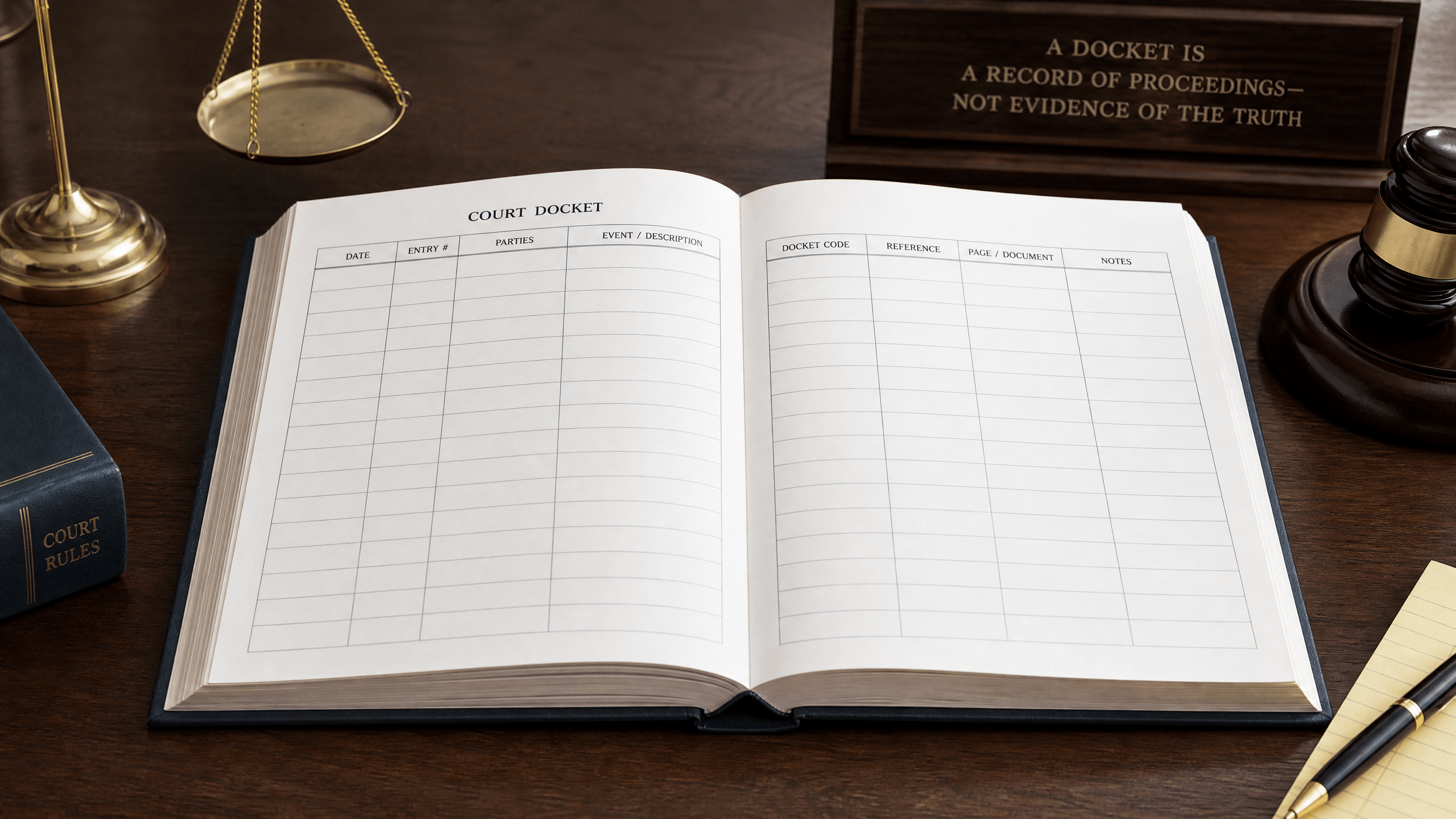
Tennessee court docket entries are the running log of a case: who filed what, when the court took action, and how the case was resolved. They are foundational public records that organize a matter’s procedural history. But a docket is not a transcript, not an opinion, and not a substitute for reading the orders and judgments that control outcomes. This guide explains what Tennessee court docket entries generally include, how to interpret dates and dispositions, and where their limits begin. This guide explains the basics of reading Tennessee docket entries and understanding what they establish.
What a Tennessee court docket is (and is not)
In broad terms, a Tennessee court docket is a public record that records procedural steps in a case, the court’s judgments, and post-judgment execution status. Typical entries identify case parties and attorneys, list the dates of filings and court actions, and reflect financial outcomes such as costs or amounts due. These functions help the public and the parties follow a case’s path through the courts.
Equally important is what a docket is not. Docket text is not evidence and is not a finding about the truth of any allegation. Many docket lines simply note that a filing occurred; they do not evaluate its accuracy. Short labels such as “dismissed” or “granted” summarize outcomes but do not capture the full terms of a judge’s order. For detailed reasoning, the controlling documents are the signed orders and, when a case is appealed, the written appellate decisions made publicly available by the court system. For a centralized overview of official appellate case materials, see the judiciary’s statewide portal at the Tennessee Courts appellate resources page Tennessee Courts appellate resources portal for opinions.
Public access and its limits
Access to Tennessee court records occurs within a statewide public-records framework that includes statutory exceptions. While dockets are public records, not everything in a court file (or about a litigant) will appear on a public-facing docket, and some materials may be restricted by statute or court order. The State maintains a searchable reference that catalogs exceptions to access; this tool helps explain why certain information is redacted or withheld from public view Tennessee Public Records Exception Database maintained by the state.
Because access rules arise from statutes and court orders that can change, the exceptions database is a practical starting point for recognizing categories of information that may be confidential or restricted from public view. This legal framework explains, for example, why juvenile matters or certain sensitive personal data may be absent from public dockets.
Core elements you are likely to see on a docket
Short editorial visual: navigating docket columns.
Although formats vary across courts, most Tennessee court dockets will include some combination of the following elements:
Case identifiers: a case number and case type label used to track filings and orders.
Parties and attorneys: names of plaintiffs/petitioners, defendants/respondents, and counsel of record.
Filings and court actions by date: chronological entries noting pleadings, motions, responses, notices, and court rulings.
Scheduled events: hearing dates, trial settings, and continuances.
Dispositions: shorthand notations reflecting outcomes (for example, a final judgment entered or a motion resolved).
Financial outcomes: costs assessed, amounts awarded, and other monetary entries associated with the judgment.
Post-judgment activity: entries showing enforcement steps or “execution” status after a judgment.
Some fields or documents may be redacted or omitted if they fall within statutory confidentiality or a sealing order.
How to read dates on a docket
Dates are often the key to understanding what happened and when. A single case can contain multiple date types that serve different functions. Common ones include:
Filing date: when a document was received and file-stamped by the clerk.
Entry date: when an order or judgment was entered on the docket, which may be later than the date the judge signed it.
Service date: when a party or attorney was formally served with a document or notice.
Scheduled date: when a hearing, conference, or trial is set to occur.
Disposition date: when the court resolved a motion or the entire case.
These distinctions matter. For example, appeal deadlines and certain post-judgment time limits are frequently tied to entry dates, not the date a hearing occurred. Likewise, a docket might show that a hearing was scheduled, but a subsequent entry (or the absence of one) could indicate it was continued or resolved without a hearing. Always read dates in sequence, and remember that the docket is a living record: a later entry can change the legal landscape by superseding an earlier order.
How to read dispositions and orders
Disposition entries function as short administrative labels. They tell you that the court took an action, but not necessarily why or under what exact terms. Some common labels you may encounter include “dismissed,” “granted,” “denied,” “settled,” and “judgment entered.” To know the scope of an order—who prevailed, what relief was awarded, what deadlines apply, and whether any claims remain—look for the underlying signed order or judgment referenced by the docket entry. The order contains the controlling language.
Financial lines on the docket may show costs assessed and amounts due as part of a judgment. After judgment, entries referring to “execution” or other enforcement steps relate to collection and compliance status. Track these chronologically to see whether an initial judgment has been modified, satisfied, or remains outstanding. If a later entry notes that an earlier order was vacated or superseded, the later entry controls.
What a Tennessee docket cannot establish
Because a docket is a summary tool, there are strict limits on what you can conclude from it:
Truth of allegations: a docket shows that a pleading was filed; it does not prove the facts alleged.
Complete reasoning: brief labels for rulings rarely include the court’s analysis. Appellate opinions are where legal reasoning is published for statewide reference, accessible through the judiciary’s public portal Tennessee Courts appellate resources portal for opinions.
Confidential matters: categories protected by statute or court order do not appear on public dockets or may be redacted, consistent with statewide exceptions to public access documented in the state’s reference tool Tennessee Public Records Exception Database for restricted access.
Off-record events: conferences, settlement discussions, and clerk’s desk communications may not be reflected unless a filing or order memorializes them.
Real-time status: a docket can lag. Clerks update entries, but delays occur between a hearing, the signing of an order, and the entry of that order on the docket.
Finding official appellate materials and case context
When a case reaches the appellate courts, the most authoritative sources for what the court decided are the opinions and orders the judiciary publishes. Tennessee centralizes public appellate case resources to help the public track these materials Tennessee Courts appellate resources portal for opinions. Reading the appellate docket alongside the issued opinion or order provides both the procedural context and the court’s reasoning.
Practical tips for reading docket entries
Start with identifiers: confirm you are on the correct case number and case type before drawing any conclusions.
Follow the chronology: read entries in order. Note the difference between the date an event occurred and the date it was entered.
Find the controlling document: where a disposition line references an order or judgment, read that document for the full terms.
Watch for superseding entries: later orders can modify or vacate earlier ones. The most recent controlling order governs.
Separate allegations from rulings: distinguish between a party’s filing (an allegation or argument) and a court order (a decision).
Note privacy indicators: redactions, initials, or omitted data often reflect statutory confidentiality or a sealing order under statewide access rules. For context about why certain data is withheld, consult the state’s reference tool Tennessee Public Records Exception Database for restricted access.
Recheck the record: because updates can lag, revisit the docket to confirm no later order has changed the status.
Why the same case can look different across systems
Not every Tennessee court publishes docket information in the same format or on the same schedule. Some systems provide more detail or link directly to orders; others display minimal lines until documents are scanned and entered. Differences in software, local practice, and the presence of confidential material all affect what the public can see on a given day. The underlying principle remains the same: the docket is the case’s procedural ledger, and access to it operates within the statewide framework of public access and statutory exceptions.
Limits of this guide
This guide addresses what Tennessee court dockets commonly show and what they do not, based on general principles of public access. It does not list every possible exception or confidential record type, and it does not detail the specific contents of every court’s docket. Court practices and legal standards change. For official case materials on appeal, consult the judiciary’s public appellate case resources maintained by Tennessee Courts, and review the state’s reference for statutory limits on access in the Public Records Exception Database.
This article provides general information, not legal advice. Court rules, records, and legal consequences depend on the facts, the forum, and current law; consult a qualified lawyer for advice about a specific situation.
General-information disclaimer: This article is provided for journalism and general information only. It is not legal advice and does not create an attorney-client relationship.
When you open a Tennessee appellate opinion, the first page does a lot of quiet work. The header tells you which court issued the decision, who the parties are, what the docket number is, when the court filed the document, and whether the writing can be cited in other cases. Because publication and citation status affect whether an opinion is precedential, learning to read the header carefully is an essential research skill. This article explains Tennessee appellate opinion citation status and shows where to locate the designation that controls how you may use the document in later filings. This guide helps readers learn how to read a Tennessee appellate opinion header while identifying publication or not-for-citation status.
Appellate courts resolve appeals in written opinions or orders. Tennessee’s judiciary provides a concise overview of how a case moves from notice of appeal to a written decision that concludes the appeal and explains the court’s ruling. For general context about process and output, see the official summary here: Tennessee Courts: Appeals Process in a Nutshell (official PDF).
Why headers matter in Tennessee appellate opinions
State courts: a neutral illustration for Tennessee appeals.
Once you have the opinion in hand, the header is the map. It orients you to the court, the parties, the case number, the filing date, the authoring judge, and any publication or not-for-citation designation. Tennessee’s appellate courts use a uniform, statewide format for opinions and orders. That structure is designed to make the header predictable, so readers can quickly find the essentials—who, what, where, and when—before turning to the court’s reasoning. The governing format rule is available here: Tennessee Supreme Court Rule 35 on opinion format.
The rulebook behind the header: format and designation
Rule 4 designations: a neutral illustration for publication rules.
Two statewide rules shape what you will see on the first page of a Tennessee appellate opinion and what that header means:
These rules complement each other: the format rule tells you where to look for critical information, and the publication rule tells you what that information means for precedent and citation practice.
What to look for in the header
While the precise appearance can vary over time, Tennessee’s standard format directs courts to include certain core items at the beginning of an opinion or order. Read top-to-bottom and left-to-right, you can expect to find several of the following elements as part of a uniform presentation under Rule 35’s structure:
Court and location: The court that issued the opinion (for example, the Supreme Court of Tennessee or one of the two intermediate appellate courts) and, where applicable, the place of sitting.
Style of the case: The caption listing the parties (for example, Appellant v. Appellee). The caption is the formal shorthand for the dispute and the parties’ posture on appeal.
Appellate docket number: The appellate case number assigned when the appeal was docketed. This identifier is central for tracking filings and related orders.
Filing date: The official “Filed” date. This date anchors when the decision became part of the appellate record and is important for timing rules and citation.
Originating court and judge: A line identifying the trial court, the county, and the judge from whom the appeal was taken.
Authoring judge and panel: The appellate judge who wrote the opinion and, when applicable, the other judges who joined or concurred. Separate concurring or dissenting writings, if any, will be noted and appear after the main opinion.
Designation statement: A notation reflecting publication or a “not-for-citation” designation, as contemplated by Tennessee Supreme Court Rule 4.
Because Tennessee uses a standardized approach, these data points appear in predictable places, which reduces the risk of missing a key designation that affects whether and how the opinion may be cited in future filings.
Publication, not-for-citation, and precedential value under Rule 4
Publication and citation status in Tennessee are governed by Tennessee Supreme Court Rule 4. In broad terms, when an appellate court designates an opinion for publication, that opinion carries precedential value under the rule. Opinions or orders designated “not for citation” are not precedential, and the rule explains how such writings may be used. This is why the header’s designation line is more than a label—it is the rule-based signal of how the writing functions in later research and briefing.
Practically, if the header reflects publication, you are reading an opinion the courts treat as precedent under Rule 4. If the header reflects a not-for-citation designation, the writing does not operate as precedent, and its use is limited as explained by the rule. Treat this as a bright-line signal about whether the writing may be cited as authority.
Where the designation appears—and why the first page matters
Finding the designation: a neutral illustration for scanning opinions.
When you review a Tennessee appellate opinion, look for a statement on publication or not-for-citation near the beginning of the document. Because the standard format under Rule 35 organizes essential information up front, the first page is the best place to confirm the designation made under Rule 4. Finding it early avoids building a legal argument on a writing that the rules do not treat as precedential authority.
Reading the header step-by-step
Short editorial visual: scanning an appellate opinion header.
The top line typically names the issuing court. Tennessee has a court of last resort and two intermediate appellate courts. The institutional source matters: a Supreme Court opinion designated for publication has statewide precedential force under Rule 4. Opinions of the intermediate appellate courts likewise may be designated for publication and carry precedential value when published under the rule.
2) Read the style and parties’ posture
The caption lists parties and their positions in the appeal—for example, appellant v. appellee. This tells you who sought appellate review and helps you follow references throughout the opinion. If the caption lists more than two names, expect shorthand references within the body of the opinion; the full list at the top remains your authoritative guide.
3) Note the appellate docket number
The appellate case number is a reliable way to search the docket and locate related filings. Keeping the number handy allows you to track motions, orders, and subsequent opinions that may affect the appeal’s procedural posture. If multiple consolidated appeals are involved, the header may list more than one number; record them all.
4) Confirm the filed date
The “Filed” date in the header is the official date of the decision for research and citation purposes. The date helps you determine whether the opinion was current at the time of your research and whether intervening rule changes might affect how it can be cited. When comparing authorities, placing opinions in chronological order can also clarify how the law has developed.
5) Check the originating court and judge
A line in the header typically identifies the trial court, county, and judge from which the appeal was taken. This helps you understand the procedural history and where the appellate court is positioned in the state’s judicial hierarchy when reviewing that judgment. If the appeal stems from multiple orders or a transferred case, the header may include clarifying references to the source proceedings.
6) Identify the authoring judge and panel
Opinions list the judge who authored the decision and often note which judges concurred. Knowing the author and the composition of the panel can help you follow how the court frames the issues and how the analysis is structured. If separate concurrences or dissents appear later, the header’s panel listing helps you keep track of which judges joined the majority opinion.
7) Locate the publication or not-for-citation designation
Before you read the facts and analysis, find the designation governed by Rule 4. If the header reflects publication, you are reading a precedential opinion under the rule. If the header reflects a not-for-citation designation, the writing is not precedential and the rule restricts citation. Confirming this status first saves time and prevents citation miscues.
Published does not just mean “online”
Online versus published: a neutral illustration for legal research.
“Published” here is a formal status under the publication rule, not merely a matter of availability on a website or in a commercial reporter. Many opinions and orders are accessible in electronic databases; the key question is whether the appellate court has designated the writing for publication. For the governing standard, see Tennessee Supreme Court Rule 4 on publication and citation status. That designation is what confers precedential value.
Orders, opinions, and common section headings
The format rule covers both opinions and orders. In practice, you will often see section headings such as “OPINION,” followed by organizational headings like “Background,” “Standard of Review,” “Analysis,” and “Conclusion.” While the names and sequence of substantive sections can vary with the case and the court’s needs, Rule 35 anchors the overall structure so that readers can reliably find key components in familiar places across opinions and orders.
How the header supports trustworthy citation
When you prepare a citation, the header supplies the pieces you need to represent the decision accurately: the style (caption), the court, the filing date, and the publication or not-for-citation designation. The designation has a direct consequence under the publication rule: a published opinion is precedential; a writing marked not for citation is not. Confirming that status before you rely on the writing helps avoid missteps in briefs and filings.
Reading what follows the header: allegations, standards, and holdings
Although this article focuses on headers and citation status, one reading principle helps put headers in context. The body of an opinion includes different categories of statements: a recounting of allegations or procedural history, the court’s articulation of legal standards, and the court’s findings and holdings. The header tells you the document’s identity and formal status; the sections that follow indicate what the court has actually decided. Read with an eye for which portions reflect the court’s determinations versus the parties’ accounts.
Common pitfalls when scanning a header
Careful reading: a neutral illustration for avoiding common pitfalls.
Assuming availability equals publication: Do not assume that an opinion is precedential because a copy appears online. Look for a designation made under the publication rule.
Overlooking the filed date: The date matters for understanding the rule set in effect at the time of decision and for placing the opinion in the sequence of authority.
Confusing parties’ posture: The caption signals who appealed and who responded. Misreading it can invert the context of the court’s analysis.
Missing the panel attribution: Noting the authoring judge and panel helps you follow references throughout the opinion, including any concurrences or dissents.
Skipping the originating court line: That line connects the appellate decision to the trial proceedings and can clarify the scope of review.
A quick checklist for Tennessee opinion headers
Read the court name at the top of the first page and note whether it is the Supreme Court or an intermediate appellate court.
Read the style (caption) to confirm the parties’ posture on appeal.
Record the appellate docket number for docket searches and related filings.
Note the filed date for accurate citation and chronology.
Identify the originating court and judge to situate the appeal.
Identify the authoring judge and panel to track concurrences or dissents.
Find the publication or not-for-citation designation and treat it as the rule-based signal of precedential value.
Context: where the decision fits in Tennessee’s appellate system
Tennessee’s appellate process channels disputes from trial courts to one of the intermediate appellate courts and, where granted, to the Supreme Court. The judiciary’s public guide describes how notices of appeal lead to records and briefs, how panels hear cases, and how the appeal concludes with a written decision. That official overview is here: Tennessee Courts: Appeals Process in a Nutshell (official PDF). Understanding that flow reinforces why standardized headers and clear publication designations matter: they allow readers to quickly place each document within the lifecycle of an appeal.
Putting it together
If you remember one rule-of-thumb about Tennessee appellate opinion headers, make it this: the first page is your orientation guide. It tells you which court is speaking, when it spoke, whom it is addressing in the caption, which record is on review, who authored the decision, and, critically, whether the writing is precedential or not-for-citation under the publication rule. The standardized format set by Tennessee Supreme Court Rule 35 on opinion format makes these signals consistent across courts and cases.
Once you have confirmed the header details—especially citation status—you can turn to the body of the opinion with confidence about how to treat what you are reading. This habit ensures that your research respects Tennessee’s rules on publication, citation, and precedent and that you are drawing from the right kind of authority for the purpose at hand.
This article provides general information, not legal advice. Court rules, records, and legal consequences depend on the facts, the forum, and current law; consult a qualified lawyer for advice about a specific situation.
General-information disclaimer: This article is provided for journalism and general information only. It is not legal advice and does not create an attorney-client relationship.
This public-record guide explains how to read a Tennessee Public Participation Act motion and trace its procedural steps. The Tennessee Public Participation Act (TPPA) creates an early procedure for courts to evaluate certain claims that implicate speech, petitioning, or association on matters of public concern. In court dockets and media coverage, this filing is often described as a “TPPA motion,” though in the statute the party typically files a petition to dismiss. This article offers a public-record reading map: what the TPPA is designed to do, the key statutory terms to look for in filings, and how to trace the petition-to-dismiss sequence and related orders in a Tennessee docket. It is a general-information overview for readers who want to understand the documents and decisions without drawing conclusions about any specific lawsuit.
What the TPPA is and where to find it in the record
Reading a public filing: flagged documents illustrate the statutory review process.
The TPPA was enacted by the Tennessee General Assembly to establish a special procedure for early consideration of certain claims. The official bill record for SB1097 in the 111th General Assembly collects the legislative materials and links to the enacted text. That page describes the core features of the procedure, including the petition to dismiss, a stay of discovery upon filing, the allocation of burdens, and stated limitations on the statute’s reach. Readers can begin with the state’s page here: Official TPPA legislative record for SB1097 (111th General Assembly).
On the General Assembly page, the bill summary and links to the final text outline the procedural steps and definitions that practitioners reference when drafting or opposing a TPPA petition to dismiss. When you see a TPPA-related filing in a case docket, comparing the filing’s language to the statutory terminology can help you situate what the litigants are asking the court to do. For orientation, see the state’s summary materials here: Bill summary and enacted TPPA text posted by the General Assembly.
Key terms that appear in TPPA filings
TPPA petitions to dismiss and responses often revolve around defined phrases. The statutory text, as reflected in the legislative record, supplies definitions for the exercise of the right of free speech, the right to petition, and the right of association, in connection with a matter of public concern. In a public docket, you may see parties quote or paraphrase those definitions to argue that the statute applies (or does not). When reading:
Match terms to the statute: Filings may use headings or argument sections that track the statutory elements. As you read, compare the terms used in the papers to the definitions signposted on the official record.
Note how “matter of public concern” is framed: Parties typically explain why their dispute does or does not fit that concept as the statute uses it.
Watch for statutory exclusions: The TPPA contains stated limitations—categories of actions the statute does not cover. Briefing often addresses these limits up front.
A public-record process map: how a TPPA petition to dismiss moves through a case
Procedural context: a neutral illustration for statutory court motions.
While each case has its own timing and local rules, the TPPA’s framework creates a recognizable sequence in many dockets. The official legislative record sketches that sequence; what follows is a reader’s map for spotting it in public filings.
1) The petition to dismiss and supporting papers
In the TPPA, the defense filing is often titled a “petition to dismiss,” accompanied by a memorandum of law and supporting materials (such as declarations). In an electronic docket, look for a cluster of entries: the petition itself, exhibits, and sometimes a separate statement of facts. The petition generally sets out:
The statute invoked: A citation to the TPPA and a summary of why the statute is being raised, often pointing to the nature of the speech, petitioning, or association at issue as framed by the statute’s definitions.
The requested relief: Dismissal of the legal action (or specified claims) under the TPPA’s standard, plus any related relief the statute authorizes.
What the court may consider: The legislative materials describe the procedure the court uses at this stage, including what parts of the record or evidence the court may consider when deciding the petition.
Because the TPPA’s steps are statutory, many petitions to dismiss track the order of the statute. Cross-reference the filing’s structure with the summary and text on the legislative site: General Assembly page outlining the TPPA procedure.
2) The automatic stay of discovery
A central feature of the TPPA is a stay of discovery upon filing. In the docket, you may see a notice flagging the stay, or a short order from the court acknowledging it. The statute also allows the court, on a proper showing, to permit specified, targeted discovery relevant to the petition. In case files, that can appear as:
Notices referencing the stay: Parties may file notices stating that discovery is paused under the TPPA unless the court orders otherwise.
Targeted discovery motions: A party may move for limited discovery tailored to issues the court identifies as necessary to decide the petition, with the court’s order defining the scope and timing.
Protective mechanisms: Orders may clarify that the stay does not halt unrelated case management, while pausing merits discovery for the claims under the petition.
TPPA filings are organized around who must show what, and when. The official record explains the statute’s allocation of burdens in three broad steps:
Initial showing tied to protected activity: The petitioner first connects the legal action to the exercise of the right of free speech, right to petition, or right of association on a matter of public concern, as those terms are used in the statute.
Prima facie case by the responding party: If the initial showing is met, the burden shifts to the responding party to establish a prima facie case for each essential element of the claim targeted by the petition, consistent with the statute’s allowances at this stage.
Further defenses or grounds: Depending on the petition and the claims, the court can consider other grounds identified in the statute. The sequence is designed to let courts evaluate threshold issues early.
In a docket, you may see this framework reflected in the briefing: an opening petition, a response addressing prima facie elements, and a reply discussing statutory defenses or limits. Courts may issue written orders that track these steps, making findings about burdens met or not met under the statute’s terms. For overview purposes, see: General Assembly page outlining the TPPA petition and burden steps.
4) Hearing practice and interim orders
TPPA matters are often set for a hearing after the initial briefing unless the court decides the petition on the papers. Public dockets usually show:
Notices of hearing: Calendar entries and notices setting a date for argument on the petition to dismiss.
Orders on limited discovery: If the court authorizes targeted discovery, look for a short order laying out the permitted topics and deadlines before the hearing.
Minute entries or audio/video references: Some counties note whether a hearing was held and may reference transcriptions or recordings available through the clerk if permitted by local practice.
Any references you see to the discovery stay, targeted discovery, or briefing sequence are grounded in the statute described in the official legislative record.
5) Orders granting or denying relief
When a court decides a TPPA petition, the order often addresses each claim challenged and explains whether the statutory burdens were met. Common features include:
Scope: The court may grant or deny the petition as to all or some claims, depending on the arguments and statutory definitions.
Reasoning: Findings typically reference the statute’s terms, any limited discovery, and the submissions allowed at this early stage.
Further proceedings: The order may set next steps, such as deadlines for any fee applications authorized by the statute, or a schedule for remaining claims.
Because the TPPA contains stated limitations, orders may also explain why the statute does not reach particular claims or parties. Those discussions commonly cite definitions and exclusions signposted in the legislative record.
How to spot TPPA issues in pleadings and exhibits
When you read a complaint, counterclaim, or third-party claim in a case where a TPPA petition to dismiss is later filed, look for the factual allegations the parties later emphasize under the statute’s definitions. Then, when you review the TPPA petition and response, note how each side uses exhibits to connect (or disconnect) the claims from the statute’s coverage:
Context exhibits: Declarations often provide context about the challenged speech, petitioning, or association. These materials are cited to meet the statute’s initial showing or to address statutory defenses.
Prima facie materials: The responding party may cite documents or declarations to establish the essential elements of the targeted claim at the prima facie stage.
Limitations and carve-outs: Parties sometimes submit materials to show that a statutory limitation applies, which would take the claim outside the TPPA’s procedure. The legislative record identifies that such limitations exist and must be considered.
Discovery stay, targeted discovery, and the record
Timing context: a neutral illustration for the discovery stay and targeted-discovery timeline.
The discovery stay often shapes the early record. While merits discovery generally pauses upon filing, the court may tailor limited discovery needed to decide the petition. In the docket this can appear as:
Narrow depositions or document exchanges: Orders can authorize specific depositions or document categories strictly tied to issues to be resolved under the statute.
Deadlines aligned with the hearing: Targeted discovery windows are commonly scheduled to close before the hearing so that parties can file supplemental papers if permitted.
Protective terms: Courts sometimes include confidentiality or sequencing provisions so that targeted discovery fits the statute’s early-resolution purpose.
The TPPA authorizes certain forms of relief when a petition to dismiss is granted. Orders can address dismissal of targeted claims and may also address fees or sanctions as outlined in the statute. In the public record, fee and sanction issues frequently surface in post-order filings, such as:
Applications for reasonable attorney’s fees and costs: Where the statute authorizes fee-shifting after a grant of the petition, look for a motion supported by billing records or declarations.
Briefing on amounts and reasonableness: Parties often file a memorandum addressing the factors a court may consider in awarding fees and costs authorized by the statute.
Orders awarding or denying amounts: Courts may issue a separate order specifying any award.
Voluntary dismissal and a note on Tennessee Supreme Court guidance
In some cases, a plaintiff may file a voluntary dismissal while a TPPA petition is pending. The Tennessee Supreme Court has addressed how the TPPA’s attorney’s fee provision operates in that voluntary-dismissal scenario. Readers interested in the statewide guidance on that question can review the Court’s published opinion discussing attorney’s fees in connection with voluntary dismissal under the TPPA. The opinion explains how the statute’s fee language applies when no ruling on the petition’s merits has yet issued.
Limitations and scope: what the statute does not cover
Legal-research context: a neutral illustration for statutory limits and scope.
The TPPA contains stated limitations that cabin its reach. Those limitations, identified in the legislative materials, can be important in the record for two reasons:
Threshold applicability: A petition to dismiss may rise or fall on whether a limitation applies. Parties typically brief these limits prominently, and courts often address them first.
Partial application: The statute’s procedure may apply to some claims in a mixed-claim complaint but not others, depending on the definitions and limitations. Orders sometimes reflect this by granting relief as to certain counts while denying as to others.
When you read a TPPA order, scan for a section labeled “Applicability” or “Scope” where the court works through the definitions and any limitations. Compare the analysis to the terms highlighted on the General Assembly page: Legislative record noting TPPA limitations and fee provisions.
How to track a TPPA petition across the docket
Docket-tracking context: a neutral illustration for following case activity.
To follow a TPPA petition in public records, consider this neutral checklist for locating filings and understanding where a case stands:
Identify the initiating TPPA filing: Search for “petition to dismiss” or references to the TPPA in the docket index. Open the main petition and any exhibits.
Locate the discovery stay reference: Check for a notice or order acknowledging the statutory stay and any exceptions for targeted discovery.
Find briefing milestones: Look for a response addressing the prima facie elements of the challenged claim(s) and a reply focusing on statutory defenses or limitations.
Check the hearing schedule: Note any hearing notices, minute entries, or rescheduling orders related to the petition.
Read the court’s order carefully: Determine which claims were decided under the statute and whether fee or sanction issues were reserved for separate motion practice.
Review post-order motions: If permitted by the statute, fee applications or related motions may follow; the docket will show the filings and any subsequent rulings.
Document-reading pointers for TPPA materials
When navigating TPPA filings, keep these general document-reading principles in mind:
Distinguish allegations from findings: Petitions, responses, and declarations are party filings and reflect each side’s assertions. Judicial orders reflect the court’s rulings, which may or may not adopt a party’s position.
Follow the statute’s structure: Because the TPPA prescribes a sequence and identifies limits, many filings mirror that order. Using the official legislative record as a reference can help you map arguments to statutory elements: Official TPPA legislative record for SB1097 (111th General Assembly).
Note the procedural posture: Orders may grant, deny, or partially grant relief. Fee or sanction questions may be decided at the same time or reserved for later motion practice.
Watch for jurisdictional and local-rule overlays: Tennessee trial courts apply statewide statutes alongside local rules. Docket formatting and minute entry detail can vary by county.
Why the TPPA is prominent in Tennessee civil procedure
From a public-record perspective, the TPPA is notable because it creates a defined, early path for courts to address certain disputes touching on speech, petitioning, and association. That path is visible in dockets: a petition invoking statutory definitions; a discovery stay that reshapes early case activity; a burden-shifting sequence; and orders addressing applicability, merits at the prima facie level, and any relief the statute authorizes. The official legislative record collects the statute and summary descriptions that courts and litigants use to navigate this process.
Putting it all together
Short editorial visual: flagged filings, calendar timing, a courtroom doorway, and abstract process mapping.
To read a Tennessee Public Participation Act motion—more precisely, a petition to dismiss under the statute—start with the filing’s invocation of the statute and its definitions, compare it to the official legislative record, track the discovery stay and any targeted discovery orders, map the burden-shifting in the briefing, and then read the court’s order to see how each statutory step was resolved. If the order grants relief, watch the docket for any authorized fee applications or related motions. If a party takes a voluntary dismissal while a petition is pending, note that the Tennessee Supreme Court has addressed how the TPPA’s fee language operates in that setting; reviewing that opinion will provide current statewide guidance on fees after a voluntary dismissal. For a consolidated reference to the statute and summary, see the state’s page: Bill summary and enacted TPPA text posted by the General Assembly.
This article provides general information, not legal advice. Court rules, records, and legal consequences depend on the facts, the forum, and current law; consult a qualified lawyer for advice about a specific situation.
General-information disclaimer: This article is provided for journalism and general information only. It is not legal advice and does not create an attorney-client relationship.
Understanding Tennessee Appellate Opinions: Holding, Dicta, and Procedural Posture
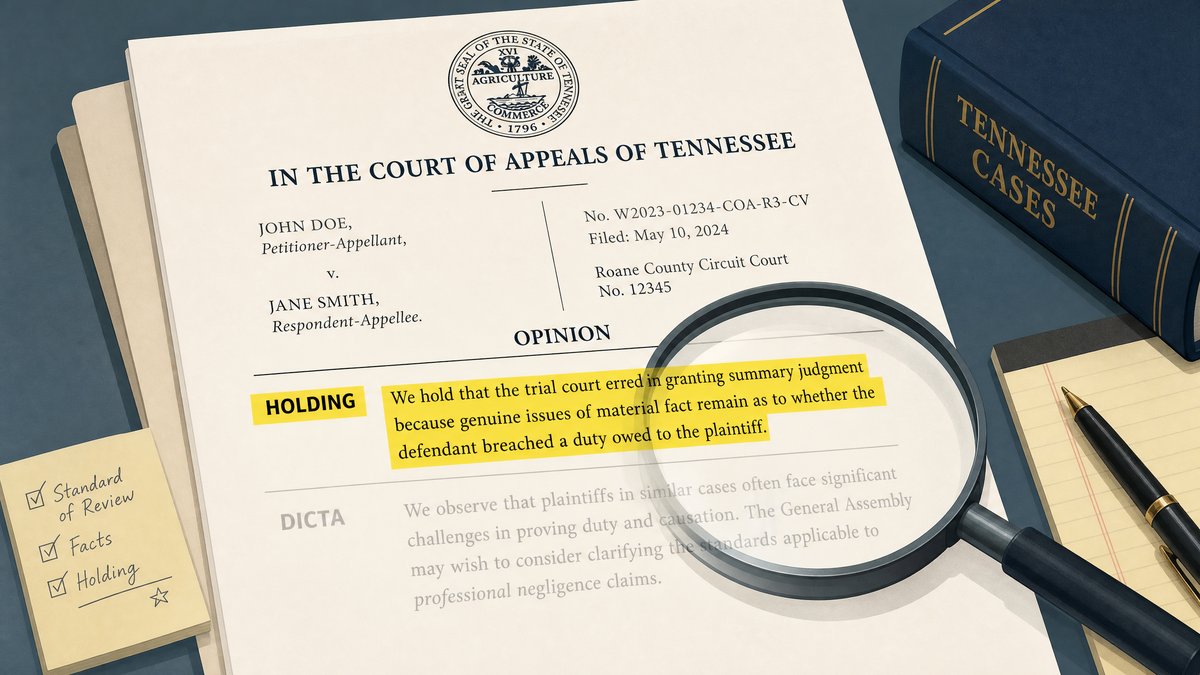
Reading an appellate opinion is different from reading a news summary. The opinion identifies the questions the court was asked to decide, describes the procedural path that produced those questions, and explains the legal reasoning that supports the judgment. For Tennessee readers, three terms are especially important: holding, dicta, and procedural posture.
Start with the procedural posture
Procedural posture describes how a case reached the appellate court and what the court is reviewing. An opinion may begin by explaining that a trial court granted a motion to dismiss, entered summary judgment, denied a new trial, or issued another ruling. The Court of Appeals or Tennessee Supreme Court usually reviews that particular decision; it does not start the case over from the beginning.
A hand selects a color-coded tab on a stack of documents, illustrating how readers navigate sections of an appellate opinion.
Readers should identify whether the appeal follows a final judgment or a permitted interlocutory appeal. Tennessee Rule of Appellate Procedure 3 governs many appeals as of right from final judgments. Rules 9 and 10 address certain interlocutory or extraordinary appeals. The procedural posture helps explain the standard of review and the scope of the ruling.
Find the holding
The holding is the legal rule or conclusion necessary to decide the case. It is not merely the final sentence stating “affirmed” or “reversed.” A careful reader should look for language such as “we hold,” “we conclude,” or a direct answer to the issue presented. The holding must be understood alongside the material facts and the procedural question before the court.
A hand marks passages on printed pages while note-taking materials and a magnifying glass sit on the desk, illustrating careful close reading.
For public-interest reporting, a holding should be described narrowly and accurately. If an opinion resolves whether a particular claim survived a motion to dismiss, it does not necessarily decide what would happen after a trial. A story should explain what the court actually decided and avoid implying that the opinion establishes a broader rule than its text supports.
Recognize dicta
Dicta are statements that are not essential to the judgment. Courts may discuss background principles, possible future questions, or alternative reasoning. Such passages can be useful and persuasive, but they do not have the same precedential force as the holding. The line can be difficult to draw, which is one reason careful journalists should link the original opinion and attribute interpretations to the court’s language rather than overstate them.
Stacked binder, loose pages, and labeled folders illustrate arranging an appellate record and organizing opinion excerpts for review.
Use the opinion’s structure
Most opinions have a predictable structure: a caption, background facts, procedural history, issues, standard of review, analysis, and conclusion. Begin with the conclusion, then return to the issue presented and analysis. Check whether the opinion is published, whether there are concurrences or dissents, and whether later decisions have affected it. Tennessee Courts publishes opinions and appellate materials on its official website.
Why this matters
Legal reporting becomes more reliable when it separates the court’s factual recitation, the parties’ allegations, the procedural ruling, and the court’s legal analysis. This approach respects the difference between a lawsuit’s claims and an adjudicated fact, and it gives readers a usable path back to the underlying public document.
Disclaimer
This article provides general information about reading Tennessee appellate opinions and is not legal advice. For advice about a particular case, consult a qualified attorney.
A reader uses a magnifying glass and pencil to examine printed text, illustrating close, detailed reading useful for parsing appellate opinions.
Understanding Judicial and Attorney Accountability in Tennessee
Maintaining public trust in the legal system is paramount, and a key component of this trust is the accountability of those who serve within it. In Tennessee, mechanisms are in place to address concerns regarding the conduct of both judges and attorneys. This article provides an overview of where the public can find information about judicial conduct and attorney discipline, outlining the roles of the Tennessee Board of Judicial Conduct and the Tennessee Board of Professional Responsibility.
The Tennessee Board of Judicial Conduct: Upholding Judicial Integrity
The Tennessee Board of Judicial Conduct (BJC) is an independent body established by the state legislature to ensure the integrity of the judiciary. Its primary role is to investigate and address allegations of misconduct against judges across various courts, including appellate, trial, general sessions, probate, juvenile, and municipal courts, as well as judicial candidates. The BJC’s jurisdiction extends to matters concerning a judge’s physical, mental, and moral fitness, their performance of duties, and any actions that might unfavorably reflect upon the judiciary or adversely affect the administration of justice.
Seated person using a laptop beside a law book and notepad, illustrating consulting online resources about official conduct and attorney discipline.
Judicial misconduct is defined as conduct that violates the Code of Judicial Conduct, which is Tennessee Supreme Court Rule 10. This code sets standards for how judges should conduct themselves both inside and outside the courtroom. When a complaint is filed, it must be in writing, signed by the complainant, and allege specific facts related to the alleged misconduct. The BJC’s legal staff reviews complaints, and if sufficient grounds exist, an investigation may be initiated. It is crucial to understand that matters before the BJC are confidential unless formal charges are filed against a judge. Only when formal charges are filed does the matter become public.
If the BJC finds that charges of misconduct are established by clear and convincing evidence, it can impose various disciplinary actions. These range from private or public reprimands to recommending that the Tennessee General Assembly remove a judge from office. It is important to note that the BJC is not an appellate court; it cannot review, revise, or correct a judge’s rulings, nor can it provide legal advice. Its focus is solely on judicial conduct.
Stacked manila folders, notebooks, and a computer monitor illustrate archival organization and search tools for locating public disciplinary records.
The Tennessee Board of Professional Responsibility: Ensuring Attorney Ethics
For concerns related to the ethical conduct of attorneys, the Tennessee Board of Professional Responsibility (BPR) is the relevant authority. The BPR’s mission is to protect the public from harm caused by unethical lawyers by administering the disciplinary process. It supervises the ethical conduct of attorneys and investigates alleged violations of the Rules of Professional Conduct, which govern the legal profession in Tennessee.
Members of the public, including clients, judges, or anyone who believes an attorney has acted unethically, can file a complaint with the BPR. Similar to judicial complaints, these must detail specific allegations of misconduct. The BPR offers both a formal complaint process for serious ethical violations and an informal Consumer Assistance Program (CAP) for less severe concerns. The BPR’s website provides information on recent disciplinary and licensure actions, offering transparency into its proceedings. These public records typically include details of the attorney, the nature of the misconduct, and the disciplinary action taken, such as censure, suspension, or disbarment.
A person at a library table uses a laptop, checklist, folders and a magnifying glass, illustrating research steps for locating disciplinary information.
The BPR, like the BJC, does not provide legal advice. Its role is to investigate and adjudicate matters of attorney ethics, ensuring that legal professionals adhere to the standards set forth by the Tennessee Supreme Court. The disciplinary actions taken by the BPR are intended to protect the public and maintain the integrity of the legal profession.
Distinguishing Allegations from Verified Facts
When seeking information about judicial or attorney conduct, it is vital to distinguish between allegations and verified facts. A complaint filed with either the BJC or the BPR is an allegation. These allegations undergo a rigorous investigation process. For judicial conduct, matters remain confidential unless formal charges are filed. For attorney discipline, while the filing of a complaint initiates a process, public disciplinary actions are only reported after a finding of misconduct has been made and approved by the Board or the Tennessee Supreme Court. Therefore, information found regarding ongoing investigations or initial complaints should be understood as unverified allegations until a formal finding or disciplinary action is publicly announced.
Disclaimer
This article provides general information about where to find judicial conduct and attorney discipline information in Tennessee and is not intended as legal advice. For specific legal questions or assistance, please consult with a qualified attorney.
A person reviews papers and notes at a courtroom table, illustrating the final step of carefully checking documents and records described in the article.
Open Courtrooms, Closed Proceedings, and the Difference Between Attendance and Recording
Public access to court proceedings is an important part of judicial accountability. Yet “open court” does not mean that every proceeding is open in every circumstance, or that any person may record inside a courtroom. For readers, reporters, and people following a case, the key is to distinguish the right to attend from the separate rules governing cameras, microphones, and other recording equipment.
The Presumption of Public Access
Tennessee’s Constitution states that courts shall be open, and Tennessee courts ordinarily conduct hearings in public. Public attendance can help people understand the justice system and allows scrutiny of how court business is conducted. The public character of a hearing, however, does not make spectators parties to the case. Judges may enforce decorum, restrict disruptive conduct, and regulate seating or access for safety and case-management reasons.
Open doors and a sparsely filled public gallery illustrate the difference between attending proceedings in person and rules on recording or coverage.
Court records and court proceedings can also be subject to limits. A court may seal a record or close a portion of a proceeding when a legally sufficient reason supports a narrowly tailored restriction. The legal standards and procedures depend on the court, case type, and information at issue. Common concerns include minors’ privacy, confidential information, safety, or the protection of a fair proceeding. A closure or sealing order should be read closely: it may apply only to a particular document, witness, or portion of a hearing rather than to the entire case.
A smartphone and portable recorder on a wooden bench visually connect the article’s points about courtroom attendance versus recording.
Attendance Is Not the Same as Recording
Supreme Court Rule 30 governs media coverage in Tennessee courtrooms. The rule addresses how representatives of the news media may use cameras, audio equipment, and related technology. The rule contains a request process and permits judges to manage coverage in light of the proceeding and the people involved. It includes restrictions designed to protect jurors and to minimize disruption. A person who can enter a courtroom therefore should not assume that recording, livestreaming, photographing, or broadcasting is also permitted.
For journalists, Rule 30 is a practical starting point: make a timely request, identify the coverage sought, comply with courtroom instructions, and be prepared for limits that may be appropriate in the case. The Tennessee Administrative Office of the Courts publishes media-coverage guidance that should be checked alongside the text of Rule 30 and any order issued by the presiding judge.
A closed envelope and lamp on a courtroom desk visually underscore differences between presence in courtrooms and access to confidential files.
How to Report a Closed or Restricted Proceeding
Accuracy matters especially when access is restricted. A responsible report should identify the source of the restriction—such as a written order, a judge’s oral ruling, or a court rule—and explain its scope without speculation. “The public was excluded from a portion of the hearing under the court’s order” is more precise than claiming that the court acted secretly. When possible, link to the public order or docket entry, note any stated reason, and distinguish verified court action from a party’s allegation about access.
A Practical Checklist
Confirm the courtroom, date, and hearing type before attending.
Review local courtroom rules and any orders in the case.
Do not bring or operate recording equipment without understanding the applicable rule or permission.
When access is limited, obtain the order or docket entry that explains the limitation.
Attribute statements about access to the court record, the judge, or a named official source.
Disclaimer
This article is general information about court access and media coverage. It is not legal advice and does not determine whether access or recording will be permitted in a particular proceeding.
An observer takes notes from a courtroom bench, accompanying discussion about how being present in court differs from recording or transcribing proceedings.
How to Read a Judicial Order Without Overstating What It Decides
A court order is an official act of the court, but its meaning depends on its wording, procedural posture, and scope. A careful reader does more than scan the result line. The goal is to identify what motion was decided, what standard the court applied, which issues remain unresolved, and whether the order makes factual findings or only addresses procedure.
Start With the Caption and the Motion
The caption identifies the court, case number, and parties. The first paragraphs often identify the motion before the court: a motion to dismiss, summary-judgment motion, discovery motion, request for a protective order, or a request to seal. That distinction is essential. An order denying a motion to dismiss, for example, may mean only that the claim can proceed at that stage. It does not necessarily decide that the allegations are true.
Careful inspection of a document highlights the importance of focusing on precise wording when reading an order.
Similarly, a discovery order may require documents to be produced or may limit a subpoena. It is not usually a final decision about liability. Accurate coverage should name the precise motion and avoid substituting broader conclusions for the order’s actual result.
Identify the Standard the Court Applied
Orders often cite a legal standard. A court considering a motion to dismiss generally evaluates whether a pleading states a legally sufficient claim under the applicable rule; the court may accept certain well-pleaded allegations for that limited procedural purpose. A court considering summary judgment applies a different standard and may consider a record of affidavits, depositions, admissions, or other evidence. The standard tells readers what the order did—and what it did not do.
A file, single document and pen suggest focusing on a record and its surrounding materials when assessing an order’s scope and context.
Separate Findings, Allegations, and Arguments
An order can describe allegations made by a party, arguments advanced by counsel, and findings made by the judge. Those categories should not be blurred. Look for language such as “the plaintiff alleges,” “the defendant argues,” “the court finds,” or “the record shows.” A judge’s quotation of an allegation is not necessarily an endorsement of it. A decision resolving a motion may also leave important factual disputes for a later hearing or trial.
Read the Disposition Carefully
The final section normally states what the court ordered: granted, denied, granted in part, dismissed with prejudice, dismissed without prejudice, stayed, remanded, or continued. Each phrase has consequences that vary by context. If the order dismisses only one count, one party, or one motion, the case may continue on other issues. If the order says it is not final, or if it directs further proceedings, that is a signal not to report the case as over.
Person examines documents at a courtroom table, illustrating careful review when assessing what a judicial order actually decides.
A Reliable Reporting Method
Link to the public order or quote the relevant passage exactly.
State what motion was decided before describing the result.
Use “alleged” for unproven factual claims and identify the speaker or filing.
Check the docket for later orders, notices of appeal, or amended filings.
Ask counsel or the court’s public-information office for clarification when appropriate, while making clear that their explanation does not replace the document.
Why Precision Matters
Judicial orders can affect people, institutions, and public confidence in the courts. Overstating an order can create a false impression that a court resolved facts it did not reach. Precise, document-led reporting better serves readers and reduces the risk of turning a procedural event into a misleading claim about guilt, liability, or credibility.
This article is general information about reading public court orders and is not legal advice. Individual orders should be interpreted in their procedural and factual context.
A hand turning through tabbed folders on a desk with a gavel and calendar, illustrating careful attention to procedural posture and document review.