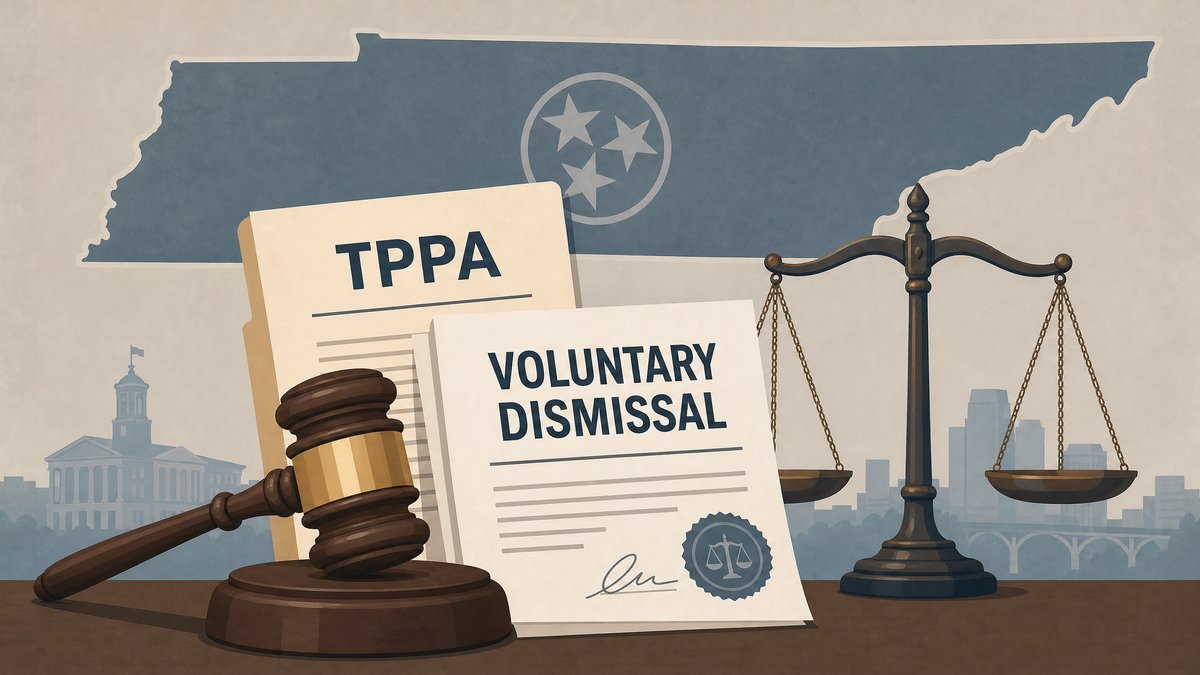
The Tennessee Supreme Court unanimously ruled that a pending TPPA petition does not prevent a plaintiff from taking a voluntary nonsuit, though the defendant cannot recover TPPA fees if the dismissal occurs before the petition is adjudicated.
On October 9, 2024, the Tennessee Supreme Court issued a unanimous decision in Robert E. Lee Flade v. City of Shelbyville, Tennessee, et al. The decision addresses the interaction between a plaintiff’s right to take a voluntary nonsuit under Tennessee Rule of Civil Procedure 41.01 and a defendant’s petition to dismiss under the Tennessee Public Participation Act (TPPA).

The question before the court
The case began after Robert E. Lee Flade sued several defendants over statements made on social media. In response, two defendants filed motions to dismiss and TPPA petitions that sought dismissal with prejudice, attorney’s fees and costs, and sanctions. Before the trial court heard those requests, Flade voluntarily nonsuited the complaint. The trial court entered an order dismissing the case without prejudice, and it declined to adjudicate the pending TPPA petitions. The Court of Appeals affirmed.
The Supreme Court accepted the appeal to decide whether filing a TPPA petition creates an exception to a plaintiff’s right of voluntary dismissal under Rule 41.01.
What Rule 41.01 generally allows
Tennessee Rule of Civil Procedure 41.01 generally gives a plaintiff the right to take a voluntary nonsuit without prejudice before trial, subject to the rule’s terms and specified exceptions. A nonsuit ends that action without a decision on the merits, although the rule and other law may affect whether and how a claim can later be refiled. The rule is procedural and should be read closely in the context of a specific case.

The court’s holding
The Supreme Court held that the filing of a TPPA petition is not an exception to Rule 41.01’s voluntary-nonsuit right. In the court’s analysis, the TPPA did not displace the long-established rule permitting a plaintiff to voluntarily dismiss an action in these circumstances. Because the plaintiff dismissed the action before the trial court adjudicated the TPPA petitions, the trial court correctly declined to rule on them.
The practical consequence identified by the court was significant: where a plaintiff voluntarily dismisses the lawsuit before the TPPA petition is adjudicated, the defendant cannot obtain TPPA attorney’s fees in that proceeding. That conclusion follows from the procedural posture of the case; it does not resolve the merits of every dispute that may involve a TPPA petition.

Why the decision matters
The TPPA was enacted to provide a mechanism for early dismissal of certain legal actions that implicate free speech, petition, or association rights. The statute also includes provisions concerning discovery, fees, and sanctions. Flade clarifies a limit on that mechanism: a pending TPPA petition alone does not prevent a plaintiff from taking a timely voluntary nonsuit under Rule 41.01.
For reporters and readers, the opinion is also a reminder that the timing of a filing can be outcome-determinative. A public docket might show a TPPA petition, a nonsuit, and a dismissal order. Those entries do not necessarily tell a full story unless the underlying pleadings and opinion are reviewed.

How to read this ruling responsibly
The decision does not announce that every claim implicating speech is meritless, nor does it answer whether a particular lawsuit is retaliatory. It addresses a particular procedural question arising from the relationship between a voluntary dismissal and a statutory dismissal petition. When discussing the case, it is important to distinguish the court’s legal holding from allegations made in the underlying pleadings.
Primary sources
- Tennessee Supreme Court opinion, Flade v. City of Shelbyville.
- Tennessee Administrative Office of the Courts press release.
- Tennessee Rule of Civil Procedure 41.01.
Editorial note: This article provides general information based on public court materials. It is not legal advice and does not assess the truth of unproven allegations in the underlying dispute.
Related reading: TPPA abuse-of-process protections.
Leave a Reply