Stop Legal Harassment

Court access · Free expression · Accountability

Category: Legal Resources

  • Public Access to Appellate Arguments and Opinions in Tennessee

    Public Access to Appellate Arguments and Opinions in Tennessee

    Public Access to Appellate Arguments and Opinions in Tennessee

    Public access to court proceedings and decisions helps people understand how judicial institutions work. Tennessee’s appellate courts provide several official ways to find opinions, follow case histories, and in some circumstances watch oral arguments. Access is meaningful only when readers understand both the available records and the limits that may apply.

    A legal research desk with appellate case files, a court opinion, a laptop, and the Tennessee State Capitol in the background.
    Public access to appellate materials helps readers examine the records behind a court decision.

    Finding Appellate Opinions

    The Tennessee Administrative Office of the Courts maintains a Public Case History system for the Supreme Court, Court of Appeals, and Court of Criminal Appeals. The system can be used to search by case number, case style, party name, or organization. Its case pages may include a procedural history and public documents such as orders and opinions. The Court of Appeals also maintains an opinions page.

    When reporting an opinion, readers should begin with the official document rather than a summary. The caption, court, date, docket number, and disposition establish the basic frame. The procedural history and issue presented help explain what the court was deciding and what it was not deciding.

    A researcher compares a Tennessee appellate opinion with a procedural-history timeline and public case materials.
    Start with the official opinion and the case history before relying on a secondary summary.

    Watching Oral Argument

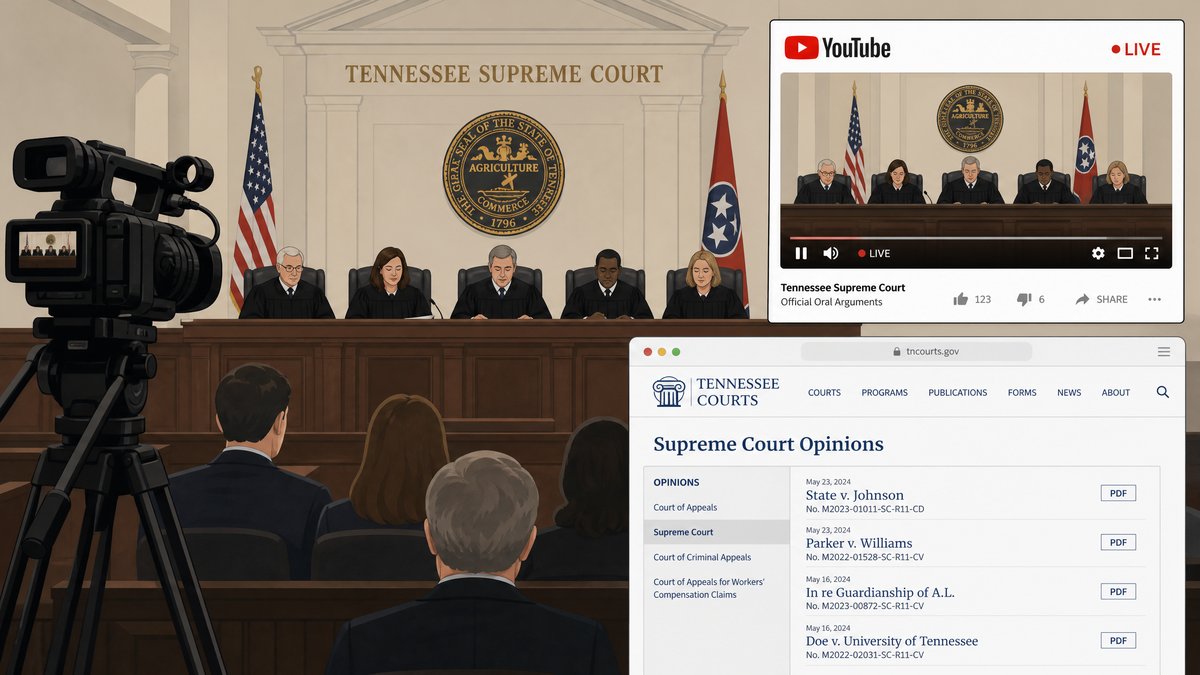
    The Tennessee Supreme Court makes many oral arguments available online through its court resources and streaming channels. Oral argument provides an opportunity to hear judges question attorneys about the governing law and the record. It should not, however, be treated as a decision. A question from the bench may test an argument; it is not a ruling. The opinion or formal order is the authoritative expression of the court’s disposition.

    A public view of a Tennessee appellate oral argument, with attorneys at lecterns and judges on the bench.
    Oral argument shows how judges examine legal questions, but the written opinion remains authoritative.

    Public Access Has Limits

    Tennessee Supreme Court Rule 34 addresses public access to court records. It recognizes categories of court records while also identifying records or portions of records that are not open for public inspection. Sealed materials, information protected by rule or law, and deliberative materials may be unavailable. A public docket entry may therefore show that a filing exists without making every underlying document publicly accessible.

    For journalists and researchers, the appropriate response to an unavailable record is not speculation. Explain what is publicly available, identify the source of the information used, and be clear about what the public record does not establish. That approach respects both open-courts values and legitimate restrictions designed to protect sensitive information or the integrity of the judicial process.

    An open court file beside a sealed folder, a rulebook, and a privacy shield representing limits on public court-record access.
    Open-courts access is important, but sealed and protected records require careful, non-speculative reporting.

    A Responsible Research Checklist

    • Use the official court site and public case history before relying on secondary summaries.
    • Record the case number, court, date, and document title.
    • Distinguish allegations in a filing from findings in an opinion or order.
    • Check whether an opinion has later history, including rehearing or further review.
    • Do not infer the contents of sealed or unavailable records.

    Readers should also distinguish access from interpretation. A filing, an oral-argument recording, and a final opinion have different legal and editorial significance. Linking each claim to the appropriate official record makes a story more transparent and makes it easier for the public to see what supports a particular conclusion.

    Disclaimer

    This article offers general public-information guidance and is not legal advice. Access to particular records may depend on court rules, orders, and applicable law.

    Sources

    Related reading: Tennessee Rule 30 media coverage.
  • Friday Accountability Briefing: Five Public Tennessee Legal Documents Worth Watching

    Friday Accountability Briefing: Five Public Tennessee Legal Documents Worth Watching

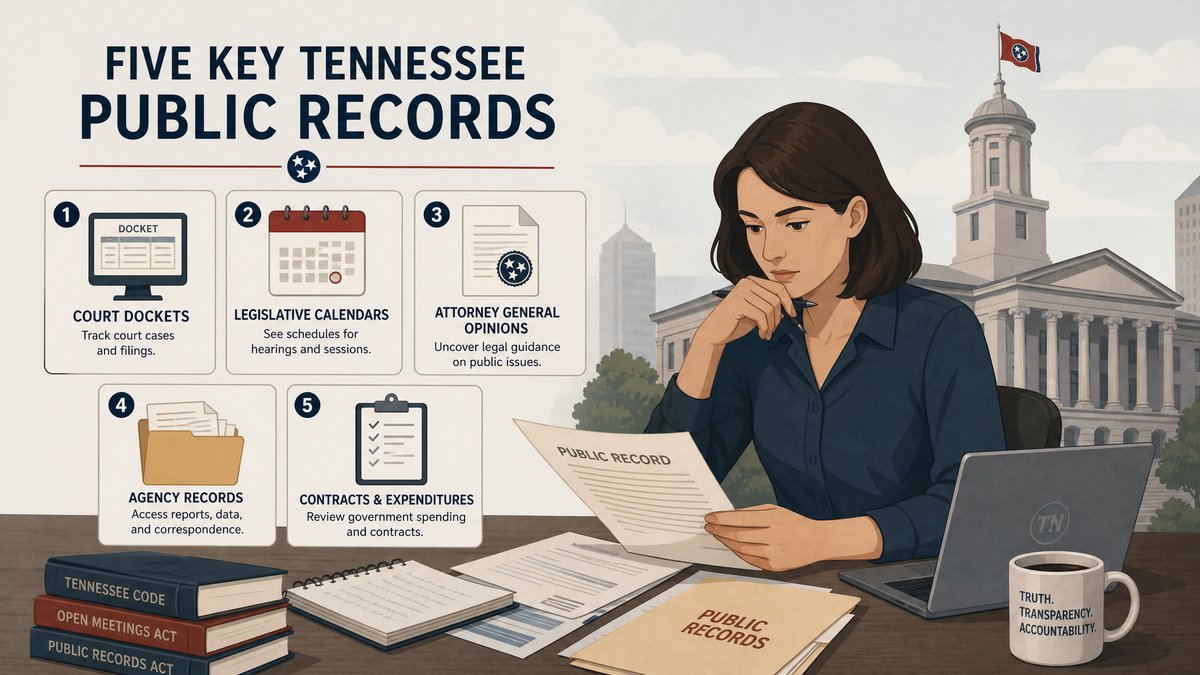
    Accountability reporting begins with documents. Public records do not answer every question, and a filing or bill is not proof of an allegation. But primary materials can help readers see what government bodies and courts have actually done, what remains unresolved, and where to look next.

    Here are five useful Tennessee document types for readers who want to follow legal and civic issues with care.

    A carefully organized research desk with Tennessee court documents, public-records papers, legislative materials, a magnifying glass, and a notebook.
    Public documents provide the foundation for accurate accountability reporting.

    1. A court docket

    A docket is the court’s running list of events in a case. It can show filings, hearing dates, orders, and case-status entries. It is a roadmap—not a substitute for reading the documents themselves. A docket entry may identify that a motion was filed, but the motion and resulting order will usually provide the context needed to describe it accurately.

    When writing from a docket, record the court, case number, date, and document title. Separate a party’s allegation from a court’s finding. If access is limited or a record is sealed, do not infer what the unavailable material says.

    An open court docket beside a case file and calendar, representing the timeline of filings, hearings, orders, and case-status entries.
    A court docket is a roadmap to a case, not a substitute for reading the underlying filings and orders.

    2. A court order or opinion

    An order explains a court’s decision on a motion or procedural question. An appellate opinion may provide a fuller legal analysis and is often the most reliable starting point for explaining a rule or precedent. Read the holding before summarizing the case. Pay attention to the precise question the court answered, the standard it applied, and whether the decision is final or subject to further review.

    The Tennessee judiciary publishes opinions and many other resources at tncourts.gov. An official decision is stronger reporting support than a summary or a social-media characterization of the case.

    3. A public-records request and response

    Tennessee’s Public Records Act provides a framework for inspecting or receiving copies of public records maintained by governmental entities, subject to statutory exceptions. For court records, Supreme Court Rule 34 addresses public access and identifies categories of records that are confidential or otherwise unavailable. A records request should be specific, respectful, and tailored to documents that the agency or court actually maintains.

    A denial or redaction is not proof of misconduct. It may reflect a lawful exception, privacy protection, court order, or an administrative issue. Good reporting asks what legal basis was cited and preserves the correspondence for readers to evaluate.

    A Tennessee public-records request and response paperwork set on a desk with files and a privacy shield.
    Public-records correspondence can document what was requested, what was produced, and what was withheld.

    4. A bill and its history

    Before a proposal becomes law, readers can follow the bill number, sponsors, amendments, committee actions, fiscal notes, and votes. The Tennessee General Assembly’s website provides bill information and legislative materials. Tracking a bill’s history helps distinguish a proposal from enacted law—and helps journalists identify the version that was actually considered by a committee or passed by a chamber.

    Tennessee’s Constitution requires bills to be considered and passed on three different days in each house before becoming law, subject to the state’s constitutional process. A bill may be amended many times along the way, which is why the final enrolled version matters.

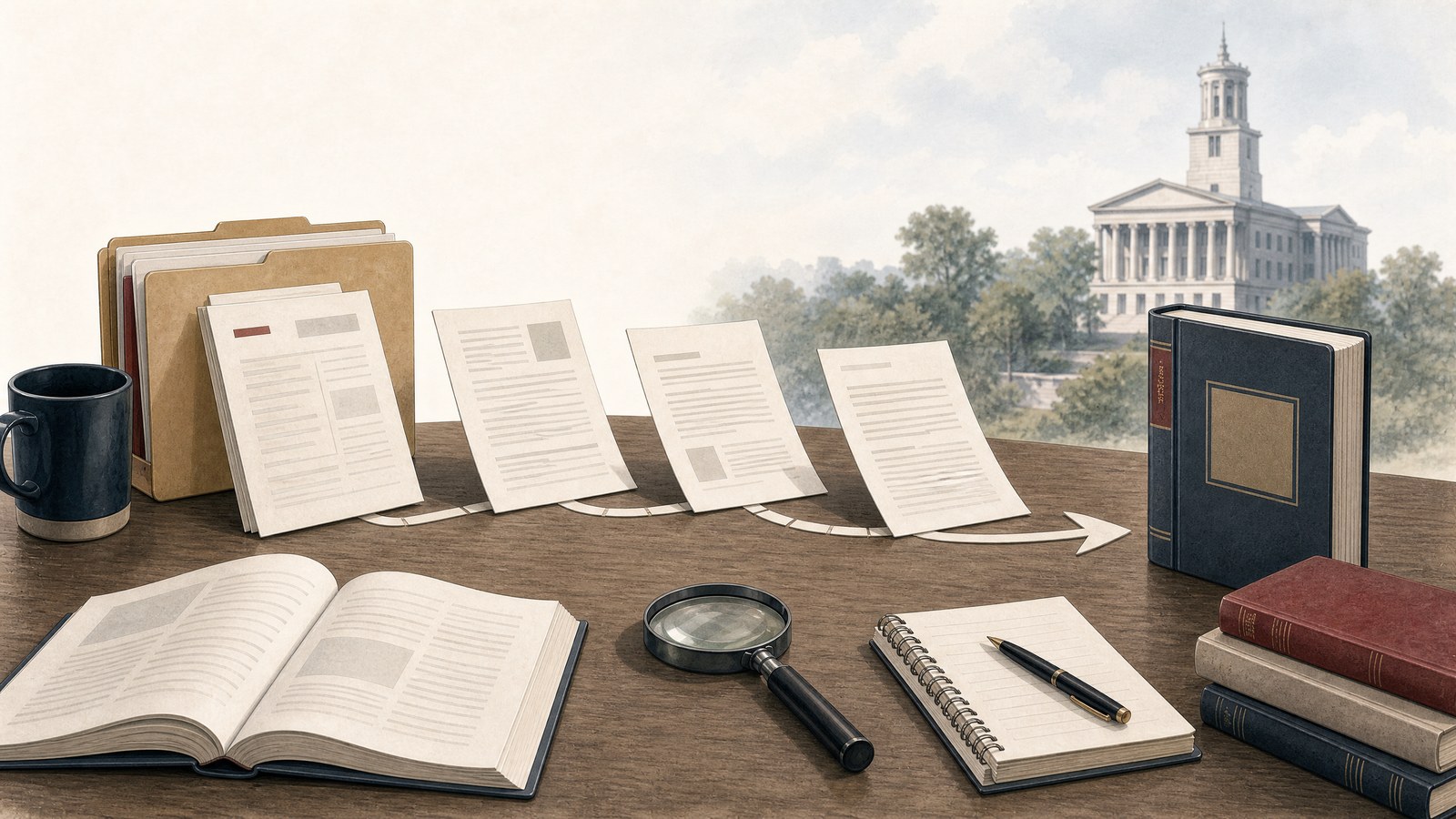
    A Tennessee legislative bill-tracking path from documents to a bound public chapter, with the State Capitol in the background.
    Bill history shows how a proposal moved from filing through committee action, votes, and final enactment.

    5. A public chapter

    Once legislation becomes law, it is assigned a public chapter number and later incorporated into the Tennessee Code Annotated when appropriate. The public chapter is the most direct record of what the legislature enacted at that time. A responsible explainer links to the public chapter, describes the effective date, and checks whether the provision has later been amended or challenged.

    A simple verification checklist

    • Identify the primary document and its official source.
    • State the date, issuing body, and procedural posture.
    • Distinguish allegations, arguments, evidence, rulings, and final judgments.
    • Link readers to documents whenever possible.
    • Correct the record promptly if new documentation changes the story.

    Document-based reporting is not glamorous, but it is durable. It gives readers a way to check a story’s foundations and makes public debate more accurate.

    Primary sources

    1. Tennessee Supreme Court Rule 34: Public Access to Court Records.
    2. Tennessee General Assembly: How a Bill Becomes a Law.
    3. Tennessee Courts.

    Editorial note: This briefing provides general public-information guidance. It is not legal advice and does not replace the applicable rules, statutes, or court orders.

    Related reading: Tennessee public-records checklist.

  • Court Access & Free Expression: What Tennessee Supreme Court Rule 30 Means for Media Coverage

    Court Access & Free Expression: What Tennessee Supreme Court Rule 30 Means for Media Coverage

    Public access to court proceedings is an important part of public confidence in the justice system. But attending an open proceeding and recording or broadcasting it are not the same thing. In Tennessee, Supreme Court Rule 30 governs media coverage of public judicial proceedings and sets a framework for when cameras, audio equipment, and other recording tools may be used.

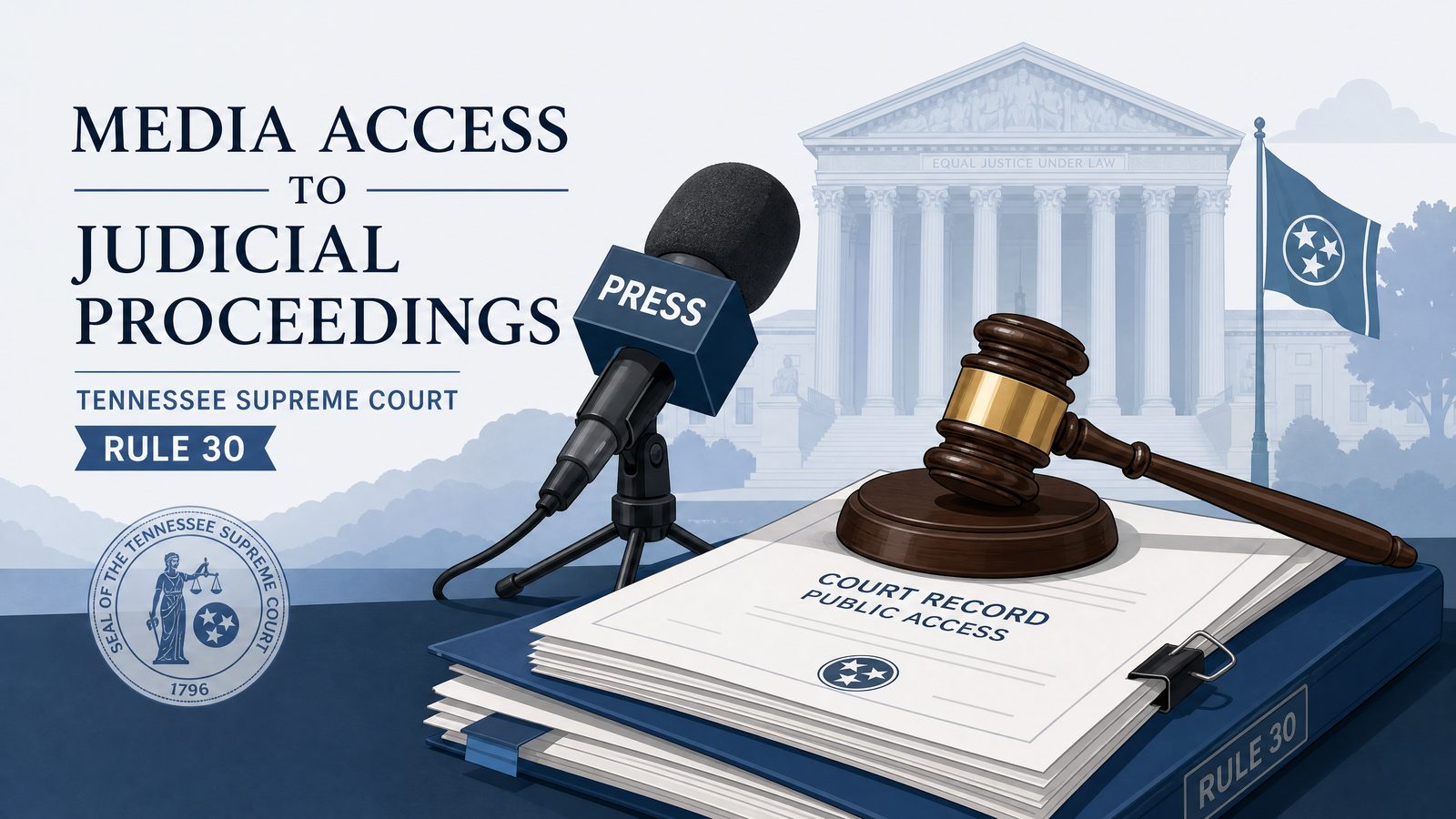
    A microphone and a gavel resting on a stack of legal documents, representing media access to judicial proceedings.
    Tennessee Supreme Court Rule 30 governs media coverage of public judicial proceedings.

    What Rule 30 covers

    Rule 30 addresses media coverage in Tennessee courts. It applies to coverage using television, radio, photographic, or recording equipment in public judicial proceedings. The rule aims to accommodate public information interests while protecting the court’s ability to control proceedings, preserve decorum, maintain safety, and ensure fair administration of justice.

    A proceeding may include a trial, hearing, motion, appellate argument, or other matter held in open court that the public is entitled to attend. That does not create an unconditional right to record. The presiding judge retains authority over the courtroom and may impose limits consistent with the rule.

    Planning a coverage request

    Rule 30 provides a formal request process. A written request for media coverage is ordinarily submitted to the presiding judge at least two business days before the scheduled proceeding, although the judge may waive that deadline. The clerk generally notifies the attorneys of record after a request is received. A newsroom should check the court’s current practices and any local procedures rather than assume that a single form or contact will work everywhere.

    A clear request should identify the proceeding, date and time, type of coverage sought, outlet or project, and a contact person. Coverage teams should arrive prepared to follow equipment, placement, and pooling rules. The purpose is not merely administrative: orderly planning helps reduce disruption for parties, witnesses, jurors, court staff, and the public.

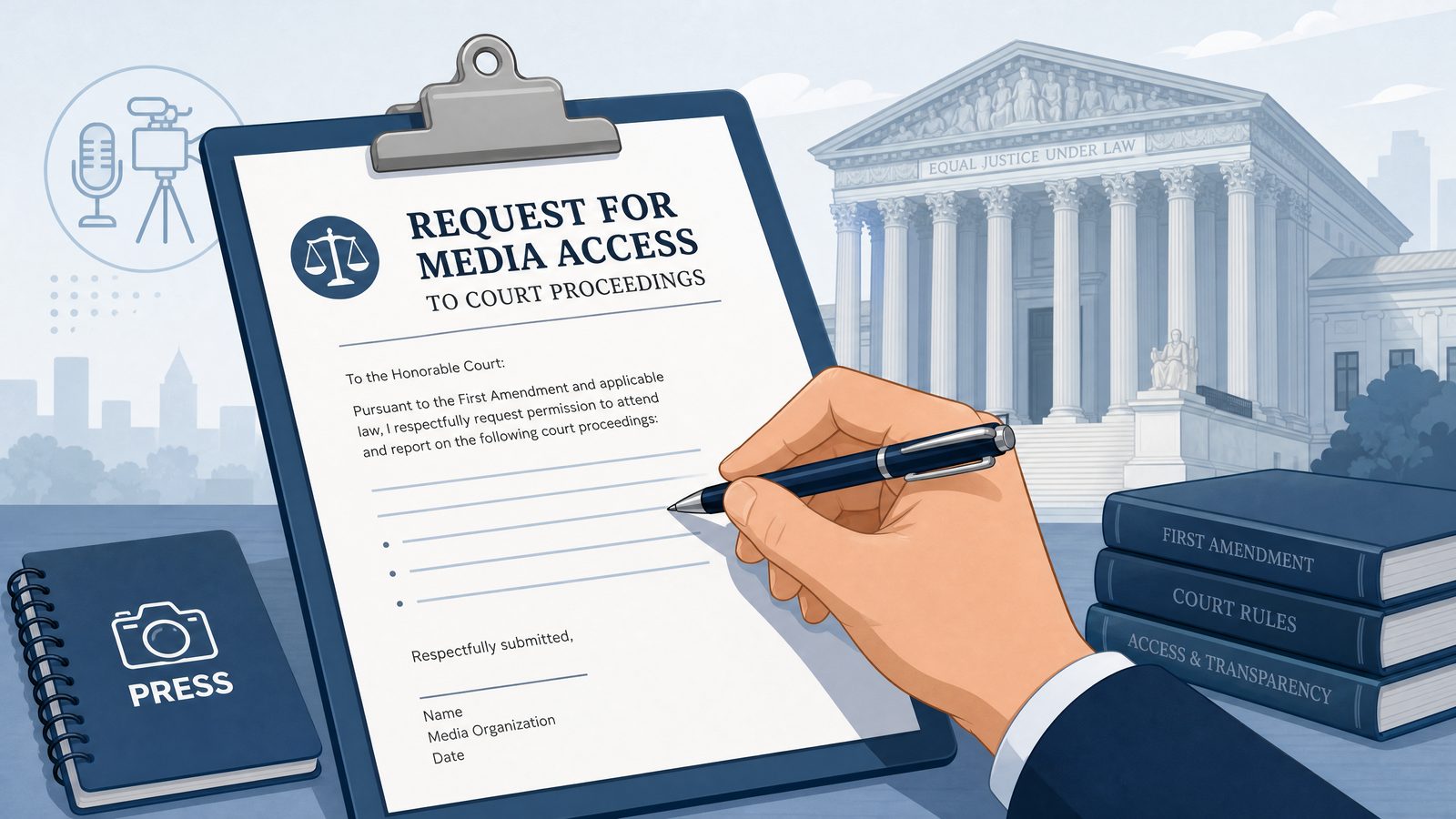
    A hand holding a pen, drafting a formal written request on a clipboard, with a courthouse subtly visible in the background.
    A written request for media coverage is ordinarily submitted to the presiding judge before the scheduled proceeding.

    Important limits

    Rule 30 identifies situations in which coverage is restricted or prohibited. Media may not cover a proceeding that is closed to the public. The rule also bars coverage of jury selection and jurors during the proceeding. It protects certain private communications: there may be no audio pickup, recording, broadcast, or close-up video of conferences between attorneys and clients, co-counsel, counsel and the judge at the bench or in chambers, or judges in appellate proceedings.

    The rule also includes special protections for minors and juvenile-court proceedings. Coverage of a minor witness, party, or victim is prohibited except as specified by the rule. In juvenile proceedings, notice and objection provisions can affect whether and how coverage may occur. Those safeguards reflect the additional privacy and fairness concerns that can arise when children and juvenile matters are involved.

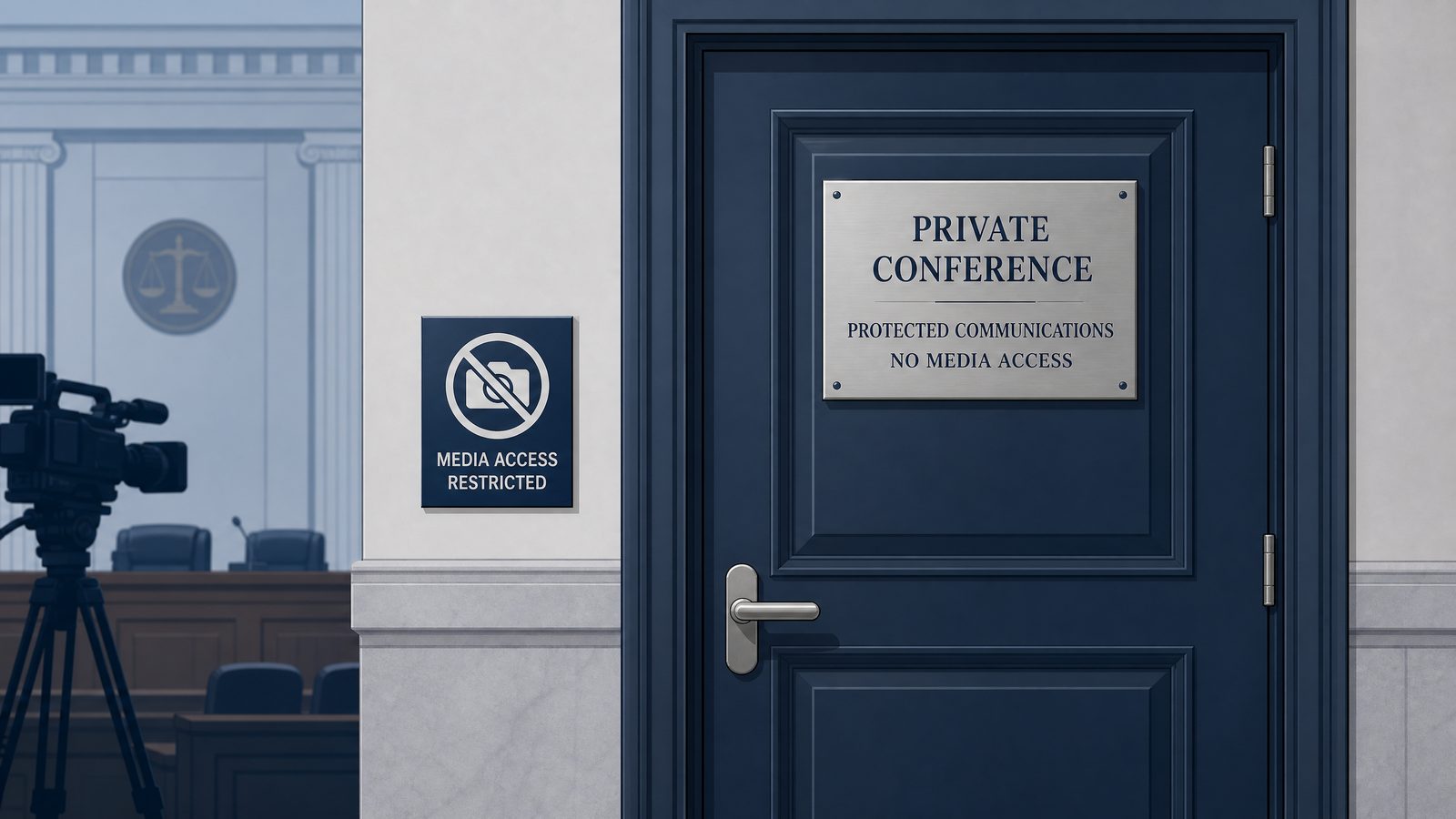
    A closed door with a sign indicating a private conference, symbolizing limits on media access and protected communications in court.
    Rule 30 identifies situations in which coverage is restricted, including certain private communications.

    Judicial discretion and written findings

    A judge may refuse, limit, terminate, or temporarily suspend coverage when necessary to control the proceeding, preserve decorum, protect safety, or ensure fair administration of justice. Rule 30 generally calls for an evidentiary hearing before coverage is denied or limited when one can be held without delaying or disrupting the proceeding. The party seeking a restriction bears the burden, and the court’s action must be supported by substantial evidence and written findings.

    For the public, this means court-access questions are document questions. If coverage is restricted, the request, objections, hearing record, and order may explain what happened. Reporting should distinguish between an open courtroom, a permitted recording request, and an actual authorization to cover the proceeding.

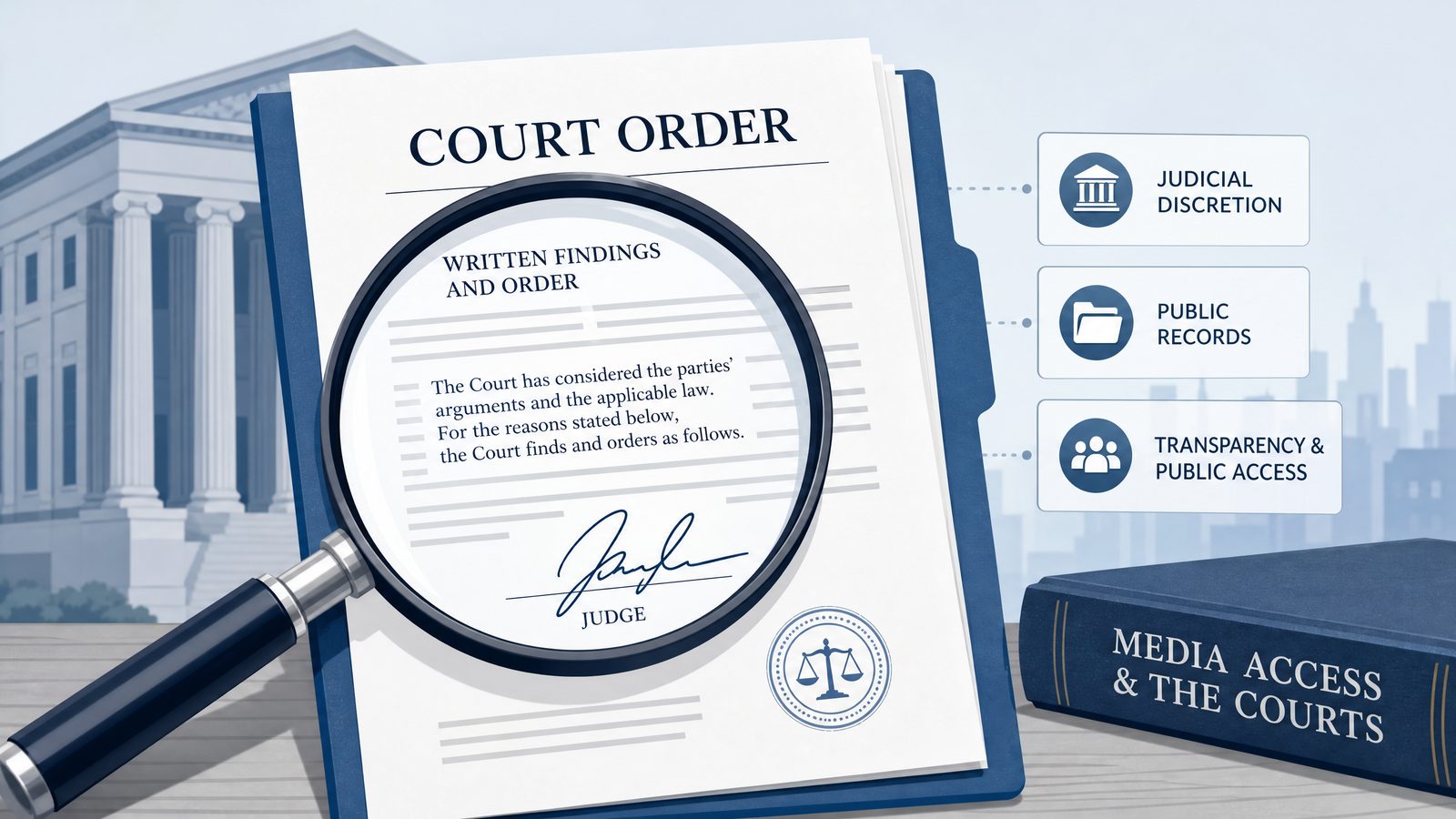
    A court order under a magnifying glass beside symbols for judicial discretion, public records, and transparency in media access.
    Written findings support transparent judicial decisions on media-access requests.

    Practical newsroom standard

    The strongest court reporting is accurate, minimally disruptive, and transparent about its sources. Verify the status of the proceeding, follow the court’s instructions, protect minors and private communications, and link to the orders or public filings that support a story. Court-access rules make room for accountability reporting—but they also impose obligations on those who do it.

    Primary source

    Tennessee Supreme Court Rule 30: Media Guidelines.


    Editorial note: This article provides general information about Rule 30. It is not legal advice or a substitute for the court’s current rules, orders, or directions in a particular case.

    Related reading: public access to Tennessee appellate arguments and opinions.

  • Documents & Decisions: Tennessee Supreme Court Clarifies TPPA and Voluntary Dismissal

    Documents & Decisions: Tennessee Supreme Court Clarifies TPPA and Voluntary Dismissal

    The Tennessee Supreme Court unanimously ruled that a pending TPPA petition does not prevent a plaintiff from taking a voluntary nonsuit, though the defendant cannot recover TPPA fees if the dismissal occurs before the petition is adjudicated.

    On October 9, 2024, the Tennessee Supreme Court issued a unanimous decision in Robert E. Lee Flade v. City of Shelbyville, Tennessee, et al. The decision addresses the interaction between a plaintiff’s right to take a voluntary nonsuit under Tennessee Rule of Civil Procedure 41.01 and a defendant’s petition to dismiss under the Tennessee Public Participation Act (TPPA).

    A photograph of bound legal briefs and a gavel on a polished desk, representing a court ruling.
    The Tennessee Supreme Court recently clarified the interaction between the TPPA and voluntary dismissals.

    The question before the court

    The case began after Robert E. Lee Flade sued several defendants over statements made on social media. In response, two defendants filed motions to dismiss and TPPA petitions that sought dismissal with prejudice, attorney’s fees and costs, and sanctions. Before the trial court heard those requests, Flade voluntarily nonsuited the complaint. The trial court entered an order dismissing the case without prejudice, and it declined to adjudicate the pending TPPA petitions. The Court of Appeals affirmed.

    The Supreme Court accepted the appeal to decide whether filing a TPPA petition creates an exception to a plaintiff’s right of voluntary dismissal under Rule 41.01.

    What Rule 41.01 generally allows

    Tennessee Rule of Civil Procedure 41.01 generally gives a plaintiff the right to take a voluntary nonsuit without prejudice before trial, subject to the rule’s terms and specified exceptions. A nonsuit ends that action without a decision on the merits, although the rule and other law may affect whether and how a claim can later be refiled. The rule is procedural and should be read closely in the context of a specific case.

    A photograph of a person holding a pen over a legal document, illustrating procedural review.
    Tennessee Rule of Civil Procedure 41.01 governs voluntary nonsuits before trial.

    The court’s holding

    The Supreme Court held that the filing of a TPPA petition is not an exception to Rule 41.01’s voluntary-nonsuit right. In the court’s analysis, the TPPA did not displace the long-established rule permitting a plaintiff to voluntarily dismiss an action in these circumstances. Because the plaintiff dismissed the action before the trial court adjudicated the TPPA petitions, the trial court correctly declined to rule on them.

    The practical consequence identified by the court was significant: where a plaintiff voluntarily dismisses the lawsuit before the TPPA petition is adjudicated, the defendant cannot obtain TPPA attorney’s fees in that proceeding. That conclusion follows from the procedural posture of the case; it does not resolve the merits of every dispute that may involve a TPPA petition.

    A photograph of an empty courtroom bench, representing a judicial holding.
    The court held that a pending TPPA petition does not prevent a plaintiff from taking a voluntary nonsuit.

    Why the decision matters

    The TPPA was enacted to provide a mechanism for early dismissal of certain legal actions that implicate free speech, petition, or association rights. The statute also includes provisions concerning discovery, fees, and sanctions. Flade clarifies a limit on that mechanism: a pending TPPA petition alone does not prevent a plaintiff from taking a timely voluntary nonsuit under Rule 41.01.

    For reporters and readers, the opinion is also a reminder that the timing of a filing can be outcome-determinative. A public docket might show a TPPA petition, a nonsuit, and a dismissal order. Those entries do not necessarily tell a full story unless the underlying pleadings and opinion are reviewed.

    A photograph of hands typing on a laptop, illustrating the review of public court records.
    Reviewing the underlying pleadings and opinion is essential to understanding a case’s procedural posture.

    How to read this ruling responsibly

    The decision does not announce that every claim implicating speech is meritless, nor does it answer whether a particular lawsuit is retaliatory. It addresses a particular procedural question arising from the relationship between a voluntary dismissal and a statutory dismissal petition. When discussing the case, it is important to distinguish the court’s legal holding from allegations made in the underlying pleadings.

    Primary sources

    1. Tennessee Supreme Court opinion, Flade v. City of Shelbyville.
    2. Tennessee Administrative Office of the Courts press release.
    3. Tennessee Rule of Civil Procedure 41.01.

    Editorial note: This article provides general information based on public court materials. It is not legal advice and does not assess the truth of unproven allegations in the underlying dispute.

    Related reading: TPPA abuse-of-process protections.

  • When Litigation Becomes a Tool of Pressure: Tennessee’s TPPA and Abuse of Process

    When Litigation Becomes a Tool of Pressure: Tennessee’s TPPA and Abuse of Process

    “Legal harassment” is a useful description of a concern, not a legal conclusion. A lawsuit can be expensive, disruptive, and emotionally difficult without being unlawful. At the same time, Tennessee law contains procedural and common-law concepts that address certain improper uses of litigation. Two are especially important to understand: the Tennessee Public Participation Act and the tort of abuse of process.

    The Tennessee Public Participation Act

    A wooden gavel resting on legal briefs in front of a subtle shield, representing procedural protection under the Tennessee Public Participation Act.
    Illustration of procedural protection under the Tennessee Public Participation Act.

    The Tennessee Public Participation Act, often called the TPPA, is Tennessee’s anti-SLAPP statute. It provides a procedure for seeking dismissal of a legal action that is based on, relates to, or is in response to a person’s exercise of the right of free speech, the right to petition, or the right of association. The legislature enacted the statute through 2019 legislation to protect constitutional activity on matters of public concern while preserving claims that meet the governing legal standard.

    The statute is procedural. A party who believes an action implicates the TPPA may file a petition to dismiss. The court then applies the statute’s burdens and deadlines. In general terms, the petitioning party must first make a prima facie showing that the challenged action is based on, relates to, or is in response to protected activity. If that showing is made, the responding party must establish a prima facie case for each essential element of its claim. The statute also provides rules concerning discovery, fees, sanctions, and appeal.

    That does not mean the TPPA decides whether speech was wise, accurate, or harmless. It also does not make every dispute involving criticism, social media, advocacy, or government participation an anti-SLAPP case. Courts apply the statute to the claims and record before them. Its availability and effect are fact-specific, and parties should not rely on a general description in place of qualified legal advice.

    Why “SLAPP” is a description, not a finding

    SLAPP is shorthand for “strategic lawsuit against public participation.” The term is often used to describe litigation perceived as intended to chill speaking, petitioning, reporting, or organizing. But whether a particular case qualifies for TPPA relief depends on the statute and the court’s application of it—not simply on the label used by a litigant, advocate, or observer.

    Careful reporting should therefore identify what is documented: the claim asserted, the activity alleged to be protected, the motion or petition filed, the court’s ruling, and any appeal. It should avoid saying that a lawsuit was “harassment” or “retaliation” as a fact unless a court finding or other reliable evidence supports that characterization.

    Abuse of process under Tennessee common law

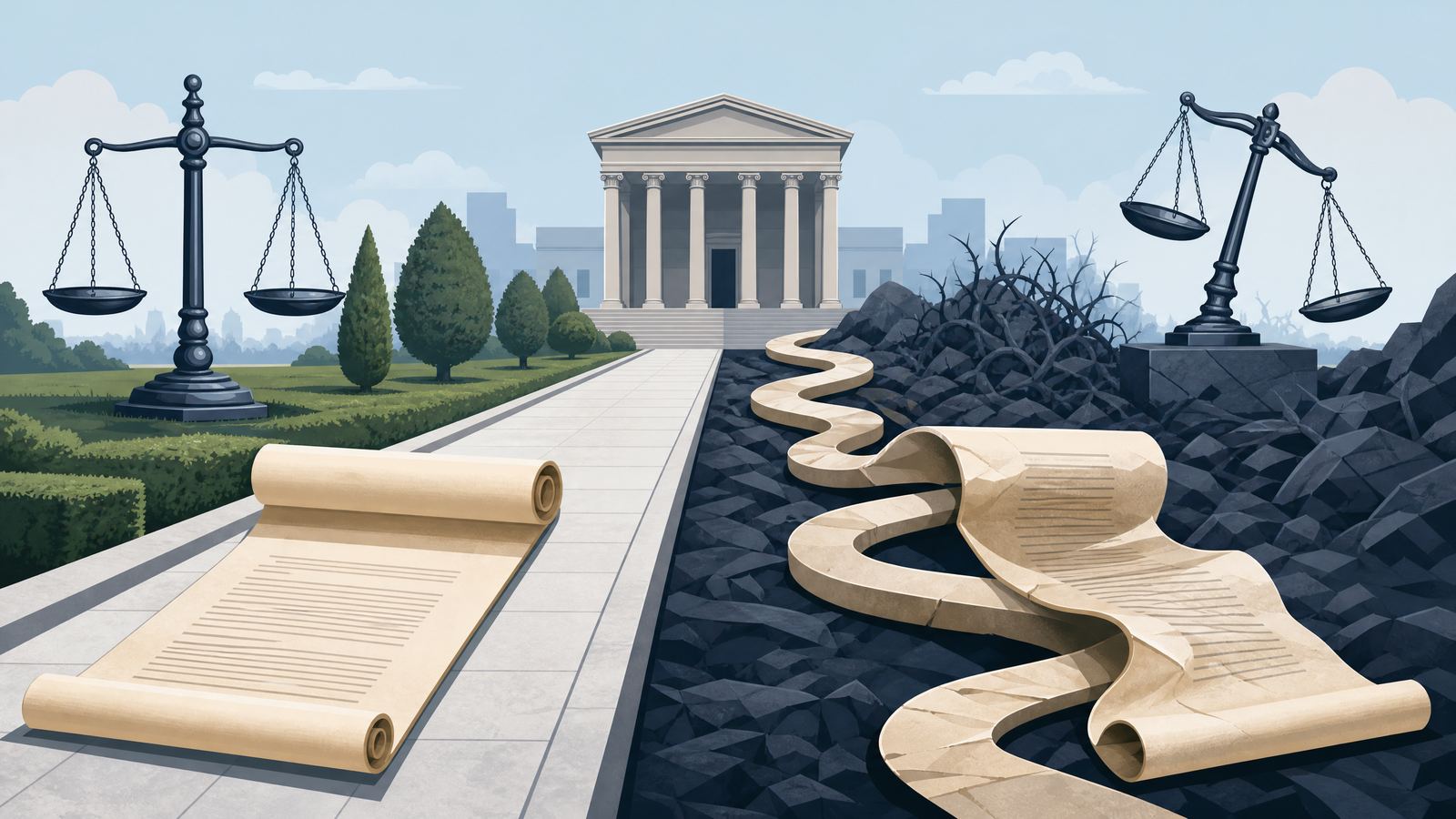
    Two legal documents showing diverging paths, illustrating the distinction between normal litigation and abuse of process under Tennessee common law.
    Illustration of the distinction between ordinary legal process and abuse of process under Tennessee law.

    The separate tort of abuse of process concerns an improper use of legal process after it has been issued. It is not the same as a claim that a lawsuit never should have been filed. In the Tennessee Supreme Court’s 1999 decision in Bell v. Icard, Merrill, Cullis, Timm, Furen, and Ginsburg, P.A., the court addressed an abuse-of-process allegation and affirmed dismissal because a required element—an improper act in the use of process—was not sufficiently alleged.

    The distinction matters. A claimed ulterior motive alone is not enough. The focus is on whether process was used for a purpose for which it was not designed, coupled with an improper act in that use. This is why public discussion should be disciplined: litigation can be contentious or deeply harmful without satisfying the elements of a specific tort.

    What readers can verify

    A magnifying glass resting on a legal document, emphasizing the importance of verifying primary court records.
    Illustration emphasizing the value of verifying primary court records before drawing conclusions.

    Readers evaluating a public dispute can start with primary documents. Look for the complaint, answer, motions, orders, and appellate opinions. Identify the court, case number, filing date, and current procedural posture. Separate allegations from findings. A complaint tells readers what a party alleges; it does not prove the allegation. A court order may explain what the court decided, but its scope should be read carefully.

    This approach also helps protect public discussion. Exact attribution, links to official records, and clear language about uncertainty are core practices for reporting on legal conflicts.

    Conclusion

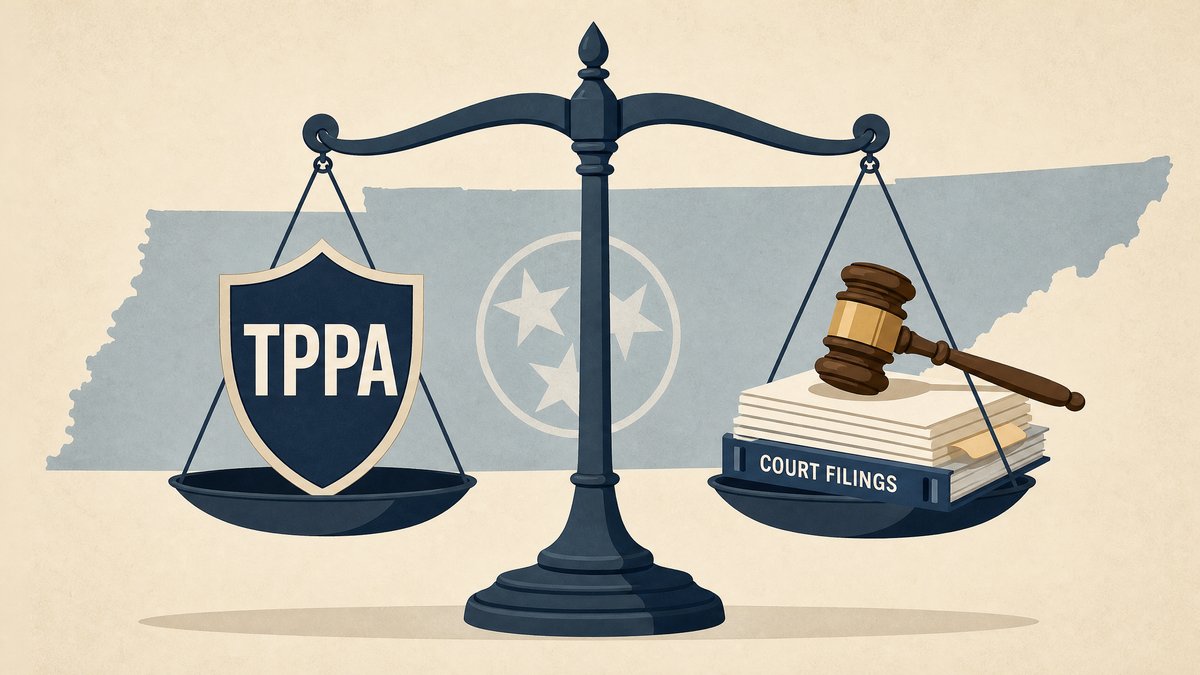
    A scale balancing a speech bubble and a legal document, representing the tension between public participation and the right to seek judicial relief.
    Illustration of the balance between public participation and the right to seek judicial relief.

    Tennessee’s TPPA and its common-law abuse-of-process doctrine address different problems and operate under different standards. Together, they illustrate an important principle: public participation and the right to seek judicial relief both matter, and responsible analysis depends on the actual pleadings, evidence, and rulings in a case.


    Editorial note

    This article provides general information based on publicly available legal materials. It is not legal advice and does not evaluate any individual dispute.

    Sources

    1. Tennessee General Assembly, SB1097.
    2. Tennessee Supreme Court, Bell opinion.
    3. Tennessee Public Participation Act, Tenn. Code Ann. §§ 20-17-101–20-17-110.

    Related reading: Tennessee Public Participation Act anti-SLAPP basics.

  • A Six-Week Public-Interest Legal Newsroom Review Checklist

    A Six-Week Public-Interest Legal Newsroom Review Checklist

    A Six-Week Public-Interest Legal Newsroom Review Checklist

    Legal journalism needs more than a compelling headline. It needs repeatable practices for checking accuracy, minimizing avoidable harm, maintaining editorial independence, and explaining legal documents clearly. This six-week checklist gives a small newsroom a practical review cycle before it scales publishing volume.

    Use the cycle as a working editorial meeting, not merely as a compliance exercise. Assign one person to gather records, another to read for clarity and fairness, and a final reviewer to check links, disclosures, and corrections information. Keeping a short written record of the decisions made each week helps the newsroom explain its process later and spot gaps before publication.

    Week 1: Confirm Editorial Foundations

    A journalist reviewing editorial policy documents on a desk

    Review the mission statement, editorial policy, corrections process, and disclosure language. The Society of Professional Journalists’ Code of Ethics identifies core principles that fit this work: seek truth and report it, minimize harm, act independently, and be accountable and transparent. Make sure every contributor understands the difference between news reporting, analysis, opinion, and legal advice.

    Set a practical assignment standard before reporting begins. Identify the public-interest question the story will answer, the records needed to answer it, and the language that should trigger an editor’s review. A clear foundation keeps a newsroom from drifting into advocacy, speculation, or unexplained conclusions when a fast-moving legal story creates pressure to publish quickly.

    Week 2: Check Sources and Records

    A researcher verifying public court records on a laptop

    For each legal story, identify the best available primary source: an order, opinion, Tennessee civil docket entry, statute, rule, hearing recording, or official public record. Label allegations as allegations and do not treat a filing as proof. Note whether a source is public, whether it is complete, and whether another party has had an opportunity to respond.

    Create a simple source log that records the document name, date, court or agency, docket reference, and the passage supporting each important statement. For Tennessee coverage, consult Rule 34 on Public Access to Court Records to understand the public-access framework and its exceptions. When facts come from a secondary source, trace them back to the original record where possible. If a source is unavailable or disputed, say so plainly rather than filling the gap with assumption.

    For federal coverage, use the U.S. Courts’ federal court-document access guide to distinguish commonly available filings from records that may be sealed or otherwise restricted.

    Week 3: Review Privacy and Harm

    A legal document with sensitive personal information redacted

    Consider whether publishing a name, address, minor detail, or allegation is necessary to serve the public interest. Ask whether the person is a public official, whether the information appears in an accessible public record, and whether the audience needs the detail to understand the story. Avoid sensational language and remove unnecessary identifying information. For a companion framework, see Five Questions to Ask Before Sharing a Court Filing Online.

    Pause for a second review when a story involves children, victims, medical information, home addresses, or records that are technically public but easily misunderstood. The question is not only whether the newsroom can repeat a detail; it is whether repeating it adds meaningful context. For general information on structuring this kind of review, consult the Reporters Committee’s Reporter’s Guide to Pre-Publication Review; it is not a substitute for legal advice. When withholding a nonessential detail, preserve the explanation that allows readers to understand the reporting without creating avoidable exposure.

    Week 4: Evaluate Legal-Journalism Guardrails

    A team reviewing an article draft against legal journalism standards

    Review attribution, headlines, images, and summaries for defamation-risk signals. Opinion should be recognizable as opinion and should rest on disclosed facts. Reporting should fairly describe a court’s procedural posture—what has been alleged, decided, appealed, or dismissed. Avoid using legal terms of art such as “fraud” or “guilty” unless they accurately reflect the record.

    Read the headline, deck, social copy, captions, and pull quotes on their own. A careful article can still mislead if its shortest elements overstate the record. Editors should confirm that each strong characterization is attributed, supported by a document, or clearly framed as analysis. This review is also a good time to ensure that images do not imply facts that the article cannot establish.

    Week 5: Clarify Public Access and Context

    An accessible guide explaining court procedures to the public

    Explain the legal process clearly. Define terms that a general audience might not understand. Provide context about the jurisdiction, the stage of the case, and the practical effect of an order. Whenever possible, link directly to the primary source documents so readers can verify the reporting. For Tennessee-specific background on attending proceedings, readers can consult the Reporters Committee’s Tennessee court-access guide.

    Build each story around the reader’s next question: what happened, what does the document actually do, and what happens next? Spell out dates, deadlines, and procedural steps in plain language. When a docket is difficult to access, describe how readers can locate the relevant record or explain what remains unknown. For Tennessee courtroom coverage, review the official Tennessee Rule 30 media guidelines; the site’s Rule 30 Court-Coverage Request Template offers a practical starting point for a request. Clear context helps the audience distinguish between a filing, a hearing, a ruling, and a final outcome.

    Week 6: Confirm Independence and Accountability

    A newsroom team reviewing independence and accountability practices

    Verify that no outside party, donor, or subject dictated the content of the reporting. Ensure that any relevant conflicts of interest are disclosed to the reader. Confirm that the process for submitting a correction or contacting the newsroom is visible and functional.

    Close the cycle by checking whether the newsroom followed the standards it set in Week 1. If a story required an unusual editorial choice, record the reason and identify whether the policy needs clarification. Publish corrections promptly and explain material changes when they affect a reader’s understanding. Accountability is strongest when it is routine, visible, and applied consistently to stories that are favorable and unfavorable alike.

    Use the Checklist as a Repeatable Practice

    A six-week cycle is not a substitute for careful reporting on any individual story. It is a way to make the newsroom’s standards concrete, searchable, and easier to apply under deadline. Revisit the checklist after major coverage, update it when a new records system or recurring issue appears, and make sure new contributors can use it without relying on informal knowledge alone. Consistent legal journalism earns trust by showing readers how the work is done as well as what the work finds.

  • Five Questions to Ask Before Sharing a Court Filing Online

    Five Questions to Ask Before Sharing a Court Filing Online

    Sharing court filings online can illuminate how a dispute is moving through the legal system, but a document’s existence in a case does not make every detail appropriate to amplify. Before a newsroom, advocate, or community member shares a filing, it is worth pausing to ask five practical questions. This general editorial framework is designed to support accurate, fair, and secure public-record reporting; it is not legal advice for a specific case or publication decision.

    A journalist reviewing court filings at a desk before sharing them online.

    1. Is the document publicly available, and has the court limited access?

    Start with the court record itself. Tennessee’s public case-history system can help readers locate case information, but the availability of a docket entry does not necessarily answer every question about a particular document. Some material may be sealed, restricted, redacted, or subject to an order governing use. A filing that is not readily visible to the public should not be reposted merely because someone has obtained a copy. Check the docket, the document’s caption, and any related orders before sharing.

    2. Does the copy contain personal information that should not be amplified?

    A hand using a black marker to redact sensitive information on a printed legal document.

    Even a public document can contain information that deserves restraint. Review it for addresses, financial-account details, medical information, information about minors, and other identifiers that could create a safety or privacy risk. Redactions that appear on a court copy should remain in place. If a document appears to disclose protected or obviously sensitive information, do not assume that a public link removes every ethical concern. Consider whether quoting a narrow passage, summarizing accurately, or omitting an identifier would serve the public interest with less harm.

    3. Are allegations clearly labeled as allegations?

    A person typing on a laptop, adding editorial context to legal documents.

    A civil complaint, an affidavit, or a motion often contains claims that have not been proven, tested in court, or accepted by a judge. Sharing these documents without context can mislead readers into treating disputed claims as established facts. When sharing a filing, clearly state its procedural role. Our Journalism Guide provides related resources for clear, responsible public-record reporting. Distinguish between what a party alleges, what a court has found, and what remains in dispute.

    4. Is the document complete, and does it represent the current state of the case?

    A single filing rarely tells the whole story. A complaint may have been amended, a motion may have been denied, or an order may have been overturned on appeal. Before sharing an older document, check the docket to see if subsequent filings change its meaning or relevance. If the document is only part of a larger exchange, consider linking to the full docket or summarizing the procedural history so readers understand the context.

    5. Have you provided a clear path to the source?

    A stack of printed legal documents and public records.

    When sharing a court document, make it easy for readers to verify the information. If the document is available through a public portal, provide the case number, court name, and a direct link or clear instructions on how to find it. If you are hosting a copy, ensure it is clearly labeled and visually distinct from editorial commentary. Providing a clear path to the source builds trust and allows readers to evaluate the material themselves.

    A careful process supports better public-record reporting

    Responsible sharing is not simply a matter of whether a filing can be found online. It means checking the document’s status, protecting sensitive information, describing allegations accurately, and linking readers to a reliable source. A consistent review process helps reporters, advocates, and community members make sharing court filings online more informative without creating avoidable privacy or accuracy harms. Visit the site’s Legal Resources archive for additional public-record guidance. When uncertainty remains, pause, review the record again, and consider seeking guidance appropriate to the circumstances before publishing or reposting the document.

  • Navigating the Tennessee Civil Docket: A Guide to the Public Case History System

    Navigating the Tennessee Civil Docket: A Guide to the Public Case History System

    Understanding the legal landscape can be a complex endeavor, particularly when attempting to track civil cases within a specific jurisdiction. For those seeking information on appellate court proceedings in Tennessee, the Tennessee Administrative Office of the Courts provides a valuable resource: the Public Case History system. This online database offers a streamlined approach to accessing case information, designed to enhance transparency and provide public access to judicial records.

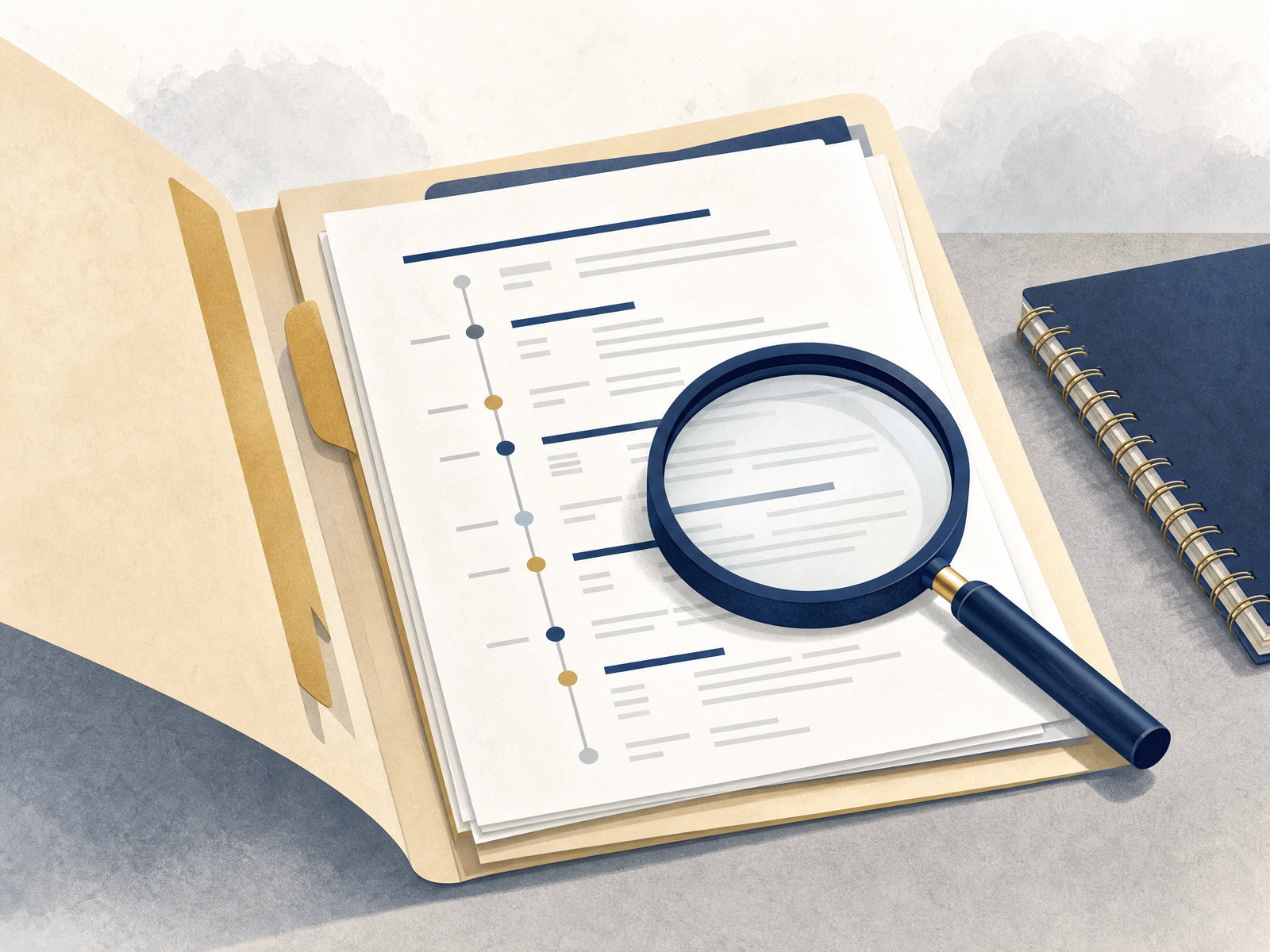
    Illustration of Tennessee civil docket case records with a public case history folder and magnifying glass.
    An editorial illustration of public case-history research for Tennessee civil docket users.

    What is the Public Case History System?

    A quick overview of the Tennessee Public Case History system, including its coverage dates and search methods.

    The Public Case History system is an online portal managed by the Tennessee Administrative Office of the Courts. It serves as a comprehensive repository for cases heard in the state’s highest appellate courts: the Supreme Court, the Court of Appeals, and the Court of Criminal Appeals. The system is powered by C-Track, the case management system utilized by the Appellate Court Clerk’s Office, ensuring a consistent and organized presentation of judicial data [1].

    Scope and Coverage

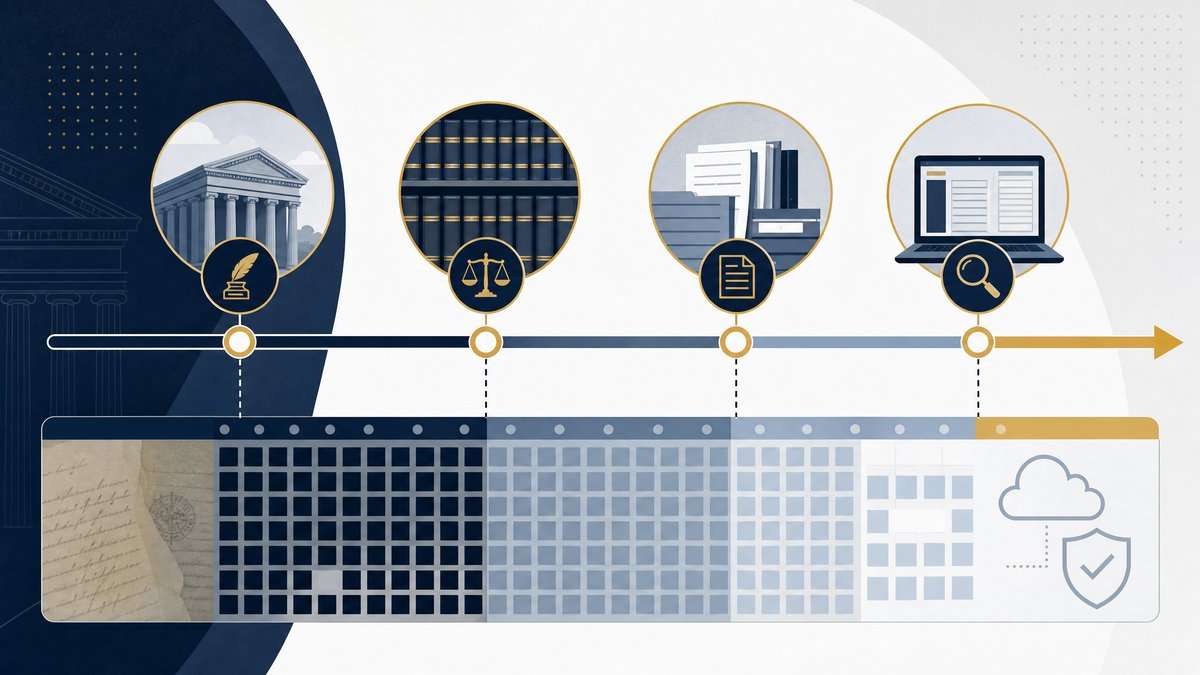
    This system is not exhaustive of all historical cases but focuses on a significant period of appellate activity. It includes appeals where the record was filed after September 1, 2006. Furthermore, it provides direct access to motions, orders, judgments, and opinions filed in the appellate courts after August 26, 2013. While older orders might be accessible if they have been migrated from legacy systems to C-Track, the primary focus is on more recent filings. The data within the Public Case History is updated regularly, reflecting information current as of the end of the prior business day [1]. For the most up-to-the-minute details, direct contact with the Appellate Court Clerk’s Office is recommended.

    Illustration of a timeline representing the Tennessee Public Case History system’s appellate case and document coverage dates.
    The Public Case History system covers appeals and documents from defined periods; confirm the applicable date range before relying on a search.

    How to Search the Database

    The Public Case History system offers several intuitive methods for searching its database, catering to various user needs. Users can retrieve case information using one of four primary criteria:

    • Case Number of the Appeal: This is a precise method for locating a specific case. Users can enter the sequence number found within the appeal’s case number. For example, to find a case like M2012-05656-COA-R3-CV, one would enter “5656,” and the system would return all relevant cases containing that sequence [1].
    • Case Style: For those who know the general name or style of a case, this option allows for a broader search. Entering a name or a portion of the case style, such as “Doe” for “State of Tennessee vs. John Doe,” will yield all cases where “Doe” appears in the case style [1].
    • First or Last Name of a Party: This search method is useful when the name of an individual involved in an appeal is known. The system will return all cases where the entered name is listed as a party [1].
    • Organization Name: Similar to searching by party name, this option allows users to find cases where a specific organization is a party to an appeal [1].
    Illustration of a Tennessee court records search interface with a magnifying glass, courthouse, and legal case categories.
    Use the database’s available identifiers and search fields to locate a specific Tennessee civil case efficiently.

    Accessing Case Documents

    One of the most significant features of the Public Case History system is its ability to provide direct access to filed documents. Users can retrieve motions, orders, judgments, and opinions in PDF format. These documents are linked directly to the specific event within the case history, making it easy to navigate and review relevant filings. This direct access streamlines the research process, eliminating the need to request physical copies or navigate complex archives for recent documents [1].

    Importance for Public Access and Transparency

    The Tennessee Public Case History system plays a crucial role in promoting transparency within the state’s judicial system. By making appellate court records readily available to the public, it empowers citizens, legal professionals, and journalists to monitor judicial proceedings and understand the outcomes of significant cases. This accessibility fosters public trust and ensures accountability within the courts. The system’s user-friendly interface and comprehensive search capabilities make it an invaluable tool for anyone interested in the workings of the Tennessee appellate courts.

    Illustration of a courthouse, balanced scales, and connected case files representing public access to Tennessee civil records.
    Public court records support transparent reporting, but users should understand the database’s scope and limits.

    Limitations and Considerations

    While the Public Case History system is a powerful tool, it is important to be aware of its limitations. As noted, it does not contain records for appeals filed before September 1, 2006, and direct access to documents is primarily for those filed after August 26, 2013. Additionally, the data is updated at the end of the prior business day, meaning that the most current information might require direct contact with the Appellate Court Clerk’s Office. Users should also remember that the information provided is for informational purposes only and does not constitute legal advice. For specific legal guidance, consulting with a qualified legal professional is always recommended.

    Conclusion

    The Tennessee Administrative Office of the Courts’ Public Case History system stands as a testament to the ongoing efforts to enhance public access to judicial information. By offering a robust and accessible platform for tracking appellate cases, it provides an essential resource for understanding the legal processes within the state. Its comprehensive search functions and direct document access make it an indispensable tool for anyone navigating the complexities of the Tennessee civil docket.


    Editorial Note

    This article is intended for informational purposes only and does not constitute legal advice. The information provided is based on publicly available data from the Tennessee Administrative Office of the Courts and should not be used as a substitute for professional legal counsel. Readers should consult with a qualified attorney for advice regarding specific legal issues.

    References

    1. Tennessee Administrative Office of the Courts. (n.d.). Public Case History. Retrieved from https://www.tncourts.gov/courts/supreme-court/public-case-history

    Related reading: Tennessee TPPA and abuse-of-process protections.