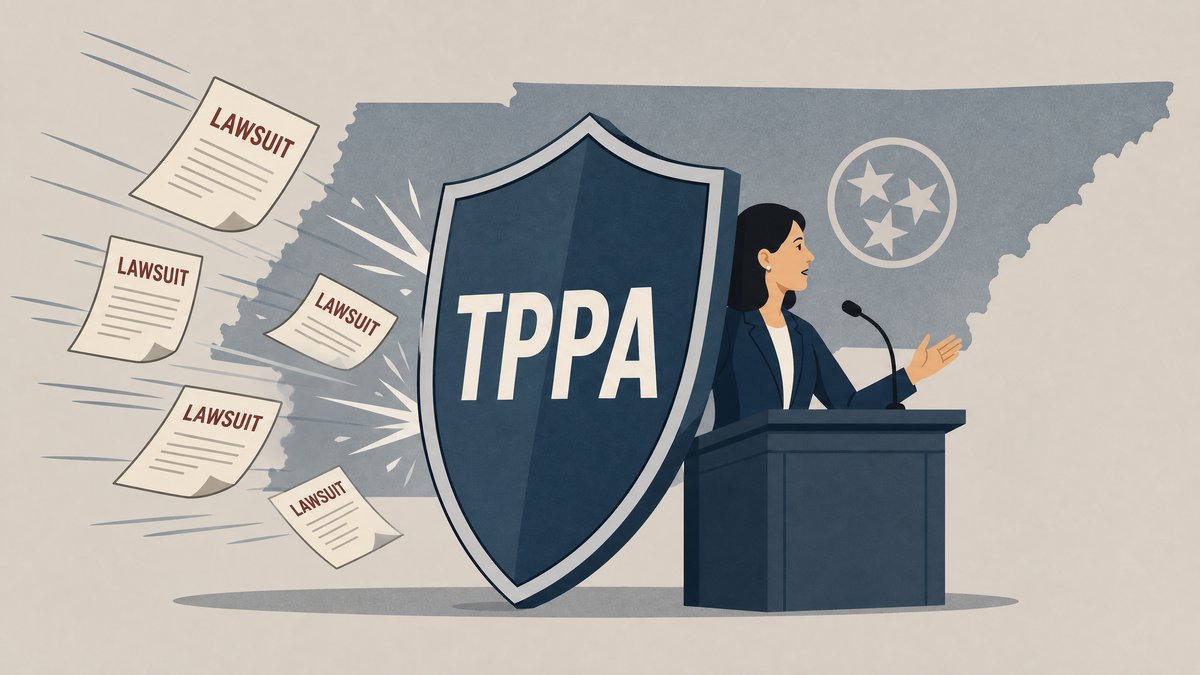
Anti-SLAPP Basics: What the Tennessee Public Participation Act Covers
Introduction
Public disagreement can sometimes lead to litigation. Anti-SLAPP laws are designed to provide a process for courts to evaluate certain claims that arise from speech, petitioning, or association. Tennessee’s law is the Tennessee Public Participation Act, often called the TPPA. This general-information guide explains the statute’s purpose and structure without advising anyone about a particular dispute.
What “Anti-SLAPP” Means
SLAPP is shorthand for a “strategic lawsuit against public participation.” The label is commonly used to describe legal claims that may impose expense or pressure on people who speak, organize, or petition government about matters of public concern. Whether a particular lawsuit qualifies for relief under Tennessee law depends on its facts, claims, and procedural posture; it is not determined simply by the label used by either side.

The Tennessee Public Participation Act
The TPPA protects certain exercises of the rights of free speech, petition, and association. It applies to a legal action that is based on, relates to, or is in response to a party’s exercise of those rights. The statute defines “exercise of the right of free speech” as a communication made in connection with a matter of public concern or religious expression. It separately defines petition activity and association.
Matters of public concern
The statutory definition includes issues concerning health or safety, environmental, economic, or community well-being, government, public officials, public figures, and goods or services in the marketplace. Courts apply the statutory text to the record before them. A connection to public concern is important for the free-speech branch of the Act, but it does not turn every dispute involving a public issue into a winning TPPA motion.

The motion process
A party seeking TPPA relief may file a motion to dismiss. The Act establishes a burden-shifting process. First, the movant must make a prima facie showing that the action is based on, relates to, or is in response to protected activity. The responding party may then avoid dismissal by establishing a prima facie case for each essential element of the claim. Even then, a motion may succeed if the movant establishes a valid defense as a matter of law.
The TPPA also addresses timing, discovery, fees, sanctions, and appellate review. Discovery is generally stayed while a motion is pending, subject to the statute’s rules. Courts must apply the current statute and relevant precedent rather than rely on a generalized description of anti-SLAPP law.

What the TPPA Does Not Do
The Act is not a blanket immunity from all accountability for speech or conduct. Defamation claims, contractual disputes, and other civil actions can involve complex questions about elements, privileges, evidence, and defenses. It is also not a substitute for careful reporting. Journalists and members of the public should verify documents, attribute allegations, seek comment when appropriate, and distinguish claims from proven facts.
Why the Distinction Matters
For public-interest reporting, the TPPA is significant because it recognizes the value of speech and petitioning while preserving procedures for courts to assess legally sufficient claims. A responsible account should state what the statute says, identify any judicial decision being discussed, and avoid implying that a party has engaged in “legal harassment” merely because a lawsuit exists.
Disclaimer
This article provides general information about the Tennessee Public Participation Act and is not legal advice. For advice on a specific matter, consult a qualified attorney.

Sources
- Tennessee Code, Title 20, Chapter 17 (Tennessee Public Participation Act)
- Tennessee Supreme Court, Flade v. City of Shelbyville
- Tennessee Supreme Court, Nandigam Neurology v. Beavers
Related reading: TPPA abuse-of-process and SLAPP defense.
Leave a Reply