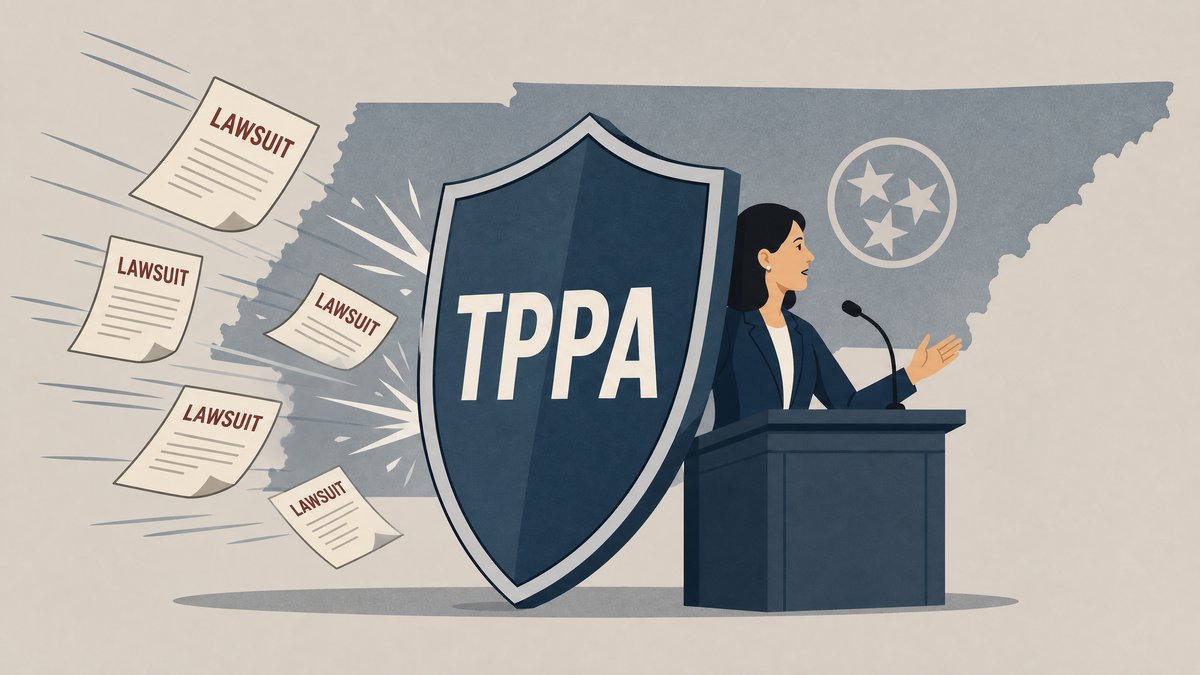
Stop Legal Harassment

Court access · Free expression · Accountability

Tag: free speech

  • Anti-SLAPP Basics: What the Tennessee Public Participation Act Covers

    Anti-SLAPP Basics: What the Tennessee Public Participation Act Covers

    Anti-SLAPP Basics: What the Tennessee Public Participation Act Covers

    Introduction

    Public disagreement can sometimes lead to litigation. Anti-SLAPP laws are designed to provide a process for courts to evaluate certain claims that arise from speech, petitioning, or association. Tennessee’s law is the Tennessee Public Participation Act, often called the TPPA. This general-information guide explains the statute’s purpose and structure without advising anyone about a particular dispute.

    What “Anti-SLAPP” Means

    SLAPP is shorthand for a “strategic lawsuit against public participation.” The label is commonly used to describe legal claims that may impose expense or pressure on people who speak, organize, or petition government about matters of public concern. Whether a particular lawsuit qualifies for relief under Tennessee law depends on its facts, claims, and procedural posture; it is not determined simply by the label used by either side.

    Man stands at a wooden podium speaking into a microphone to seated audience members who face a raised dais with five people behind a long table
    A speaker addresses a panel during a public meeting, a context often discussed when explaining anti‑SLAPP and public participation protections.

    The Tennessee Public Participation Act

    The TPPA protects certain exercises of the rights of free speech, petition, and association. It applies to a legal action that is based on, relates to, or is in response to a party’s exercise of those rights. The statute defines “exercise of the right of free speech” as a communication made in connection with a matter of public concern or religious expression. It separately defines petition activity and association.

    Matters of public concern

    The statutory definition includes issues concerning health or safety, environmental, economic, or community well-being, government, public officials, public figures, and goods or services in the marketplace. Courts apply the statutory text to the record before them. A connection to public concern is important for the free-speech branch of the Act, but it does not turn every dispute involving a public issue into a winning TPPA motion.

    Person from behind writing in an open notebook on a wooden counter, with folders, a magnifying glass and a blurred columned hallway beyond.
    Notes, folders and a magnifying glass on a wooden counter accompany someone writing, illustrating reviewing documents and preparing written remarks.

    The motion process

    A party seeking TPPA relief may file a motion to dismiss. The Act establishes a burden-shifting process. First, the movant must make a prima facie showing that the action is based on, relates to, or is in response to protected activity. The responding party may then avoid dismissal by establishing a prima facie case for each essential element of the claim. Even then, a motion may succeed if the movant establishes a valid defense as a matter of law.

    The TPPA also addresses timing, discovery, fees, sanctions, and appellate review. Discovery is generally stayed while a motion is pending, subject to the statute’s rules. Courts must apply the current statute and relevant precedent rather than rely on a generalized description of anti-SLAPP law.

    Hands of a person in a dark blazer turning a blank page and holding a pen over an open notebook, with a notebook and folder on a desk.
    Person turning pages and preparing to take notes, a neutral visual for the section on reviewing motions under Tennessee’s public participation law.

    What the TPPA Does Not Do

    The Act is not a blanket immunity from all accountability for speech or conduct. Defamation claims, contractual disputes, and other civil actions can involve complex questions about elements, privileges, evidence, and defenses. It is also not a substitute for careful reporting. Journalists and members of the public should verify documents, attribute allegations, seek comment when appropriate, and distinguish claims from proven facts.

    Why the Distinction Matters

    For public-interest reporting, the TPPA is significant because it recognizes the value of speech and petitioning while preserving procedures for courts to assess legally sufficient claims. A responsible account should state what the statute says, identify any judicial decision being discussed, and avoid implying that a party has engaged in “legal harassment” merely because a lawsuit exists.

    Disclaimer

    This article provides general information about the Tennessee Public Participation Act and is not legal advice. For advice on a specific matter, consult a qualified attorney.

    Open double doors reveal a formal hearing room with semicircular wooden benches and empty chairs; foreground desk holds an open notebook, pen, and stacked manila folders.
    A stack of manila folders and an open notebook rest at the entrance to a formal hearing room, illustrating documentary and procedural aspects discussed nearby.

    Sources

    Related reading: TPPA abuse-of-process and SLAPP defense.
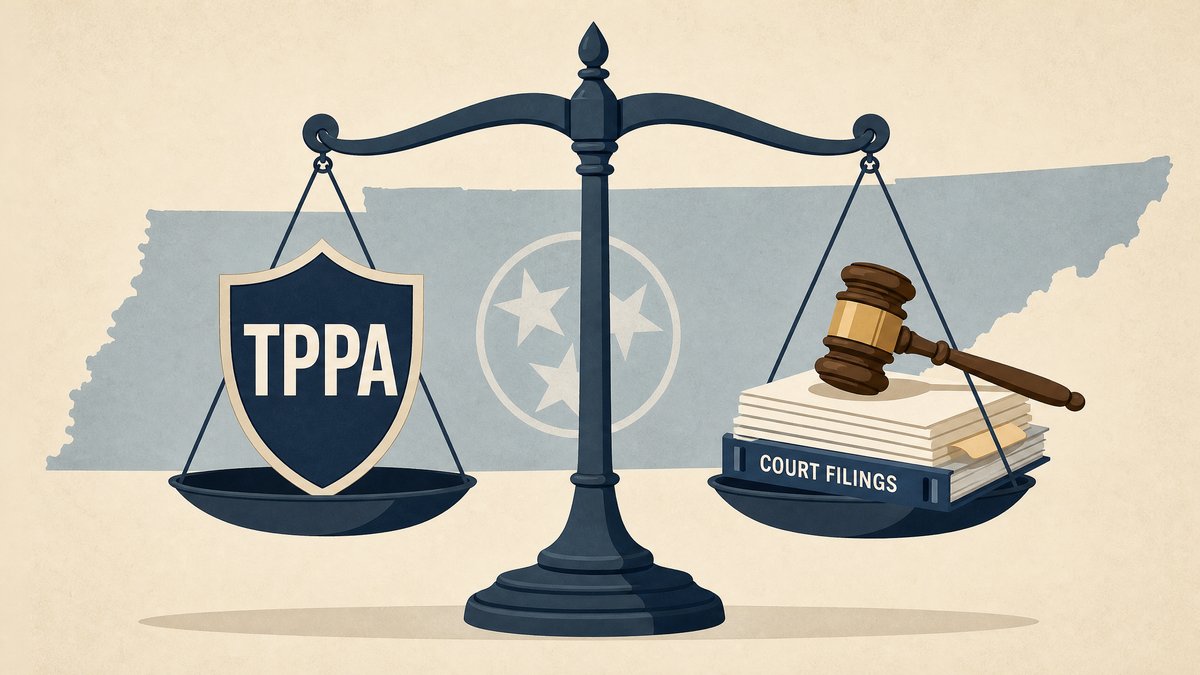
  • When Litigation Becomes a Tool of Pressure: Tennessee’s TPPA and Abuse of Process

    When Litigation Becomes a Tool of Pressure: Tennessee’s TPPA and Abuse of Process

    “Legal harassment” is a useful description of a concern, not a legal conclusion. A lawsuit can be expensive, disruptive, and emotionally difficult without being unlawful. At the same time, Tennessee law contains procedural and common-law concepts that address certain improper uses of litigation. Two are especially important to understand: the Tennessee Public Participation Act and the tort of abuse of process.

    The Tennessee Public Participation Act

    A wooden gavel resting on legal briefs in front of a subtle shield, representing procedural protection under the Tennessee Public Participation Act.
    Illustration of procedural protection under the Tennessee Public Participation Act.

    The Tennessee Public Participation Act, often called the TPPA, is Tennessee’s anti-SLAPP statute. It provides a procedure for seeking dismissal of a legal action that is based on, relates to, or is in response to a person’s exercise of the right of free speech, the right to petition, or the right of association. The legislature enacted the statute through 2019 legislation to protect constitutional activity on matters of public concern while preserving claims that meet the governing legal standard.

    The statute is procedural. A party who believes an action implicates the TPPA may file a petition to dismiss. The court then applies the statute’s burdens and deadlines. In general terms, the petitioning party must first make a prima facie showing that the challenged action is based on, relates to, or is in response to protected activity. If that showing is made, the responding party must establish a prima facie case for each essential element of its claim. The statute also provides rules concerning discovery, fees, sanctions, and appeal.

    That does not mean the TPPA decides whether speech was wise, accurate, or harmless. It also does not make every dispute involving criticism, social media, advocacy, or government participation an anti-SLAPP case. Courts apply the statute to the claims and record before them. Its availability and effect are fact-specific, and parties should not rely on a general description in place of qualified legal advice.

    Why “SLAPP” is a description, not a finding

    SLAPP is shorthand for “strategic lawsuit against public participation.” The term is often used to describe litigation perceived as intended to chill speaking, petitioning, reporting, or organizing. But whether a particular case qualifies for TPPA relief depends on the statute and the court’s application of it—not simply on the label used by a litigant, advocate, or observer.

    Careful reporting should therefore identify what is documented: the claim asserted, the activity alleged to be protected, the motion or petition filed, the court’s ruling, and any appeal. It should avoid saying that a lawsuit was “harassment” or “retaliation” as a fact unless a court finding or other reliable evidence supports that characterization.

    Abuse of process under Tennessee common law

    Two legal documents showing diverging paths, illustrating the distinction between normal litigation and abuse of process under Tennessee common law.
    Illustration of the distinction between ordinary legal process and abuse of process under Tennessee law.

    The separate tort of abuse of process concerns an improper use of legal process after it has been issued. It is not the same as a claim that a lawsuit never should have been filed. In the Tennessee Supreme Court’s 1999 decision in Bell v. Icard, Merrill, Cullis, Timm, Furen, and Ginsburg, P.A., the court addressed an abuse-of-process allegation and affirmed dismissal because a required element—an improper act in the use of process—was not sufficiently alleged.

    The distinction matters. A claimed ulterior motive alone is not enough. The focus is on whether process was used for a purpose for which it was not designed, coupled with an improper act in that use. This is why public discussion should be disciplined: litigation can be contentious or deeply harmful without satisfying the elements of a specific tort.

    What readers can verify

    A magnifying glass resting on a legal document, emphasizing the importance of verifying primary court records.
    Illustration emphasizing the value of verifying primary court records before drawing conclusions.

    Readers evaluating a public dispute can start with primary documents. Look for the complaint, answer, motions, orders, and appellate opinions. Identify the court, case number, filing date, and current procedural posture. Separate allegations from findings. A complaint tells readers what a party alleges; it does not prove the allegation. A court order may explain what the court decided, but its scope should be read carefully.

    This approach also helps protect public discussion. Exact attribution, links to official records, and clear language about uncertainty are core practices for reporting on legal conflicts.

    Conclusion

    A scale balancing a speech bubble and a legal document, representing the tension between public participation and the right to seek judicial relief.
    Illustration of the balance between public participation and the right to seek judicial relief.

    Tennessee’s TPPA and its common-law abuse-of-process doctrine address different problems and operate under different standards. Together, they illustrate an important principle: public participation and the right to seek judicial relief both matter, and responsible analysis depends on the actual pleadings, evidence, and rulings in a case.


    Editorial note

    This article provides general information based on publicly available legal materials. It is not legal advice and does not evaluate any individual dispute.

    Sources

    1. Tennessee General Assembly, SB1097.
    2. Tennessee Supreme Court, Bell opinion.
    3. Tennessee Public Participation Act, Tenn. Code Ann. §§ 20-17-101–20-17-110.

    Related reading: Tennessee Public Participation Act anti-SLAPP basics.