Stop Legal Harassment

Court access · Free expression · Accountability

Category: Legal Concepts

  • How a Bill Becomes a Tennessee Law—and How to Follow Its Changes

    How a Bill Becomes a Tennessee Law—and How to Follow Its Changes

    How a Bill Becomes a Tennessee Law—and How to Follow Its Changes

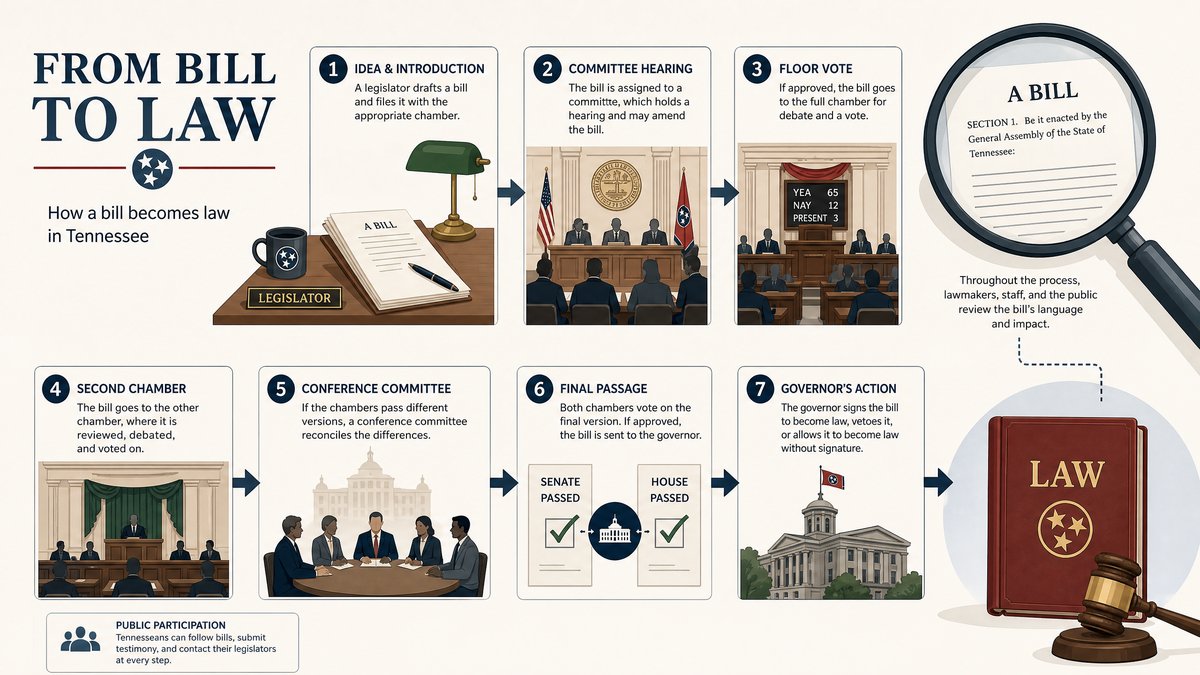
    Understanding the legislative process is crucial for any engaged citizen, especially when it comes to state-level governance. In Tennessee, the journey of a bill from an idea to a law is a multi-step process involving both chambers of the General Assembly and the Governor. This article will demystify this process and provide guidance on how to effectively track legislative changes.

    The Path of a Bill: From Introduction to Law

    The Tennessee General Assembly operates on a two-year legislative session, convening in January of odd-numbered years. The process begins with the introduction of a bill by a legislator in either the House of Representatives or the Senate. Often, identical bills, known as “companion bills,” are introduced in both chambers simultaneously to expedite the process.

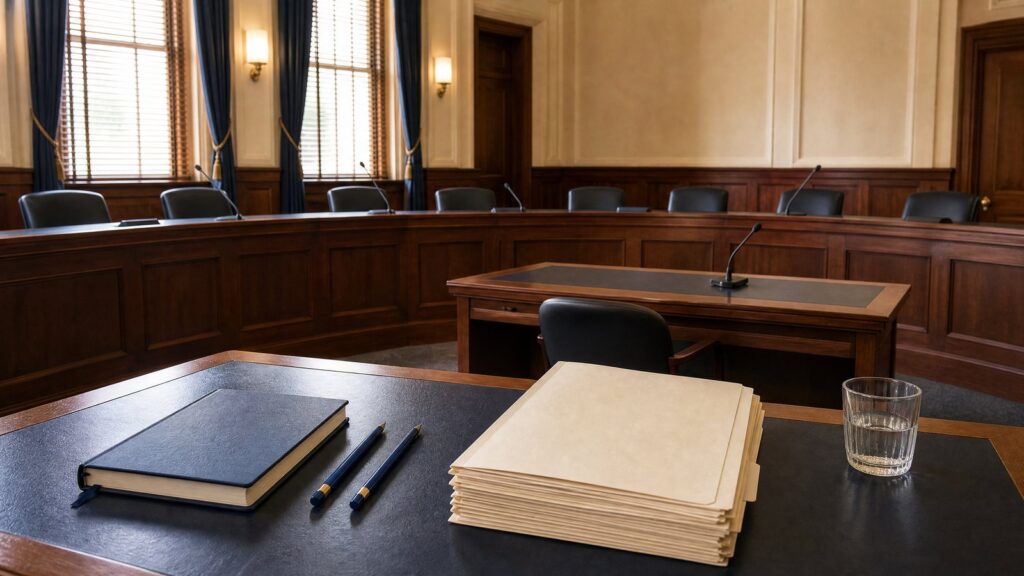
    Empty hearing room with curved wooden bench and microphones; table holds a stack of folders, a closed notebook, two pencils and a glass.
    An empty hearing room with wooden benches, microphones and a table of folders and notes, setting the scene for discussion of the legislative process.

    First and Second Consideration

    Upon introduction, a bill is assigned a number by the Chief Clerk and undergoes its “first consideration.” This is typically a procedural step where the bill is read by title. On the next legislative day, it proceeds to “second consideration,” after which it is referred by the Speaker to an appropriate standing committee based on its subject matter. The Tennessee Constitution mandates that a bill must be considered and passed on three different days in each house before it can become law.

    Committee Review and Action

    Committees play a pivotal role in the legislative process. Here, bills are thoroughly discussed, debated, and often amended. The bill’s sponsor presents the legislation to the committee, and members can ask questions, voice support or opposition, and propose amendments. If a bill has a budgetary impact, it is also reviewed by the Finance Committee, and a “fiscal note” is assigned, detailing the estimated financial implications. Public input is often sought during committee hearings, allowing citizens and affected agencies to testify. A bill can either be recommended for passage, held for further discussion, or fail in committee.

    Person's hands at a wooden desk with three folders and sheets arranged side by side; right hand holds a pencil over the right page.
    Arrangement of three document versions on a desk suggests side-by-side comparison useful for tracking changes in legislative text.

    Third Consideration and Passage

    Bills that successfully navigate the committee stage are then placed on the chamber’s calendar for “third and final consideration.” This is where the full body debates the bill, and further amendments can be introduced. Once passed by one chamber, the bill is engrossed with its amendments and sent to the other chamber. If the second chamber passes a different version, the bill returns to the originating chamber for concurrence. If differences persist, a conference committee can reconcile them.

    Governor’s Action

    After a bill passes both chambers in identical form, it is enrolled and transmitted to the Governor. The Governor may sign it, allow it to become law without a signature, or veto it. The legislature may override a veto through the process set out in Tennessee law and the state constitution.

    Person seen from behind typing on a laptop at a wooden table in an empty courtroom, with a notebook, pen, and a thick book nearby.
    A person uses a laptop alongside a notebook and reference book in a courtroom setting, illustrating the mix of online and paper research for tracking bills.

    How to Follow Legislative Changes

    The Tennessee General Assembly website is the primary source for legislative calendars, committee schedules, and bill text. Its Bill Search feature allows users to locate legislation by keywords, bill number, sponsor, or session. Readers tracking a bill should identify its House Bill or Senate Bill number, check the current version, review its action history, and compare any amendments with the original text.

    The official website is the best source for a bill’s legal text and status. News reporting and nonpartisan explainers can offer context, but readers should link back to the official record when describing what a bill does or where it stands.

    Disclaimer

    This article provides general information about the Tennessee legislative process and is not legal advice. For advice about a specific legal question, consult a qualified attorney.

    Open lined notebook with pencil and four closed folders on a wooden table, marble columns and a staircase in the background.
    Stacked folders and an open notebook serve as a visual metaphor for organizing bill paperwork and tracking legislative records.

    Sources

    Related reading: Tennessee public legal documents to watch.

  • Anti-SLAPP Basics: What the Tennessee Public Participation Act Covers

    Anti-SLAPP Basics: What the Tennessee Public Participation Act Covers

    Anti-SLAPP Basics: What the Tennessee Public Participation Act Covers

    Introduction

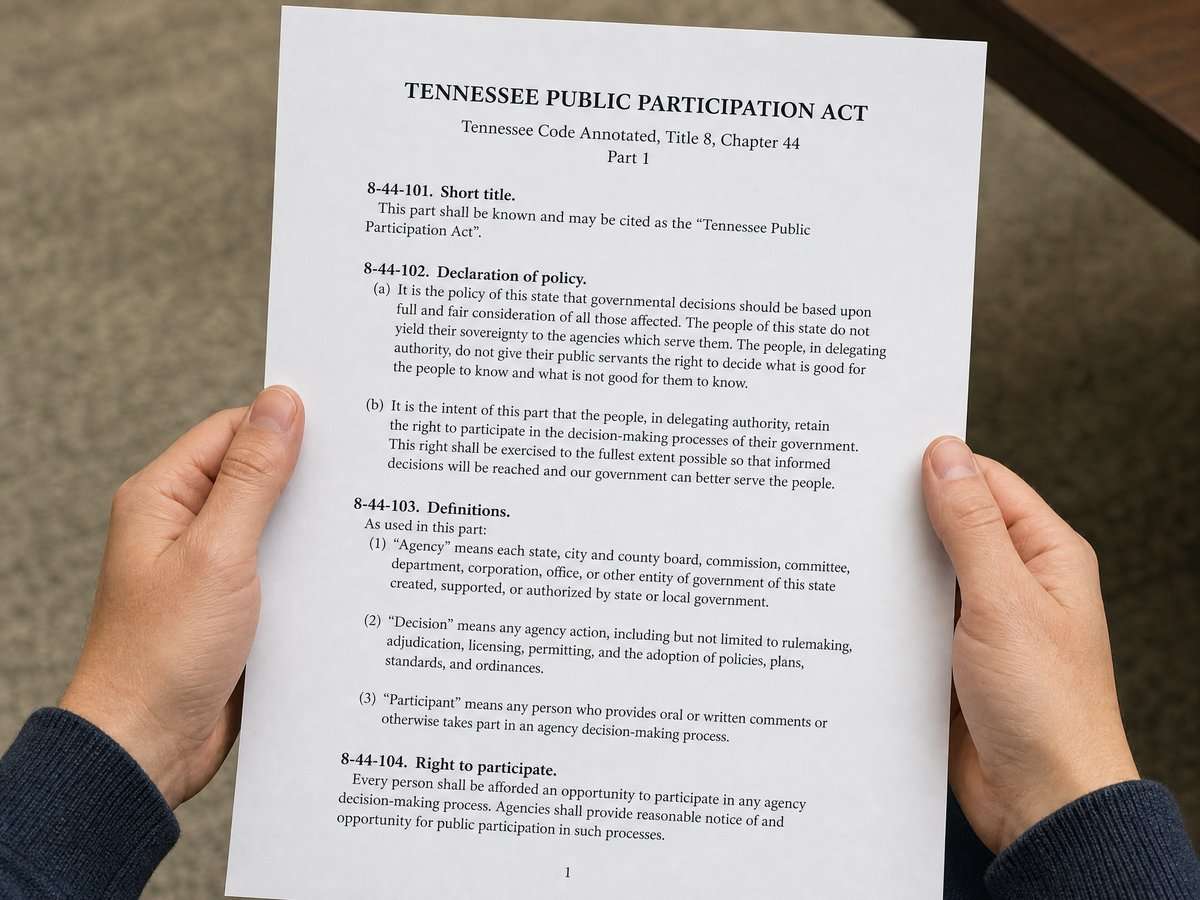
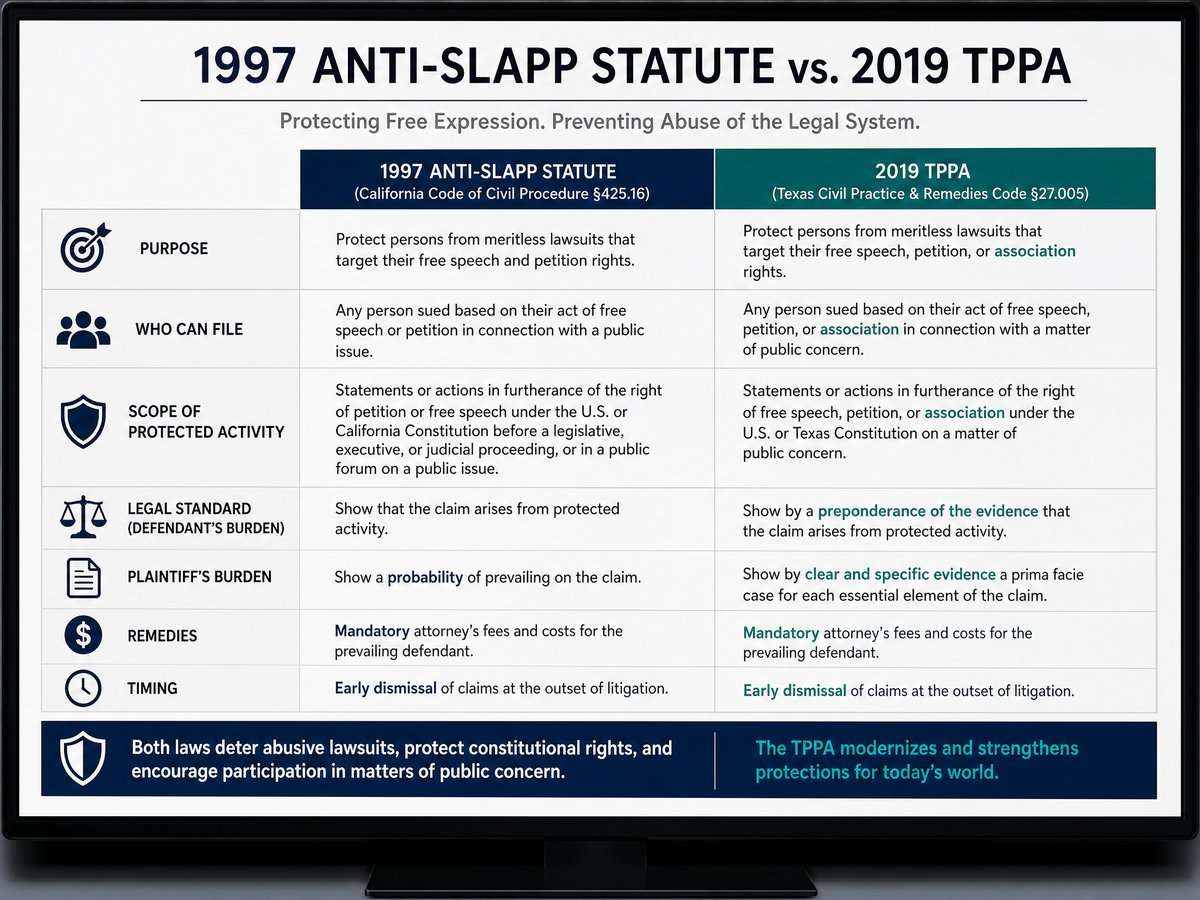
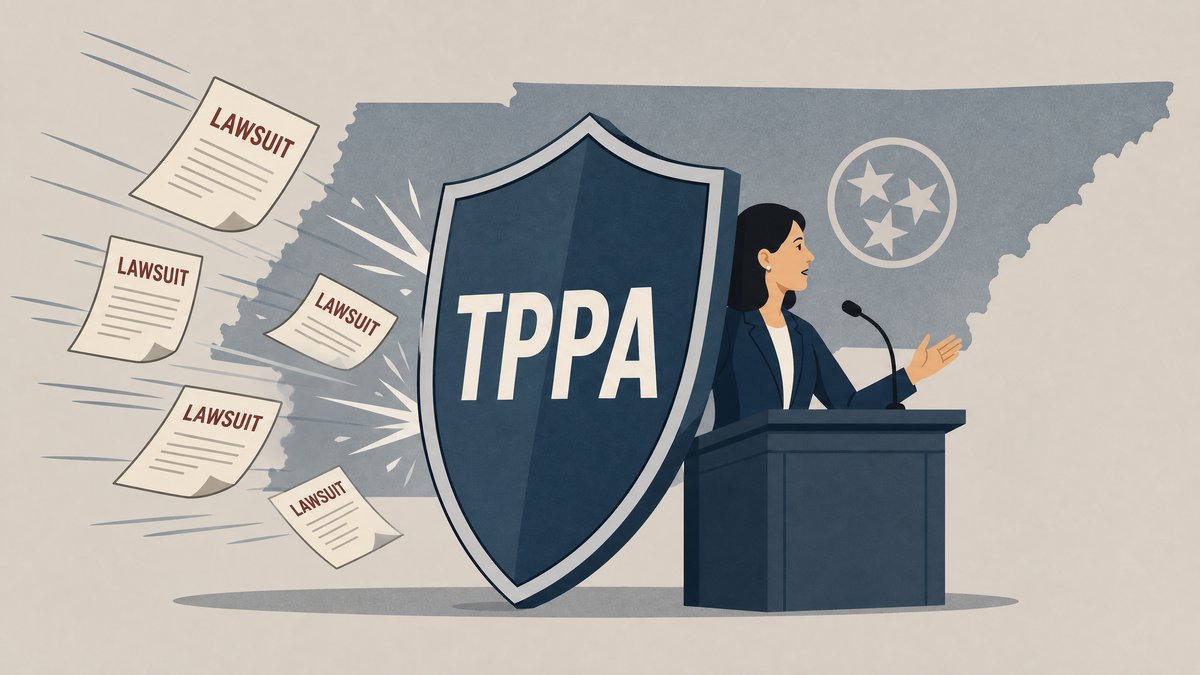
    Public disagreement can sometimes lead to litigation. Anti-SLAPP laws are designed to provide a process for courts to evaluate certain claims that arise from speech, petitioning, or association. Tennessee’s law is the Tennessee Public Participation Act, often called the TPPA. This general-information guide explains the statute’s purpose and structure without advising anyone about a particular dispute.

    What “Anti-SLAPP” Means

    SLAPP is shorthand for a “strategic lawsuit against public participation.” The label is commonly used to describe legal claims that may impose expense or pressure on people who speak, organize, or petition government about matters of public concern. Whether a particular lawsuit qualifies for relief under Tennessee law depends on its facts, claims, and procedural posture; it is not determined simply by the label used by either side.

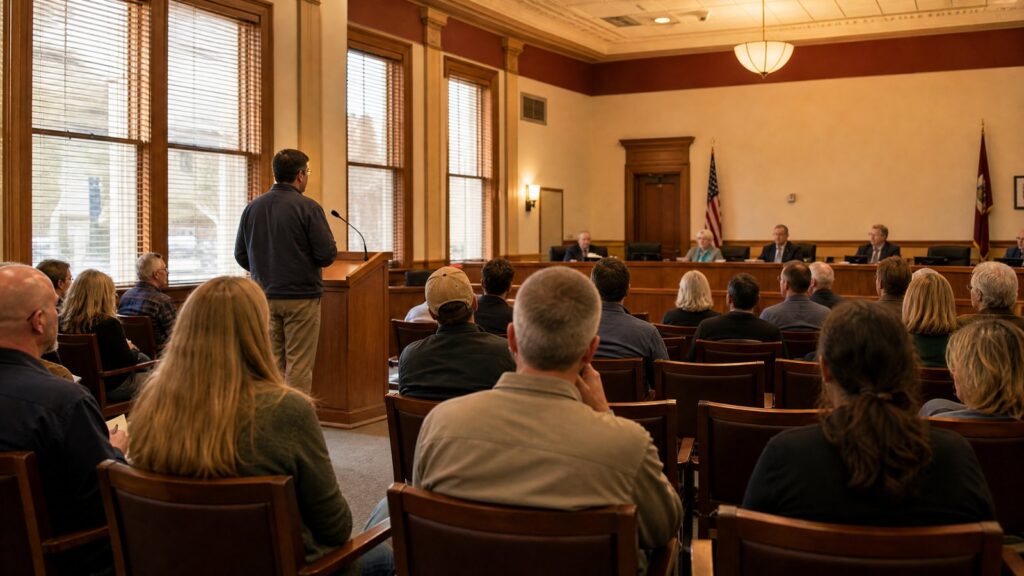
    Man stands at a wooden podium speaking into a microphone to seated audience members who face a raised dais with five people behind a long table
    A speaker addresses a panel during a public meeting, a context often discussed when explaining anti‑SLAPP and public participation protections.

    The Tennessee Public Participation Act

    The TPPA protects certain exercises of the rights of free speech, petition, and association. It applies to a legal action that is based on, relates to, or is in response to a party’s exercise of those rights. The statute defines “exercise of the right of free speech” as a communication made in connection with a matter of public concern or religious expression. It separately defines petition activity and association.

    Matters of public concern

    The statutory definition includes issues concerning health or safety, environmental, economic, or community well-being, government, public officials, public figures, and goods or services in the marketplace. Courts apply the statutory text to the record before them. A connection to public concern is important for the free-speech branch of the Act, but it does not turn every dispute involving a public issue into a winning TPPA motion.

    Person from behind writing in an open notebook on a wooden counter, with folders, a magnifying glass and a blurred columned hallway beyond.
    Notes, folders and a magnifying glass on a wooden counter accompany someone writing, illustrating reviewing documents and preparing written remarks.

    The motion process

    A party seeking TPPA relief may file a motion to dismiss. The Act establishes a burden-shifting process. First, the movant must make a prima facie showing that the action is based on, relates to, or is in response to protected activity. The responding party may then avoid dismissal by establishing a prima facie case for each essential element of the claim. Even then, a motion may succeed if the movant establishes a valid defense as a matter of law.

    The TPPA also addresses timing, discovery, fees, sanctions, and appellate review. Discovery is generally stayed while a motion is pending, subject to the statute’s rules. Courts must apply the current statute and relevant precedent rather than rely on a generalized description of anti-SLAPP law.

    Hands of a person in a dark blazer turning a blank page and holding a pen over an open notebook, with a notebook and folder on a desk.
    Person turning pages and preparing to take notes, a neutral visual for the section on reviewing motions under Tennessee’s public participation law.

    What the TPPA Does Not Do

    The Act is not a blanket immunity from all accountability for speech or conduct. Defamation claims, contractual disputes, and other civil actions can involve complex questions about elements, privileges, evidence, and defenses. It is also not a substitute for careful reporting. Journalists and members of the public should verify documents, attribute allegations, seek comment when appropriate, and distinguish claims from proven facts.

    Why the Distinction Matters

    For public-interest reporting, the TPPA is significant because it recognizes the value of speech and petitioning while preserving procedures for courts to assess legally sufficient claims. A responsible account should state what the statute says, identify any judicial decision being discussed, and avoid implying that a party has engaged in “legal harassment” merely because a lawsuit exists.

    Disclaimer

    This article provides general information about the Tennessee Public Participation Act and is not legal advice. For advice on a specific matter, consult a qualified attorney.

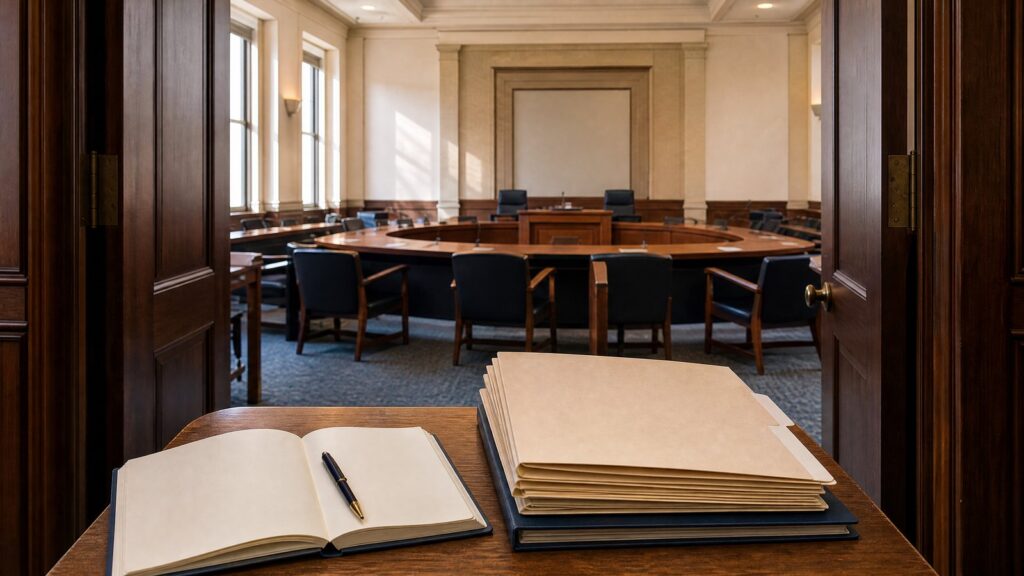
    Open double doors reveal a formal hearing room with semicircular wooden benches and empty chairs; foreground desk holds an open notebook, pen, and stacked manila folders.
    A stack of manila folders and an open notebook rest at the entrance to a formal hearing room, illustrating documentary and procedural aspects discussed nearby.

    Sources

    Related reading: TPPA abuse-of-process and SLAPP defense.

  • Civil Discovery in Plain English: What It Is and What It Is Not

    Civil Discovery in Plain English: What It Is and What It Is Not

    Civil Discovery in Plain English: What It Is and What It Is Not

    Civil discovery is a crucial pre-trial phase in civil lawsuits where parties exchange information and evidence relevant to the case. Its primary goal is to prevent surprises at trial, promote fair settlements, and ensure that justice is served based on all available facts. This process allows each side to understand the strengths and weaknesses of their own case and their opponent’s, leading to more informed decisions and potentially avoiding lengthy and costly trials.

    What Civil Discovery Is

    At its core, civil discovery is the formal process by which litigants gather information from one another and from third parties. This information can include documents, electronic data, physical evidence, and sworn testimony. The scope of discovery is generally broad, allowing parties to seek any non-privileged matter that is relevant to any party’s claim or defense and proportional to the needs of the case.

    Two people in dark business suits pass stacks of manila file folders across a polished wood conference table with notebooks, pens, and a notepad.
    Two people exchange manila file folders across a conference table, used to illustrate document exchange in civil discovery and pretrial procedure.

    Key Purposes of Discovery

    • Preventing trial by ambush: Parties disclose relevant information before trial.
    • Promoting settlement: A clearer factual record helps parties evaluate claims.
    • Narrowing issues: Discovery can clarify what is actually disputed.
    • Preserving evidence: It can collect testimony or documents that may otherwise become unavailable.

    Common Methods of Civil Discovery

    1. Interrogatories

    Interrogatories are written questions sent by one party to another, answered in writing and under oath. They often seek basic factual information, witness identities, positions, and the existence of documents.

    2. Requests for Production

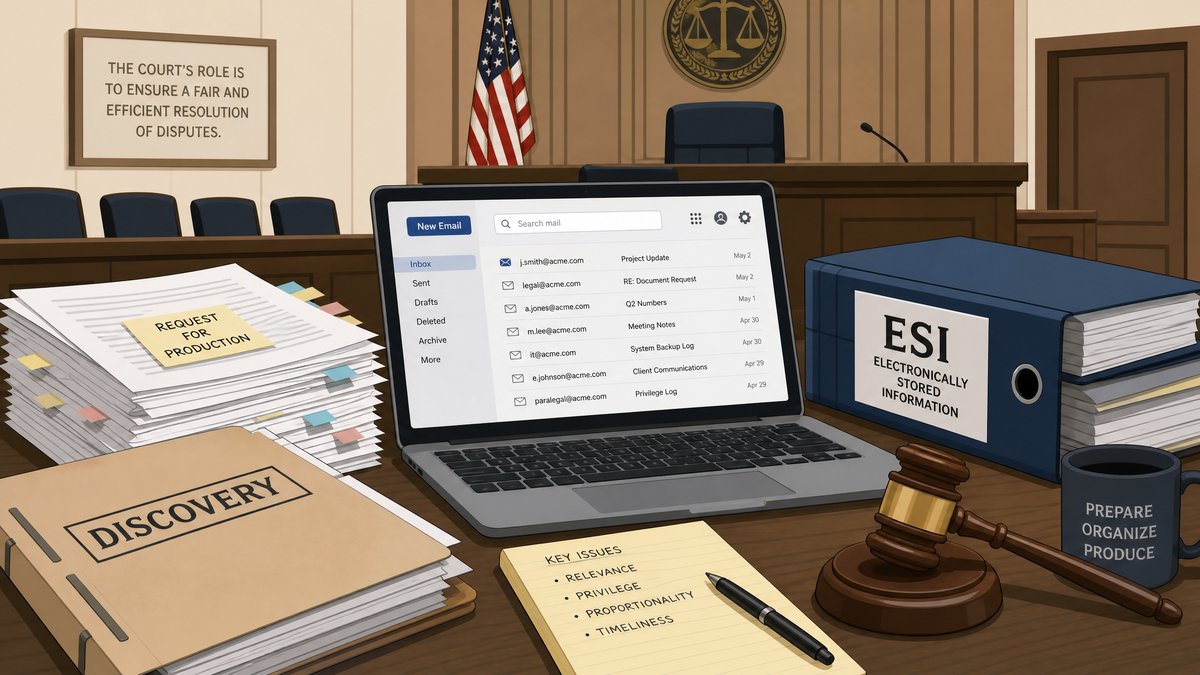
    These requests seek documents, photographs, tangible things, or electronically stored information such as emails, text messages, or digital files. The material sought must be relevant, nonprivileged, and proportional to the needs of the case.

    Person seen from behind at a wooden desk holding a pen and filling a numbered checklist on a clipboard with notebooks and calendar.
    A person reviewing a blank numbered checklist at a desk complements the article’s discussion of organizing steps in the civil discovery process.

    3. Depositions

    A deposition is out-of-court sworn testimony recorded by a court reporter. Attorneys may question a party or witness, subject to applicable rules and objections. Depositions can preserve testimony and help parties understand a witness’s account.

    4. Requests for Admission

    Requests for admission ask a party to admit or deny stated facts or the genuineness of documents. Admissions may narrow the issues that need to be proved later.

    Empty conference table with two mesh chairs, a tabletop microphone, stacked binders and folders, a notepad and a glass of water.
    A meeting table with binders, microphone, notepad and water, illustrating a neutral workspace for organizing and reviewing discovery materials.

    What Discovery Is Not

    Discovery is not an unlimited license to demand everything a party may want. Courts can limit discovery to prevent undue burden, harassment, delay, or disproportionate expense. Privileged information is generally protected. Discovery is also not a substitute for trial: the exchange of information does not itself decide liability. In addition, discovery material is not automatically public. Protective orders may limit disclosure of sensitive information.

    Why the Distinction Matters

    Public discussion of civil litigation can become misleading when discovery requests are reported as if they prove a claim or establish a fact. A request is a request; an allegation is an allegation; and an order resolving a discovery dispute may be narrow. Document-led reporting should identify the request, response, and court ruling separately.

    Disclaimer

    This article provides general information about civil discovery and is not legal advice. Procedures and deadlines depend on the court, the case, and the applicable rules.

    Person in a suit using a laptop showing file and folder icons on screen at a wooden courtroom desk with paper folders nearby.
    Person working through electronic folders on a laptop at a courtroom desk, illustrating electronic file review and organization in discovery workflows.

    Sources

    Related reading: Tennessee Rule 11 and sanctions.