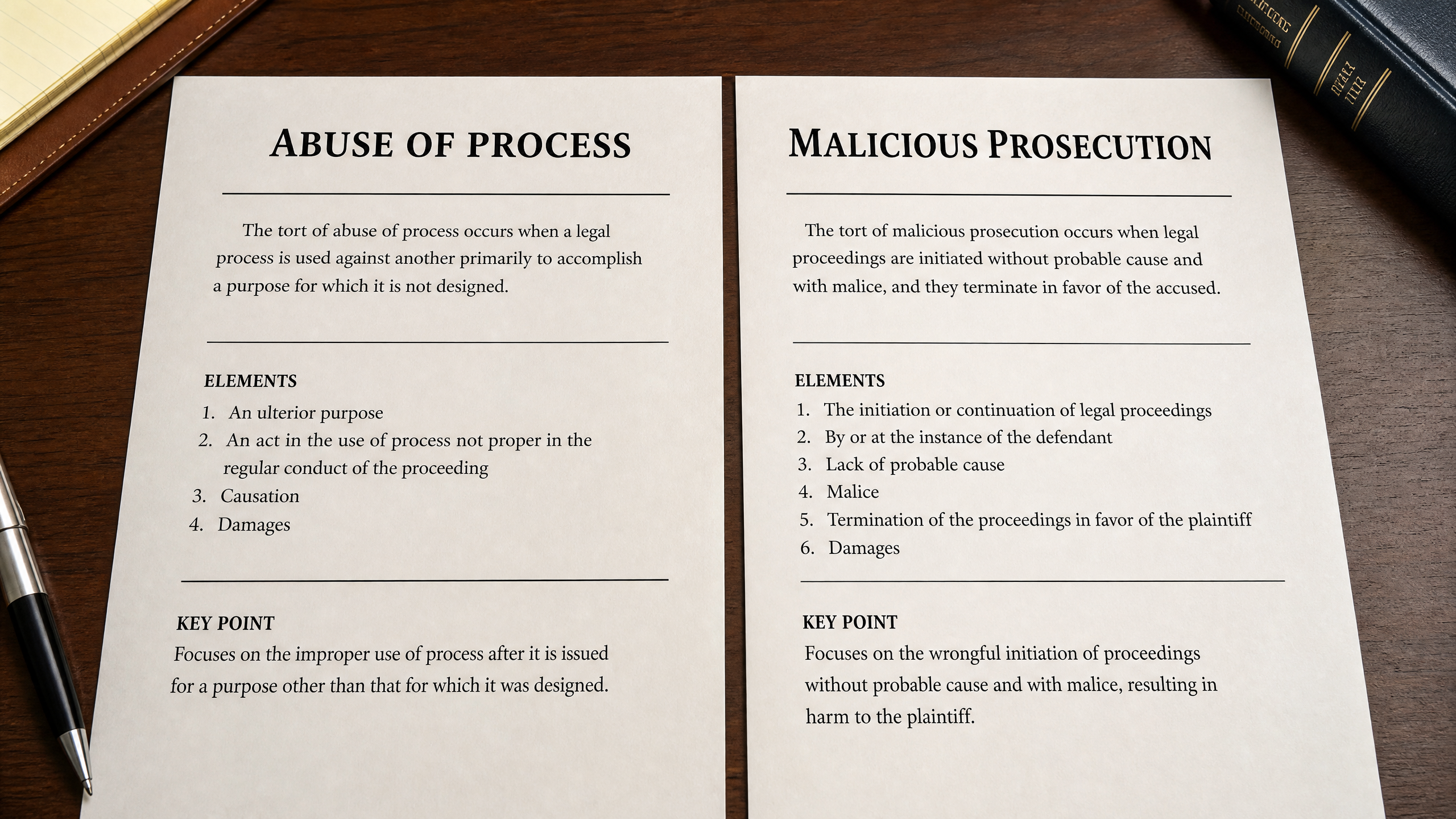
This neutral guide addresses Tennessee abuse of process and malicious prosecution as distinct legal labels with different required elements. Terms like “abuse of process” and “malicious prosecution” are sometimes used loosely in everyday conversation. In Tennessee law, though, these are not general labels—they are specific civil claims with distinct, demanding elements. Misunderstanding that difference can lead to confusion when reading court records or describing what happened in a dispute. People sometimes search for “Tennessee abuse of process malicious prosecution” as if it were one concept, but Tennessee courts analyze them as two separate torts with different requirements.
This explainer focuses on Tennessee doctrine as discussed in a public appellate opinion. It highlights how courts describe the elements of each claim and offers basic pointers for reading public records. It is not advice about any person’s situation.
Two torts, different targets
At a high level, Tennessee courts have treated malicious prosecution and abuse of process as related but different. One addresses initiating a proceeding without proper grounds and with malice; the other addresses misusing the legal process after it has been issued for a purpose outside its proper scope. A recent Tennessee Court of Appeals opinion, Goetz v. Autin, collects and discusses these standards in the course of reviewing pleadings and rulings in a civil dispute. For public access to the case materials, see the Tennessee judiciary’s descriptive docket page for Goetz v. Autin, available through the court’s site: Tennessee Court of Appeals Goetz v. Autin docket entry.
Malicious prosecution: core elements under Tennessee law
In Tennessee, a malicious prosecution claim (sometimes labeled “malicious prosecution of a civil proceeding” when the earlier case was civil) requires more than a general sense that a prior case felt unfair. As summarized in the public opinion in Goetz v. Autin, a claimant must allege and ultimately prove: (1) a prior judicial proceeding instituted against the claimant, (2) without probable cause, (3) with malice, (4) that terminated in the claimant’s favor, and (5) caused damages. The court outlines and applies those elements in its analysis. For the court’s discussion in full, see the official PDF published by the Tennessee judiciary: Official Tennessee Court of Appeals opinion in Goetz v. Autin (PDF).
Two points commonly matter when courts analyze malicious prosecution:
- Favorable termination: The earlier case must have ended in a way that is favorable to the person now bringing the claim. Courts may treat procedural dispositions differently from merits decisions; the opinion’s discussion illustrates how this element is examined in context.
- Probable cause and malice: The claimant must show the earlier case was brought without probable cause and with malice. The opinion distinguishes the showing for each concept and notes how the posture of the prior case can affect the analysis.
These elements reflect a balance: allowing redress for litigation that meets the tort’s strict criteria while protecting access to courts for disputes brought with reasonable grounds. Because the elements are cumulative, one missing element can defeat the claim.
Abuse of process: improper use after process issues
Abuse of process focuses on what happens after legal process—such as a summons, subpoena, or writ—is issued. As summarized in Goetz v. Autin, Tennessee law requires two things: (1) an ulterior motive (an improper purpose beyond securing the regular adjudication of a claim), and (2) an act in the use of process that is not proper in the regular prosecution of the proceeding. The opinion describes this as a misuse of process to achieve an end the process was not designed to accomplish. For the opinion’s formulation and example-based discussion, see the official publication: Official Tennessee Court of Appeals opinion in Goetz v. Autin (PDF).
Importantly, abuse of process is not about whether filing a case was justified in the first place. The Tennessee cases discussed in the opinion distinguish between maliciously causing process to issue (malicious prosecution) and improperly using process after it issues (abuse of process). That conceptual line helps courts decide which legal framework applies to a set of alleged facts.
Download the video transcript (TXT).
Why labels matter when reading public records
Because these claims are element-driven, how a court describes and evaluates them in orders and opinions depends on the case’s procedural posture and the evidence (or allegations) presented. When you read a Tennessee appellate opinion or trial court order, it can help to:
- Identify the posture: Is the court deciding a motion to dismiss, a summary-judgment motion, or a post-trial appeal? At the motion-to-dismiss stage, courts accept well-pleaded facts as true for limited purposes; at summary judgment, courts evaluate whether the evidence creates a genuine dispute of material fact.
- Separate allegations from findings: Complaints and counterclaims contain allegations, not findings. An appellate court may recite allegations to frame the issues and then apply legal standards to determine whether those allegations, if true, state a claim that can proceed.
- Look for the elements: Courts often list the elements of malicious prosecution and abuse of process before applying them. In the Goetz opinion, the court sets out those elements and evaluates whether the pleadings and record materials meet them, illustrating how the doctrines operate. To see that structure, review the official PDF: Official Tennessee Court of Appeals opinion in Goetz v. Autin (PDF).
- Note the outcome’s scope: A dismissal or other ruling may resolve only certain claims or parties. The specific reasoning matters because it indicates which elements the court found unmet or which procedural rules controlled.
How the elements shape practical questions

The elements for each tort drive what kinds of facts and timing issues matter:
- Timing and termination: Because malicious prosecution requires favorable termination of the prior case, that claim typically becomes ripe only after the earlier case ends in the claimant’s favor. Abuse of process, by contrast, centers on how process was used during a case; analysis therefore focuses on the purpose and manner of use, not simply on how the case concluded. For a general view of how an appellate court frames these doctrines, consult the judiciary’s public case page: Tennessee Court of Appeals Goetz v. Autin docket entry.
- Purpose versus propriety: For abuse of process, an “ulterior motive” by itself is not enough; Tennessee courts look for some act in using process that is improper in the proceeding’s regular course. For malicious prosecution, courts examine whether the initiating party had probable cause and whether malice can be inferred or shown, consistent with the opinion’s descriptions.
- Damages: Both claims require proof of harm, but the kinds of harm and the proof needed can differ. The opinion underscores that labels alone do not establish damages; a claimant must connect any alleged harm to the elements recognized by Tennessee law.
Reading a public opinion as a learning tool
Public appellate opinions serve two roles: they resolve disputes and they guide the public on how courts interpret legal standards. In Goetz v. Autin, the Tennessee Court of Appeals outlines the elements of malicious prosecution and abuse of process and applies them to the record before it. For readers trying to understand these terms, working through the court’s element-by-element analysis can be more illuminating than relying on generalized summaries.
Key takeaways for Tennessee readers

- “Abuse of process” and “malicious prosecution” are legal terms with specific elements in Tennessee law. A label without the required proof does not establish a claim.
- Malicious prosecution focuses on initiating a prior proceeding without probable cause and with malice, ending in the claimant’s favor, and causing damages.
- Abuse of process targets an improper act in the use of process, done for an ulterior purpose, after judicial process has issued.
- When reading public court documents, distinguish allegations and procedural summaries from the court’s legal conclusions about elements.
- Tennessee law can differ from other jurisdictions. If you need advice, consult a qualified Tennessee attorney.
Sources
This article provides general information, not legal advice. Court rules, records, and legal consequences depend on the facts, the forum, and current law; consult a qualified lawyer for advice about a specific situation.
General-information disclaimer: This article is provided for journalism and general information only. It is not legal advice and does not create an attorney-client relationship.
Leave a Reply