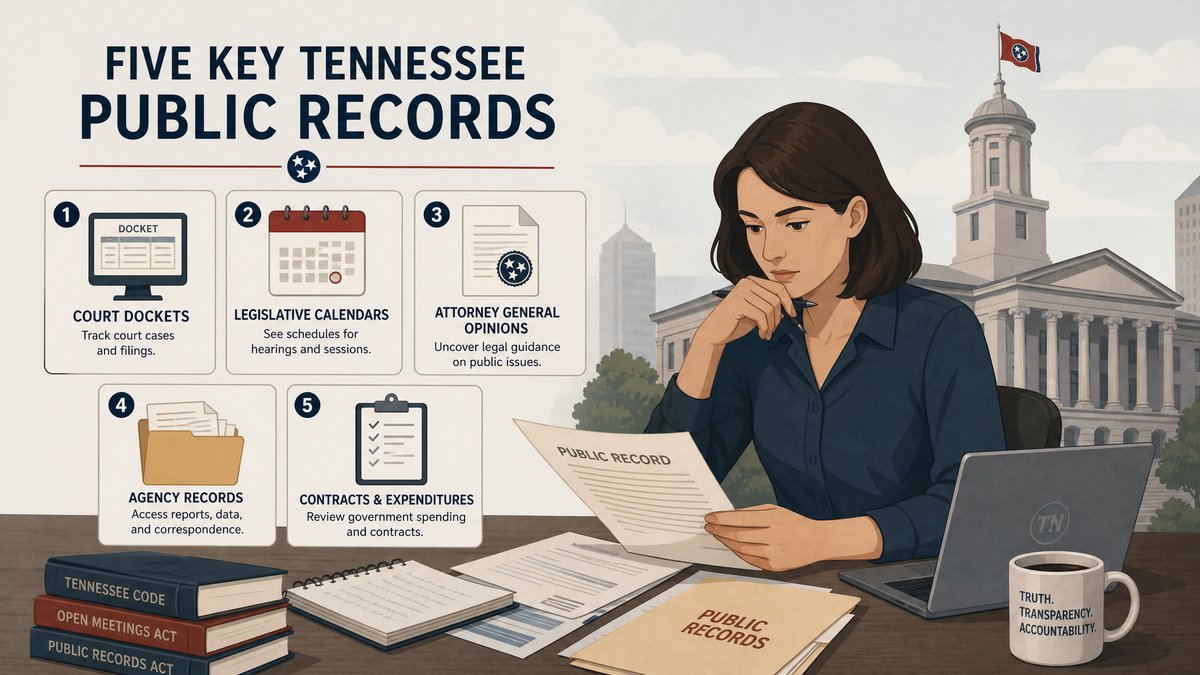
Accountability reporting begins with documents. Public records do not answer every question, and a filing or bill is not proof of an allegation. But primary materials can help readers see what government bodies and courts have actually done, what remains unresolved, and where to look next.
Here are five useful Tennessee document types for readers who want to follow legal and civic issues with care.

1. A court docket
A docket is the court’s running list of events in a case. It can show filings, hearing dates, orders, and case-status entries. It is a roadmap—not a substitute for reading the documents themselves. A docket entry may identify that a motion was filed, but the motion and resulting order will usually provide the context needed to describe it accurately.
When writing from a docket, record the court, case number, date, and document title. Separate a party’s allegation from a court’s finding. If access is limited or a record is sealed, do not infer what the unavailable material says.
2. A court order or opinion
An order explains a court’s decision on a motion or procedural question. An appellate opinion may provide a fuller legal analysis and is often the most reliable starting point for explaining a rule or precedent. Read the holding before summarizing the case. Pay attention to the precise question the court answered, the standard it applied, and whether the decision is final or subject to further review.
The Tennessee judiciary publishes opinions and many other resources at tncourts.gov. An official decision is stronger reporting support than a summary or a social-media characterization of the case.
3. A public-records request and response
Tennessee’s Public Records Act provides a framework for inspecting or receiving copies of public records maintained by governmental entities, subject to statutory exceptions. For court records, Supreme Court Rule 34 addresses public access and identifies categories of records that are confidential or otherwise unavailable. A records request should be specific, respectful, and tailored to documents that the agency or court actually maintains.
A denial or redaction is not proof of misconduct. It may reflect a lawful exception, privacy protection, court order, or an administrative issue. Good reporting asks what legal basis was cited and preserves the correspondence for readers to evaluate.

4. A bill and its history
Before a proposal becomes law, readers can follow the bill number, sponsors, amendments, committee actions, fiscal notes, and votes. The Tennessee General Assembly’s website provides bill information and legislative materials. Tracking a bill’s history helps distinguish a proposal from enacted law—and helps journalists identify the version that was actually considered by a committee or passed by a chamber.
Tennessee’s Constitution requires bills to be considered and passed on three different days in each house before becoming law, subject to the state’s constitutional process. A bill may be amended many times along the way, which is why the final enrolled version matters.

5. A public chapter
Once legislation becomes law, it is assigned a public chapter number and later incorporated into the Tennessee Code Annotated when appropriate. The public chapter is the most direct record of what the legislature enacted at that time. A responsible explainer links to the public chapter, describes the effective date, and checks whether the provision has later been amended or challenged.
A simple verification checklist
- Identify the primary document and its official source.
- State the date, issuing body, and procedural posture.
- Distinguish allegations, arguments, evidence, rulings, and final judgments.
- Link readers to documents whenever possible.
- Correct the record promptly if new documentation changes the story.
Document-based reporting is not glamorous, but it is durable. It gives readers a way to check a story’s foundations and makes public debate more accurate.
Primary sources
- Tennessee Supreme Court Rule 34: Public Access to Court Records.
- Tennessee General Assembly: How a Bill Becomes a Law.
- Tennessee Courts.
Editorial note: This briefing provides general public-information guidance. It is not legal advice and does not replace the applicable rules, statutes, or court orders.
Related reading: Tennessee public-records checklist.
Leave a Reply