Stop Legal Harassment

Court access · Free expression · Accountability

Tag: legislative-process

  • How a Bill Becomes a Tennessee Law—and How to Follow Its Changes

    How a Bill Becomes a Tennessee Law—and How to Follow Its Changes

    How a Bill Becomes a Tennessee Law—and How to Follow Its Changes

    Understanding the legislative process is crucial for any engaged citizen, especially when it comes to state-level governance. In Tennessee, the journey of a bill from an idea to a law is a multi-step process involving both chambers of the General Assembly and the Governor. This article will demystify this process and provide guidance on how to effectively track legislative changes.

    The Path of a Bill: From Introduction to Law

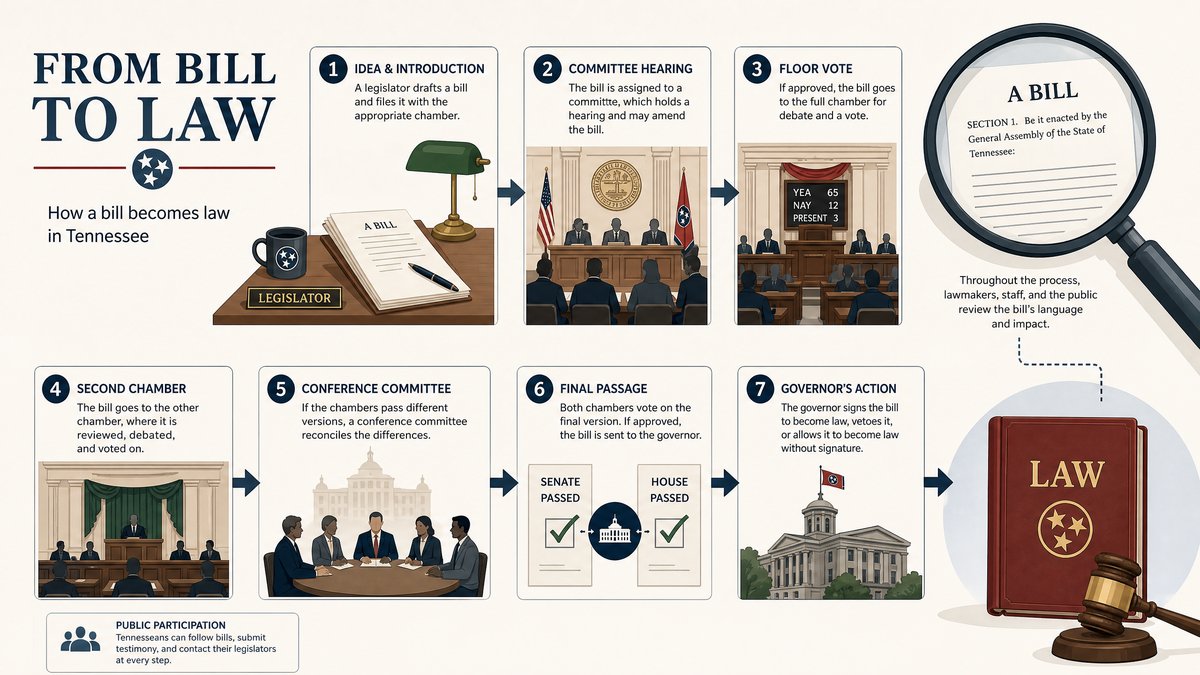
    The Tennessee General Assembly operates on a two-year legislative session, convening in January of odd-numbered years. The process begins with the introduction of a bill by a legislator in either the House of Representatives or the Senate. Often, identical bills, known as “companion bills,” are introduced in both chambers simultaneously to expedite the process.

    Empty hearing room with curved wooden bench and microphones; table holds a stack of folders, a closed notebook, two pencils and a glass.
    An empty hearing room with wooden benches, microphones and a table of folders and notes, setting the scene for discussion of the legislative process.

    First and Second Consideration

    Upon introduction, a bill is assigned a number by the Chief Clerk and undergoes its “first consideration.” This is typically a procedural step where the bill is read by title. On the next legislative day, it proceeds to “second consideration,” after which it is referred by the Speaker to an appropriate standing committee based on its subject matter. The Tennessee Constitution mandates that a bill must be considered and passed on three different days in each house before it can become law.

    Committee Review and Action

    Committees play a pivotal role in the legislative process. Here, bills are thoroughly discussed, debated, and often amended. The bill’s sponsor presents the legislation to the committee, and members can ask questions, voice support or opposition, and propose amendments. If a bill has a budgetary impact, it is also reviewed by the Finance Committee, and a “fiscal note” is assigned, detailing the estimated financial implications. Public input is often sought during committee hearings, allowing citizens and affected agencies to testify. A bill can either be recommended for passage, held for further discussion, or fail in committee.

    Person's hands at a wooden desk with three folders and sheets arranged side by side; right hand holds a pencil over the right page.
    Arrangement of three document versions on a desk suggests side-by-side comparison useful for tracking changes in legislative text.

    Third Consideration and Passage

    Bills that successfully navigate the committee stage are then placed on the chamber’s calendar for “third and final consideration.” This is where the full body debates the bill, and further amendments can be introduced. Once passed by one chamber, the bill is engrossed with its amendments and sent to the other chamber. If the second chamber passes a different version, the bill returns to the originating chamber for concurrence. If differences persist, a conference committee can reconcile them.

    Governor’s Action

    After a bill passes both chambers in identical form, it is enrolled and transmitted to the Governor. The Governor may sign it, allow it to become law without a signature, or veto it. The legislature may override a veto through the process set out in Tennessee law and the state constitution.

    Person seen from behind typing on a laptop at a wooden table in an empty courtroom, with a notebook, pen, and a thick book nearby.
    A person uses a laptop alongside a notebook and reference book in a courtroom setting, illustrating the mix of online and paper research for tracking bills.

    How to Follow Legislative Changes

    The Tennessee General Assembly website is the primary source for legislative calendars, committee schedules, and bill text. Its Bill Search feature allows users to locate legislation by keywords, bill number, sponsor, or session. Readers tracking a bill should identify its House Bill or Senate Bill number, check the current version, review its action history, and compare any amendments with the original text.

    The official website is the best source for a bill’s legal text and status. News reporting and nonpartisan explainers can offer context, but readers should link back to the official record when describing what a bill does or where it stands.

    Disclaimer

    This article provides general information about the Tennessee legislative process and is not legal advice. For advice about a specific legal question, consult a qualified attorney.

    Open lined notebook with pencil and four closed folders on a wooden table, marble columns and a staircase in the background.
    Stacked folders and an open notebook serve as a visual metaphor for organizing bill paperwork and tracking legislative records.

    Sources

    Related reading: Tennessee public legal documents to watch.
  • Friday Accountability Briefing: Five Public Tennessee Legal Documents Worth Watching

    Friday Accountability Briefing: Five Public Tennessee Legal Documents Worth Watching

    Accountability reporting begins with documents. Public records do not answer every question, and a filing or bill is not proof of an allegation. But primary materials can help readers see what government bodies and courts have actually done, what remains unresolved, and where to look next.

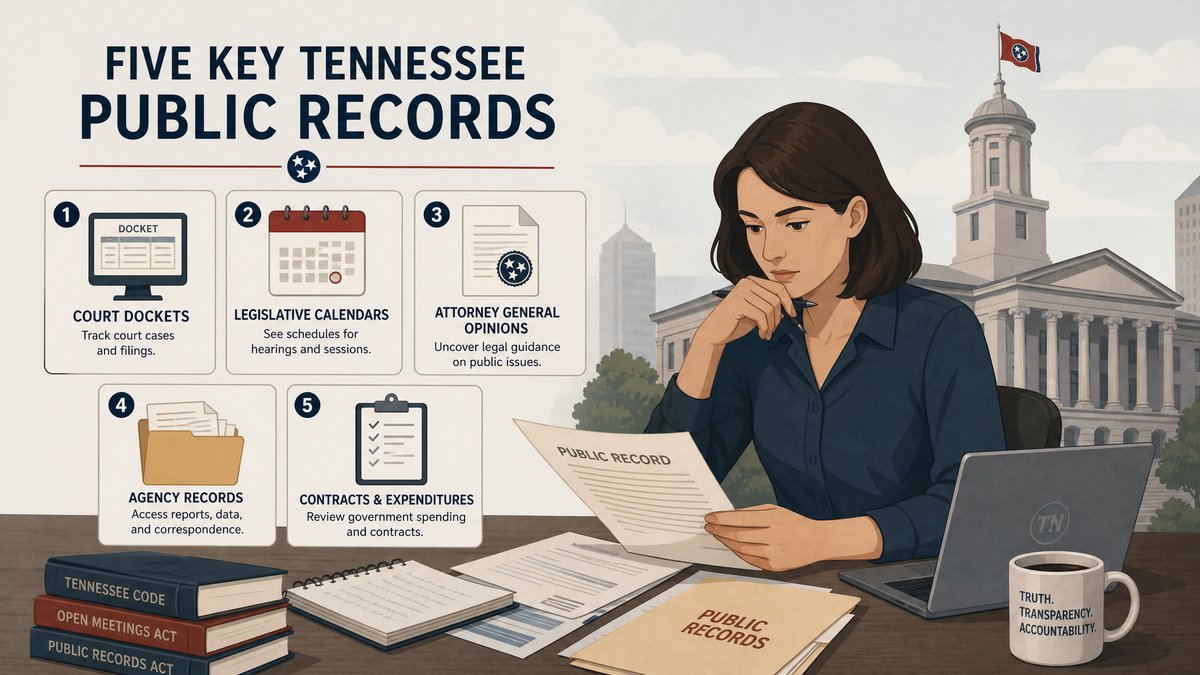
    Here are five useful Tennessee document types for readers who want to follow legal and civic issues with care.

    A carefully organized research desk with Tennessee court documents, public-records papers, legislative materials, a magnifying glass, and a notebook.
    Public documents provide the foundation for accurate accountability reporting.

    1. A court docket

    A docket is the court’s running list of events in a case. It can show filings, hearing dates, orders, and case-status entries. It is a roadmap—not a substitute for reading the documents themselves. A docket entry may identify that a motion was filed, but the motion and resulting order will usually provide the context needed to describe it accurately.

    When writing from a docket, record the court, case number, date, and document title. Separate a party’s allegation from a court’s finding. If access is limited or a record is sealed, do not infer what the unavailable material says.

    An open court docket beside a case file and calendar, representing the timeline of filings, hearings, orders, and case-status entries.
    A court docket is a roadmap to a case, not a substitute for reading the underlying filings and orders.

    2. A court order or opinion

    An order explains a court’s decision on a motion or procedural question. An appellate opinion may provide a fuller legal analysis and is often the most reliable starting point for explaining a rule or precedent. Read the holding before summarizing the case. Pay attention to the precise question the court answered, the standard it applied, and whether the decision is final or subject to further review.

    The Tennessee judiciary publishes opinions and many other resources at tncourts.gov. An official decision is stronger reporting support than a summary or a social-media characterization of the case.

    3. A public-records request and response

    Tennessee’s Public Records Act provides a framework for inspecting or receiving copies of public records maintained by governmental entities, subject to statutory exceptions. For court records, Supreme Court Rule 34 addresses public access and identifies categories of records that are confidential or otherwise unavailable. A records request should be specific, respectful, and tailored to documents that the agency or court actually maintains.

    A denial or redaction is not proof of misconduct. It may reflect a lawful exception, privacy protection, court order, or an administrative issue. Good reporting asks what legal basis was cited and preserves the correspondence for readers to evaluate.

    A Tennessee public-records request and response paperwork set on a desk with files and a privacy shield.
    Public-records correspondence can document what was requested, what was produced, and what was withheld.

    4. A bill and its history

    Before a proposal becomes law, readers can follow the bill number, sponsors, amendments, committee actions, fiscal notes, and votes. The Tennessee General Assembly’s website provides bill information and legislative materials. Tracking a bill’s history helps distinguish a proposal from enacted law—and helps journalists identify the version that was actually considered by a committee or passed by a chamber.

    Tennessee’s Constitution requires bills to be considered and passed on three different days in each house before becoming law, subject to the state’s constitutional process. A bill may be amended many times along the way, which is why the final enrolled version matters.

    A Tennessee legislative bill-tracking path from documents to a bound public chapter, with the State Capitol in the background.
    Bill history shows how a proposal moved from filing through committee action, votes, and final enactment.

    5. A public chapter

    Once legislation becomes law, it is assigned a public chapter number and later incorporated into the Tennessee Code Annotated when appropriate. The public chapter is the most direct record of what the legislature enacted at that time. A responsible explainer links to the public chapter, describes the effective date, and checks whether the provision has later been amended or challenged.

    A simple verification checklist

    • Identify the primary document and its official source.
    • State the date, issuing body, and procedural posture.
    • Distinguish allegations, arguments, evidence, rulings, and final judgments.
    • Link readers to documents whenever possible.
    • Correct the record promptly if new documentation changes the story.

    Document-based reporting is not glamorous, but it is durable. It gives readers a way to check a story’s foundations and makes public debate more accurate.

    Primary sources

    1. Tennessee Supreme Court Rule 34: Public Access to Court Records.
    2. Tennessee General Assembly: How a Bill Becomes a Law.
    3. Tennessee Courts.

    Editorial note: This briefing provides general public-information guidance. It is not legal advice and does not replace the applicable rules, statutes, or court orders.

    Related reading: Tennessee public-records checklist.