How a Bill Becomes a Tennessee Law—and How to Follow Its Changes
Understanding the legislative process is crucial for any engaged citizen, especially when it comes to state-level governance. In Tennessee, the journey of a bill from an idea to a law is a multi-step process involving both chambers of the General Assembly and the Governor. This article will demystify this process and provide guidance on how to effectively track legislative changes.
The Path of a Bill: From Introduction to Law
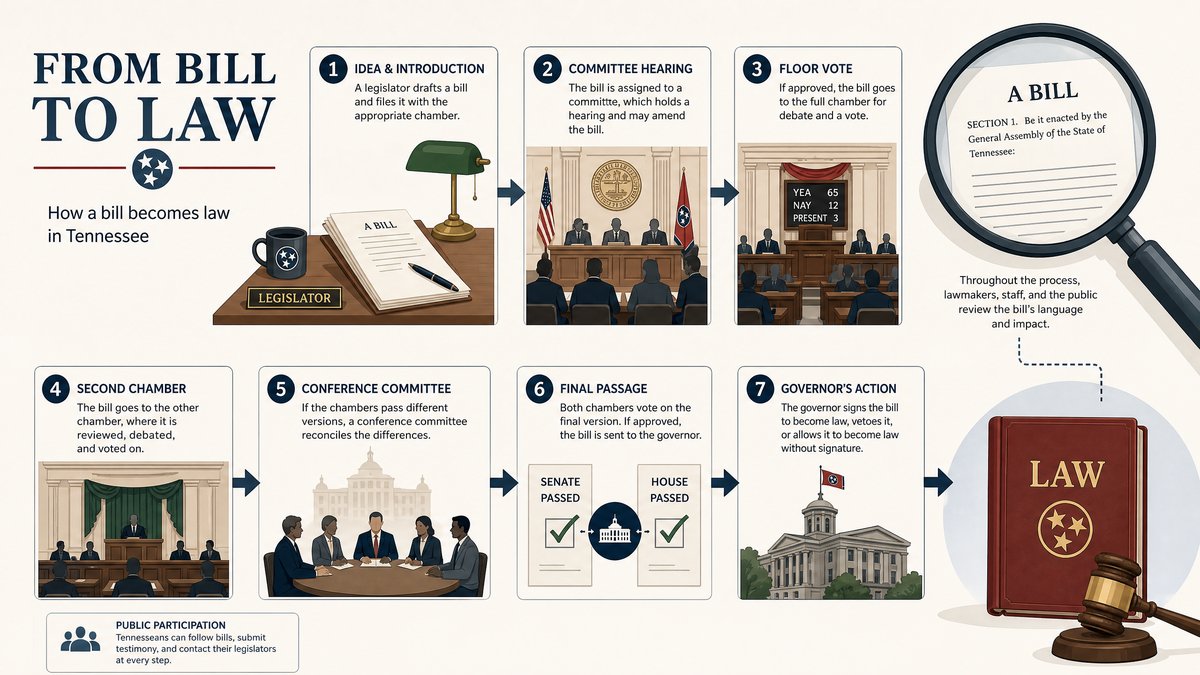
The Tennessee General Assembly operates on a two-year legislative session, convening in January of odd-numbered years. The process begins with the introduction of a bill by a legislator in either the House of Representatives or the Senate. Often, identical bills, known as “companion bills,” are introduced in both chambers simultaneously to expedite the process.

First and Second Consideration
Upon introduction, a bill is assigned a number by the Chief Clerk and undergoes its “first consideration.” This is typically a procedural step where the bill is read by title. On the next legislative day, it proceeds to “second consideration,” after which it is referred by the Speaker to an appropriate standing committee based on its subject matter. The Tennessee Constitution mandates that a bill must be considered and passed on three different days in each house before it can become law.
Committee Review and Action
Committees play a pivotal role in the legislative process. Here, bills are thoroughly discussed, debated, and often amended. The bill’s sponsor presents the legislation to the committee, and members can ask questions, voice support or opposition, and propose amendments. If a bill has a budgetary impact, it is also reviewed by the Finance Committee, and a “fiscal note” is assigned, detailing the estimated financial implications. Public input is often sought during committee hearings, allowing citizens and affected agencies to testify. A bill can either be recommended for passage, held for further discussion, or fail in committee.

Third Consideration and Passage
Bills that successfully navigate the committee stage are then placed on the chamber’s calendar for “third and final consideration.” This is where the full body debates the bill, and further amendments can be introduced. Once passed by one chamber, the bill is engrossed with its amendments and sent to the other chamber. If the second chamber passes a different version, the bill returns to the originating chamber for concurrence. If differences persist, a conference committee can reconcile them.
Governor’s Action
After a bill passes both chambers in identical form, it is enrolled and transmitted to the Governor. The Governor may sign it, allow it to become law without a signature, or veto it. The legislature may override a veto through the process set out in Tennessee law and the state constitution.

How to Follow Legislative Changes
The Tennessee General Assembly website is the primary source for legislative calendars, committee schedules, and bill text. Its Bill Search feature allows users to locate legislation by keywords, bill number, sponsor, or session. Readers tracking a bill should identify its House Bill or Senate Bill number, check the current version, review its action history, and compare any amendments with the original text.
The official website is the best source for a bill’s legal text and status. News reporting and nonpartisan explainers can offer context, but readers should link back to the official record when describing what a bill does or where it stands.
Disclaimer
This article provides general information about the Tennessee legislative process and is not legal advice. For advice about a specific legal question, consult a qualified attorney.

Sources
- Tennessee General Assembly, “How a Bill Becomes a Law”
- Tennessee General Assembly, Bill Search
- Tennessee General Assembly, Bills Subject Index
Related reading: Tennessee public legal documents to watch.