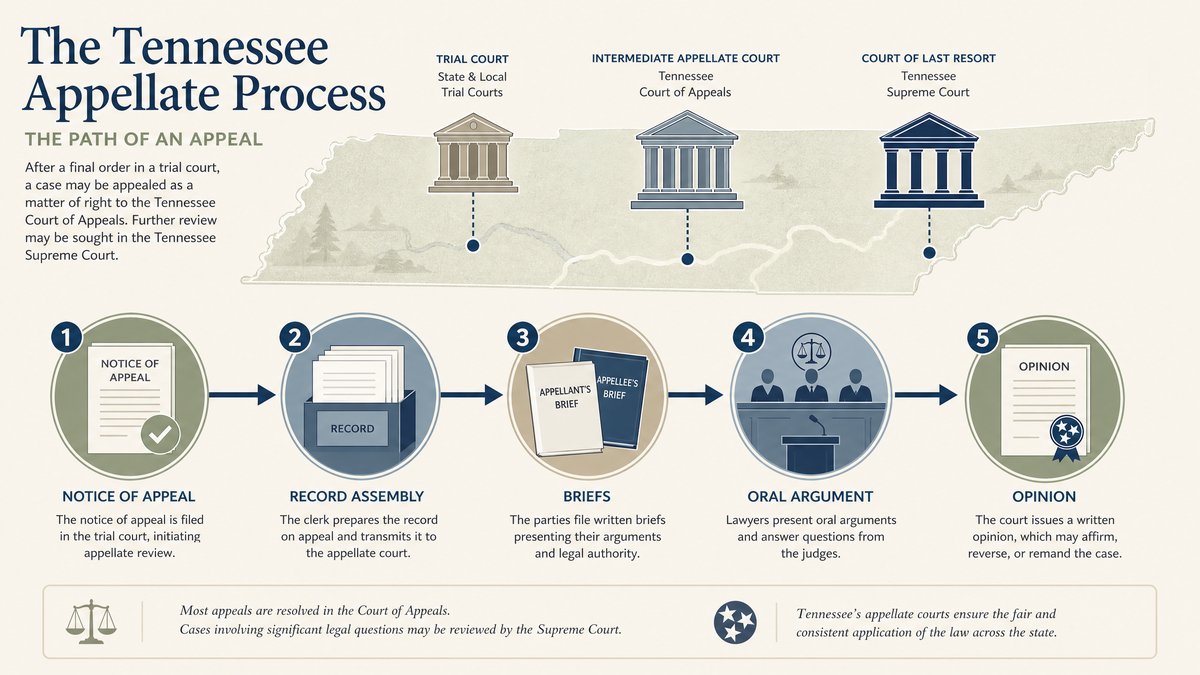
From Notice of Appeal to Opinion: A Map of the Tennessee Appellate Process
This article provides a high-level map of the appellate process in Tennessee. It is not a substitute for the rules, the specific court’s orders, or legal advice in an individual case.
Beginning an Appeal
An appeal as of right ordinarily begins with a Notice of Appeal. Tennessee Rule of Appellate Procedure 3 addresses the availability and method of initiating an appeal, and Rule 4 addresses the time for filing. In many civil and criminal matters, the notice must be filed within 30 days after entry of the judgment or order appealed from. Appellate deadlines can be jurisdictional or otherwise consequential, so parties should consult the applicable rule and qualified counsel rather than rely on a general explainer.

Building the Record
Appellate courts decide cases from the record developed below; they do not conduct a new trial. Rule 24 governs the content and preparation of the record, which may include relevant filings, exhibits, and a transcript or statement of the evidence. The record matters because arguments on appeal must be supported by what is properly before the appellate court.
Briefs
Once the record is prepared, the parties submit briefs. Rule 27 describes the elements of a brief, including issues presented, a statement of the case, citations to the record and legal authority, and the requested relief. A brief is not simply a recap of events. It is an argument about legal error, standard of review, and the effect of the claimed error on the judgment.

Oral Argument
In some cases the court hears oral argument under Rule 35. The argument allows judges to question counsel about the record, the controlling law, and the practical implications of competing positions. A decision may also be made on the written materials when the court does not hear oral argument.
Opinion and Judgment
After considering the record and the parties’ arguments, the appellate court issues an opinion or other disposition. Rule 38 addresses entry of judgment and distribution of the opinion and judgment. The result may affirm, reverse, modify, vacate, remand, or otherwise dispose of the trial court’s decision. An appellate opinion should be read carefully: its reasoning, holdings, and instructions on remand may be narrower than a headline suggests.

Reading an Appellate Opinion Responsibly
- Identify the court, date, and procedural posture.
- Read the issue presented and the standard of review.
- Distinguish the court’s holding from background facts and party arguments.
- Check whether the opinion is a final published decision, an order, or a later procedural development.
- Link to the official opinion and docket when reporting it publicly.
For readers, the important habit is to follow the document trail. An appellate opinion may identify related filings, a trial-court decision, and a further review petition. Those documents can help clarify what the court actually decided, what questions remain open, and whether later proceedings changed the posture of the matter.
Disclaimer
This article is general information, not legal advice. Appellate procedures and deadlines depend on the governing rules and case-specific facts.

Sources
- Tennessee Rules of Appellate Procedure
- Tennessee Rule of Appellate Procedure 3
- Tennessee Rule of Appellate Procedure 4
- Tennessee Rule of Appellate Procedure 24
- Tennessee Rule of Appellate Procedure 27
- Tennessee Rule of Appellate Procedure 35
Related reading: Tennessee appellate access to arguments and opinions.
Leave a Reply