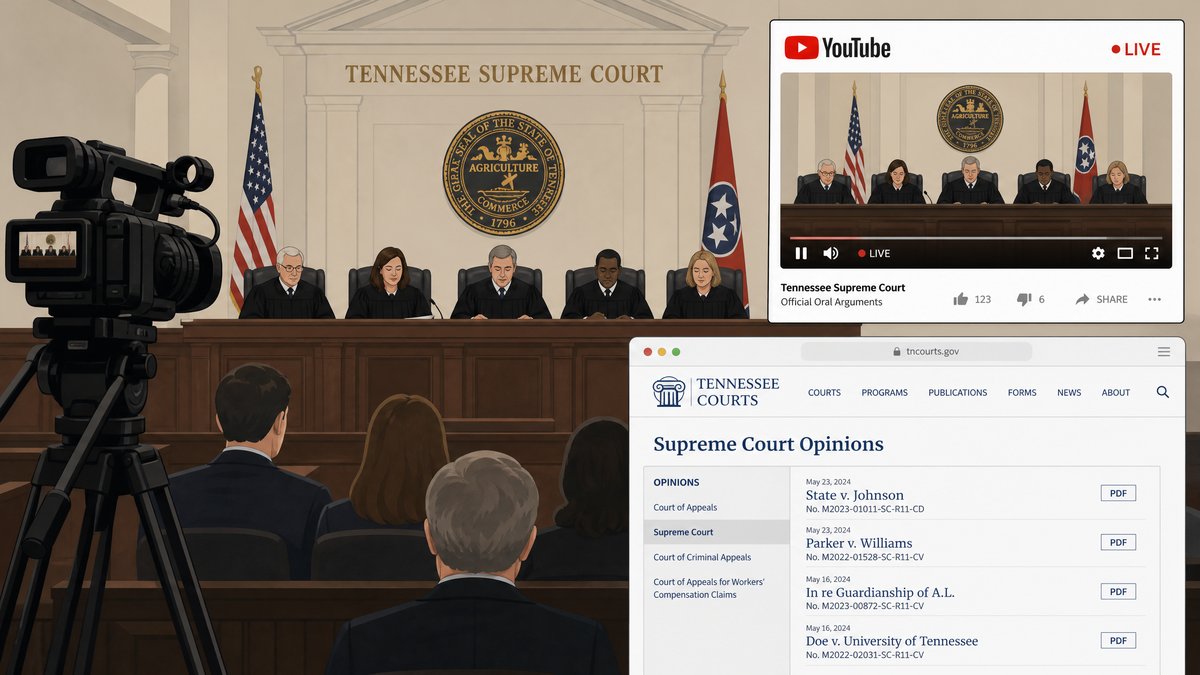
Public Access to Appellate Arguments and Opinions in Tennessee
Public access to court proceedings and decisions helps people understand how judicial institutions work. Tennessee’s appellate courts provide several official ways to find opinions, follow case histories, and in some circumstances watch oral arguments. Access is meaningful only when readers understand both the available records and the limits that may apply.

Finding Appellate Opinions
The Tennessee Administrative Office of the Courts maintains a Public Case History system for the Supreme Court, Court of Appeals, and Court of Criminal Appeals. The system can be used to search by case number, case style, party name, or organization. Its case pages may include a procedural history and public documents such as orders and opinions. The Court of Appeals also maintains an opinions page.
When reporting an opinion, readers should begin with the official document rather than a summary. The caption, court, date, docket number, and disposition establish the basic frame. The procedural history and issue presented help explain what the court was deciding and what it was not deciding.

Watching Oral Argument
The Tennessee Supreme Court makes many oral arguments available online through its court resources and streaming channels. Oral argument provides an opportunity to hear judges question attorneys about the governing law and the record. It should not, however, be treated as a decision. A question from the bench may test an argument; it is not a ruling. The opinion or formal order is the authoritative expression of the court’s disposition.

Public Access Has Limits
Tennessee Supreme Court Rule 34 addresses public access to court records. It recognizes categories of court records while also identifying records or portions of records that are not open for public inspection. Sealed materials, information protected by rule or law, and deliberative materials may be unavailable. A public docket entry may therefore show that a filing exists without making every underlying document publicly accessible.
For journalists and researchers, the appropriate response to an unavailable record is not speculation. Explain what is publicly available, identify the source of the information used, and be clear about what the public record does not establish. That approach respects both open-courts values and legitimate restrictions designed to protect sensitive information or the integrity of the judicial process.

A Responsible Research Checklist
- Use the official court site and public case history before relying on secondary summaries.
- Record the case number, court, date, and document title.
- Distinguish allegations in a filing from findings in an opinion or order.
- Check whether an opinion has later history, including rehearing or further review.
- Do not infer the contents of sealed or unavailable records.
Readers should also distinguish access from interpretation. A filing, an oral-argument recording, and a final opinion have different legal and editorial significance. Linking each claim to the appropriate official record makes a story more transparent and makes it easier for the public to see what supports a particular conclusion.
Disclaimer
This article offers general public-information guidance and is not legal advice. Access to particular records may depend on court rules, orders, and applicable law.
Sources
- Tennessee Courts: Public Case History
- Tennessee Court of Appeals Opinions
- Tennessee Supreme Court Oral Arguments
- Tennessee Supreme Court Rule 34
Related reading: Tennessee Rule 30 media coverage.