Stop Legal Harassment

Court access · Free expression · Accountability

Tag: journalism ethics

  • Reporting on Pending Cases: Navigating Tennessee’s Fair Report Privilege

    Reporting on Pending Cases: Navigating Tennessee’s Fair Report Privilege

    Reporting on Pending Cases: Navigating Tennessee’s Fair Report Privilege

    Journalists play a crucial role in informing the public about legal proceedings, but reporting on pending cases presents unique challenges, particularly concerning potential defamation claims. In Tennessee, the fair report privilege offers significant protection to journalists, allowing them to report on official acts and public proceedings without fear of liability, provided certain conditions are met. This explainer delves into the scope and limitations of this vital privilege, offering clarity for those covering the state’s legal landscape.

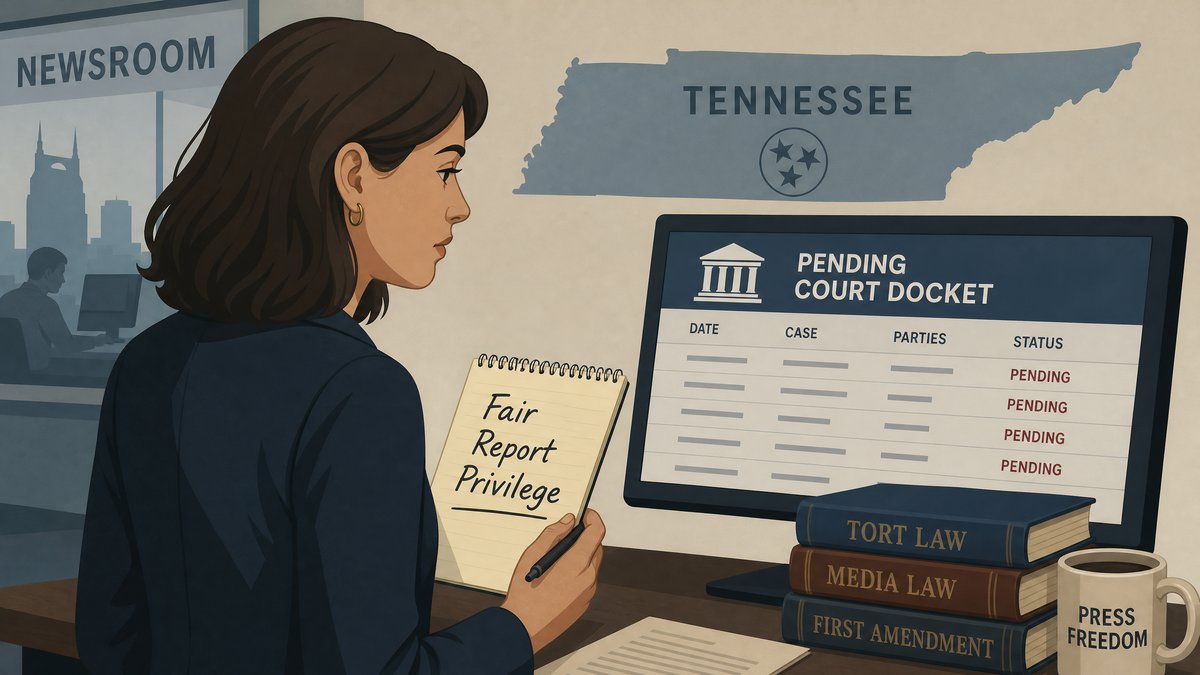
    The fair report privilege is a common law defense that shields journalists from defamation lawsuits when they accurately and fairly report on official government actions or public judicial proceedings. Its fundamental purpose is to ensure transparency in government and judicial functions, allowing the public to be informed about matters of public record. A cornerstone of this privilege in Tennessee is that it cannot be defeated by proving malice. This means that even if a journalist harbored ill will or intent to harm, the privilege still applies as long as the report itself is fair and accurate and concerns an official act or public proceeding.

    Woman seated at a courtroom table reading a printed page and writing in a notebook, with stacked books, folders, and a magnifying glass nearby.
    An individual reviews court documents and takes notes, illustrating the careful examination of public records relevant to reporting on pending cases.

    Scope and Limitations of the Privilege

    While robust, the fair report privilege is not absolute and comes with important limitations. Crucially, the privilege does not extend to nonpublic, one-on-one conversations with officials. This distinction was underscored by the Tennessee Supreme Court, clarifying that private interviews, even with public officials discussing official matters, do not fall under the umbrella of protection. The rationale is that the privilege is designed to protect reports of public records and proceedings, not private disclosures that lack the same public scrutiny or official documentation.

    For a report to qualify for protection under the fair report privilege, it must be both fair and accurate. Fairness implies that the report provides a balanced account of the official act or proceeding, without distortion or undue emphasis that would create a false impression. Accuracy requires that the report truthfully reflects what occurred or was stated in the official context. Journalists must diligently ensure their reporting meets these standards to invoke the privilege successfully.

    Person seen from behind writing in a notebook on a wooden bench while other seated people face a raised bench in a courtroom.
    A person taking notes in a courtroom interior visually illustrates the practical considerations of reporting on pending cases and hearings.

    Interaction with Tennessee’s Media Shield Law

    An important consideration for journalists in Tennessee is the interaction between the fair report privilege and the state’s media shield law. Should a journalist raise the fair report privilege as a defense in a defamation case, it may, under certain circumstances, require the identification of sources. However, it is critical to understand that this potential requirement to identify sources does not compel the disclosure of the actual information provided by those sources. The media shield law generally protects the confidentiality of source material, even if the source’s identity must be revealed to assert a defense.

    Practical Cautions for Journalists

    To effectively utilize the fair report privilege and avoid potential legal pitfalls, journalists covering Tennessee’s legal system should adhere to several key cautions:
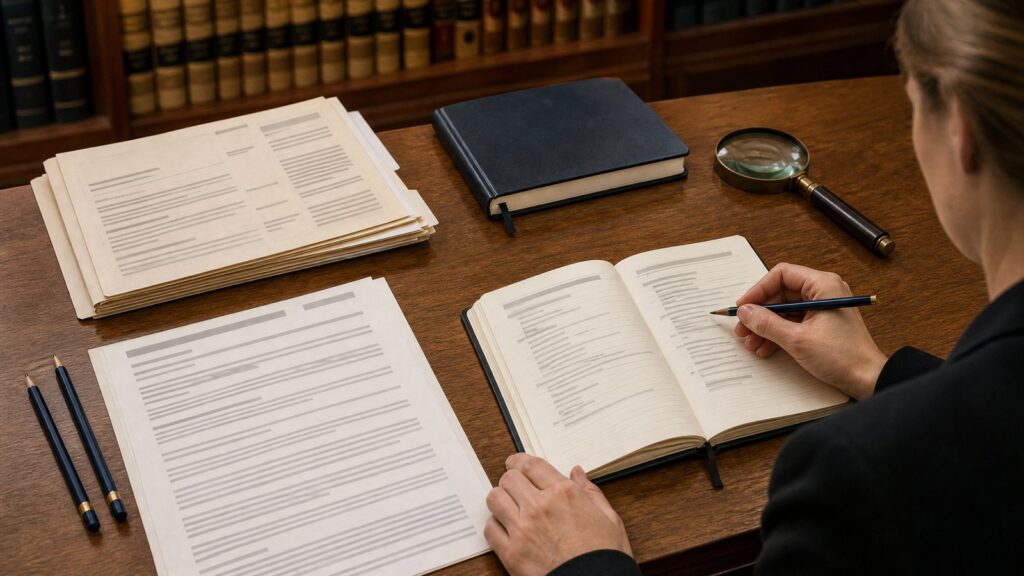
    Hands of a person writing with a pencil in an open notebook on a wooden desk with stacked papers, a magnifying glass, and shelves of volumes.
    Person annotates printed pages and a notebook at a desk, illustrating careful review of documents related to reporting on pending cases.
    • Ensure Fairness and Accuracy: Always verify that reports of official acts and proceedings are fair and accurate. Any misrepresentation or selective reporting could jeopardize the privilege.
    • Distinguish Public from Private: Be acutely aware that the privilege does not cover private interviews, even if conducted with public officials discussing their duties. Information obtained through such channels should be handled with extra scrutiny.
    • Source Identification vs. Content: Understand that claiming the privilege as a defense might necessitate identifying sources, but it does not automatically require revealing the content of their statements.
    • Verify Seal Status: Before reporting on information from official proceedings, verify whether that information was under seal at the time of reporting. Reporting on sealed information, even if from an official proceeding, may not be protected.

    By understanding and meticulously applying the principles of Tennessee’s fair report privilege, journalists can continue to provide essential public-interest reporting on legal cases, upholding their role as watchdogs while navigating the complexities of defamation law.

    Primary Sources

    Note: This article provides public-interest journalism and general information about Tennessee legal processes. It is not legal advice. If you have a specific legal question, consult a qualified attorney.

    A woman and a man sit at a wooden desk in an office, reading and marking papers by laptop, with folders, notebooks and a magnifying glass nearby.
    Two people review documents and notes at a desk, illustrating careful editorial review and source verification when reporting on pending cases.

    Related reading: Tennessee fair-report privilege decision in Burke v. Sparta.

  • Defamation, Opinion, and Fair Reporting: Guardrails for Public-Interest Journalism

    Defamation, Opinion, and Fair Reporting: Guardrails for Public-Interest Journalism

    Defamation, Opinion, and Fair Reporting: Guardrails for Public-Interest Journalism

    Introduction

    Public-interest journalism informs citizens and can strengthen accountability. It also requires careful reporting discipline, particularly when stories include allegations, court filings, or disputes that may affect a person’s reputation. This article explains several important guardrails: defamation law, the distinction between fact and opinion, and the fair-report privilege.

    Woman seated at a wooden courtroom table reads loose papers and writes in a notebook; closed book, two pencils, and a magnifying glass nearby.
    An individual reviewing documents and taking notes in a courtroom-like space, illustrating careful document review relevant to reporting guardrails.

    Understanding Defamation

    Defamation generally concerns a false statement of fact that harms a person’s reputation. It can include written statements (libel) and spoken statements (slander). The precise elements and defenses depend on the circumstances, including who was discussed, what was said, how it was published, and whether the matter involves public concern. Truth is a fundamental defense. Responsible reporting therefore begins with verification, attribution, and attention to what the source document actually says.

    Opinion Is Not a Label That Solves Everything

    Commentary and opinion can be important parts of public debate. But simply adding “in my opinion” does not transform an otherwise verifiable factual assertion into protected opinion. A statement may create legal risk if it implies undisclosed defamatory facts. A sound editorial practice is to separate reporting from analysis: identify the fact, link or cite the source, and make clear when the writer is drawing an inference or expressing a viewpoint.

    Overhead view of a person's hands and the back of their head at a wooden desk with three file folders, a pencil, and a magnifying glass.
    A person examines organized file folders with a pencil and magnifying glass, evoking the process of distinguishing fact from opinion.

    The Fair-Report Privilege

    Journalists frequently report on official proceedings, public records, and judicial matters. Tennessee recognizes a fair-report privilege for fair and accurate reports of official actions or proceedings. The privilege is not a substitute for careful work. It is strongest when reporting accurately attributes information to an identifiable public proceeding or record, fairly conveys its substance, and avoids treating allegations as established facts. The Tennessee Supreme Court has explained that the privilege does not extend to nonpublic, one-on-one conversations merely because the source is connected to government.

    Practical Editorial Guardrails

    • Verify primary sources. Read the complaint, order, recording, docket entry, or public report before characterizing it.
    • Attribute precisely. Say who made an allegation and where it appears.
    • Separate allegations from findings. A filing is not a judicial ruling, and a ruling on one issue may not resolve the entire case.
    • Invite a response when appropriate. Provide a meaningful opportunity to respond to significant adverse factual claims.
    • Use accurate headlines. Avoid headlines that overstate the source material.
    • Preserve the record. Retain copies, links, and notes showing what was reviewed.

    Speech and Anti-SLAPP Protections

    Tennessee’s Public Participation Act provides a procedure that may be available in cases targeting protected speech or petitioning activity. It does not eliminate the need for responsible reporting, and its application depends on the facts and the claims asserted. It is best understood as part of the broader framework surrounding public participation, rather than a guarantee against all litigation.

    Rear view of attendees seated on wooden pews in a courtroom, four foreground figures writing in notebooks.
    Audience members taking notes in a courtroom illustrate how public observation and careful recordkeeping relate to responsible news coverage.

    Disclaimer

    This article provides general information for journalism and public education. It is not legal advice. Specific questions should be directed to qualified counsel familiar with the governing jurisdiction and facts.

    Two people seated at a wooden table in a book-lined room, reviewing printed documents with pens and closed hardcover books nearby.
    An editorial review scene that illustrates careful document review and deliberation relevant to discussion of opinion and fair reporting.

    Sources

    Related reading: Tennessee fair-report privilege.

  • Court-Data Claims: Five Checks Before You Publish a Trend

    Court-Data Claims: Five Checks Before You Publish a Trend

    Court-Data Claims: Five Checks Before You Publish a Trend

    Court data can illuminate important public issues, but it can also mislead when a count, rate, or chart is stripped of its source and context. Before publishing a claim about a legal trend, reporters should identify what is being measured, how the numbers were collected, and what alternative explanations may exist.

    1. Identify the Source and Coverage

    Start with the original data source. A statewide annual report, a county court management system, an appellate docket, and a commercial legal database do not measure the same things. Determine the court, time period, case type, and geographic coverage. A filing count in one county should not be presented as a statewide development without evidence that the sample is representative.

    Person with glasses and ponytail at a courtroom table using a laptop showing rows of data; notebook, calculator and a magnifying glass on folders.
    Illustration of reviewing digital records and paper files at a courtroom table, underscoring the need to cross-check court data before publishing trends.

    2. Ask How the Data Was Collected

    Case-management systems may use different categories, coding rules, and closure practices. A change in a category label or reporting workflow can create an apparent increase or decrease that reflects administration rather than a real-world shift. The National Center for State Courts emphasizes the importance of reliability and integrity in case-file information. Journalists should ask whether missing entries, duplicate records, or changed definitions could affect a conclusion.

    3. Add Legal and Institutional Context

    Numbers do not explain themselves. A rise in filings can follow a new statute, a revised court rule, a fee change, an enforcement initiative, or a high-profile event. A decline in active cases may reflect settlements, dismissals, transfers, or altered reporting practices. Readers deserve context about the legal and administrative conditions surrounding a data point.

    A hand points at a tab on one of several open manila file folders spread across a wooden desk, near a magnifying glass, pencils and a notebook.
    Shows reviewing file folders and tabs to represent checking docket chronology and organization before publishing a court-data trend.

    4. Avoid Overstating What the Numbers Show

    Correlation is not causation. An increase in two variables does not prove that one caused the other. A statewide average may also conceal large differences among counties, courts, or case types. Report the denominator where possible, describe limitations, and use precise language: “the records show,” “the data suggests,” or “the count increased during this period” may be more accurate than a broad causal conclusion.

    5. Cross-Check Before Publishing

    Compare a proposed trend with official reports, public dockets, written methodology, and knowledgeable sources such as court administrators or researchers. For Tennessee-specific statistics, begin with the Administrative Office of the Courts and the underlying public records. When a data set is incomplete, say so. Transparency about limits is not a weakness; it helps readers evaluate the claim fairly.

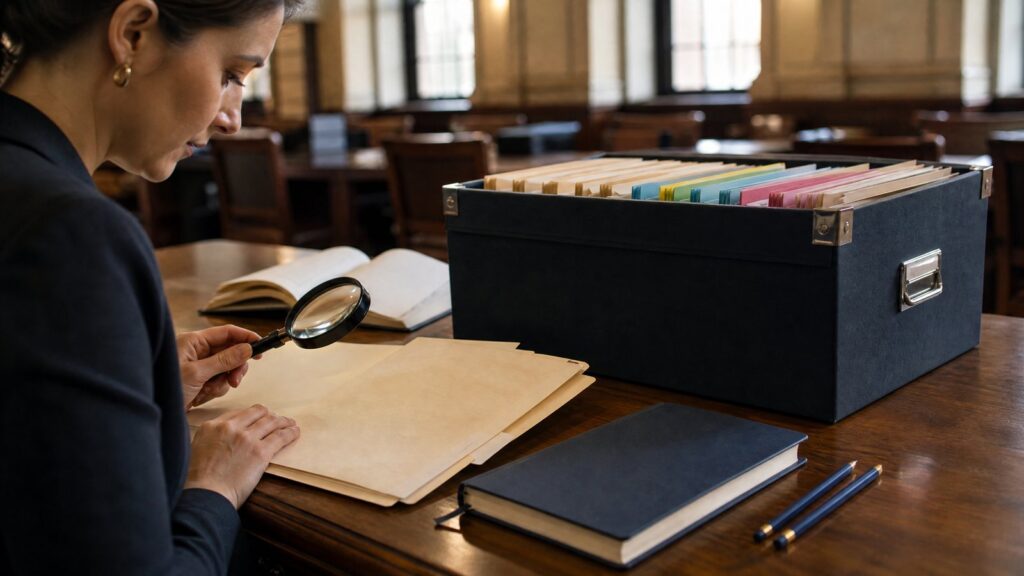
    Woman leaning over a wooden table using a magnifying glass to inspect paper folders next to a box of color-coded file folders
    Person examines paper folders with a magnifying glass, illustrating careful review of records and attention to sample-size checks.

    A Quick Editorial Checklist

    • Can readers access the original source or methodology?
    • Does the time frame match the claim?
    • Are the court type, case type, and geography clearly stated?
    • Could a rule, policy, or data-collection change explain the result?
    • Have you distinguished a documented fact from an inference?

    Good court-data reporting links the public to the underlying evidence and avoids turning a partial record into a definitive narrative. That practice supports accountability while preserving the nuance that legal systems require.

    Disclaimer

    This article provides general information about reporting on court data and is not legal, statistical, or professional advice.

    A woman and a man sit at a wooden table in a formal room, pointing to and reading papers beside a laptop, folders, and a magnifying glass.
    Two people review documents and source materials, symbolizing the final verification and cross-checking step before publishing data trends.

    Sources

    Related reading: fair reporting and public-interest journalism.

  • A Responsible Vocabulary for Reporting Litigation Abuse

    A Responsible Vocabulary for Reporting Litigation Abuse

    A Responsible Vocabulary for Reporting Litigation Abuse

    Public discussion of litigation can become imprecise quickly. A filing may be frustrating, expensive, or unsuccessful without being legally abusive. Journalists, advocates, and readers should therefore use legal labels carefully and connect them to what the public record actually shows.

    Start With the Record, Not the Label

    Before describing conduct as “frivolous,” “abusive,” or “retaliatory,” review the available complaint, motion, response, order, and docket entries. Attribute the claim to its source: “the defendant argued,” “the complaint alleges,” or “the court found.” A court filing is evidence that a party made an allegation; it is not, by itself, proof that the allegation is true.

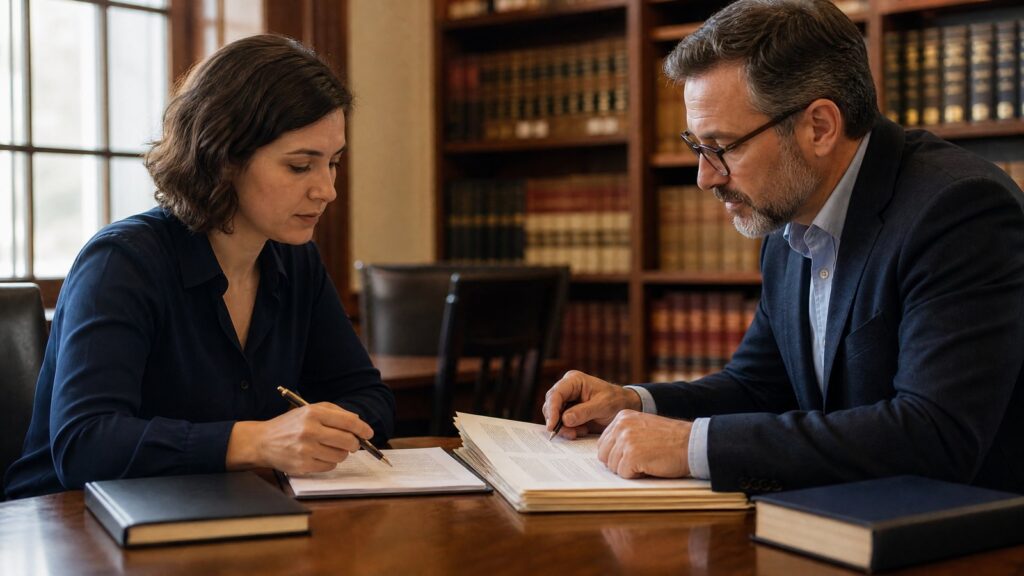
    Man with glasses pointing to a printed page while a woman writes in a notebook at a wooden table with folders, books, and mugs.
    A careful document review and note-taking scene underscores the article’s point about precise language and verification in reporting litigation.

    This distinction is especially important when private people are involved. A careful report identifies the procedural posture, distinguishes a party’s position from a judicial ruling, and gives meaningful context about what has and has not been decided.

    “Abusive Civil Action” Has a Statutory Meaning

    Tennessee’s Abusive Civil Actions law, Tennessee Code Annotated title 29, chapter 41, uses a defined term that is narrower than everyday criticism of a lawsuit. The chapter addresses specified civil-action relationships and provides a framework for courts to consider allegations that litigation is being used abusively. It should not be cited as a catch-all rule for every contentious dispute.

    For reporting purposes, the sound formulation is not “this is an abusive civil action” unless a court has made that determination. A more accurate description is: “The party asked the court to apply Tennessee’s Abusive Civil Actions law,” followed by a link or citation to the motion and the disposition.

    Person at a wooden desk by a window writing in a lined notebook, with stacks of papers, a manila folder, magnifying glass, pens and a calendar.
    Illustration of methodical note-taking and organized documents, used here to represent careful source verification and record review.

    “Abuse of Process” Is Also a Specific Claim

    Abuse of process is a common-law tort, not a general synonym for aggressive litigation. Tennessee appellate decisions describe it as the use of legal process to obtain a result the process was not intended to accomplish. The focus is on how a legal tool was allegedly used, not simply on whether the underlying lawsuit ultimately succeeded.

    That is why a responsible article should avoid treating a case dismissal as automatic proof of abuse of process. The applicable elements, evidence, and court findings matter. When the issue is still pending, describe the claim as an allegation and identify the filing in which it appears.

    Rule 11 and the Tennessee Public Participation Act

    Tennessee Rule of Civil Procedure 11 addresses representations made to a court and permits sanctions in defined circumstances. The Tennessee Public Participation Act, often described as Tennessee’s anti-SLAPP law, establishes a procedure intended to protect the exercise of certain rights of free speech, petition, and association. These are separate legal mechanisms with their own requirements, deadlines, burdens, and remedies.

    Wood desk with manila folders, magnifying glass, lamp and a navy notebook; a hand holds a pen poised to write.
    Stacked folders, a magnifying glass and a closed notebook visually underscore the editorial consideration of public records versus private claims in reporting.

    Neither mechanism is a journalistic shortcut. A motion invoking Rule 11 or the Tennessee Public Participation Act tells readers what a party has requested; the court’s order tells readers what the court decided. The two should never be conflated.

    Practical Newsroom Guardrails

    • Use “alleged,” “argued,” or “according to the filing” for unresolved assertions.
    • Quote or link to the controlling order when describing a judicial finding.
    • Do not infer motive merely from a person’s decision to file a case.
    • Explain the procedural stage and include material responses or rulings.
    • Ask for comment when reporting allegations about identifiable people or organizations.

    Precision is not a limitation on accountability reporting. It is what makes accountability reporting credible. The most useful stories show readers what the documents say, what the governing law covers, and what a court has actually done.

    Disclaimer

    This article provides general legal information and journalism, not legal advice. It does not assess any reader’s specific facts or create an attorney-client relationship.

    Rear view of a person with a hair bun writing in a notebook on a wooden bench while several others sit facing the front of a formal courtroom.
    A note-taking observer in a courtroom underscores the article’s emphasis on using careful, neutral language when describing litigation scenes.

    Sources

    Related reading: Tennessee Public Participation Act anti-SLAPP basics.