Understanding Tennessee Appellate Opinions: Holding, Dicta, and Procedural Posture
Reading an appellate opinion is different from reading a news summary. The opinion identifies the questions the court was asked to decide, describes the procedural path that produced those questions, and explains the legal reasoning that supports the judgment. For Tennessee readers, three terms are especially important: holding, dicta, and procedural posture.
Start with the procedural posture
Procedural posture describes how a case reached the appellate court and what the court is reviewing. An opinion may begin by explaining that a trial court granted a motion to dismiss, entered summary judgment, denied a new trial, or issued another ruling. The Court of Appeals or Tennessee Supreme Court usually reviews that particular decision; it does not start the case over from the beginning.

Readers should identify whether the appeal follows a final judgment or a permitted interlocutory appeal. Tennessee Rule of Appellate Procedure 3 governs many appeals as of right from final judgments. Rules 9 and 10 address certain interlocutory or extraordinary appeals. The procedural posture helps explain the standard of review and the scope of the ruling.
Find the holding
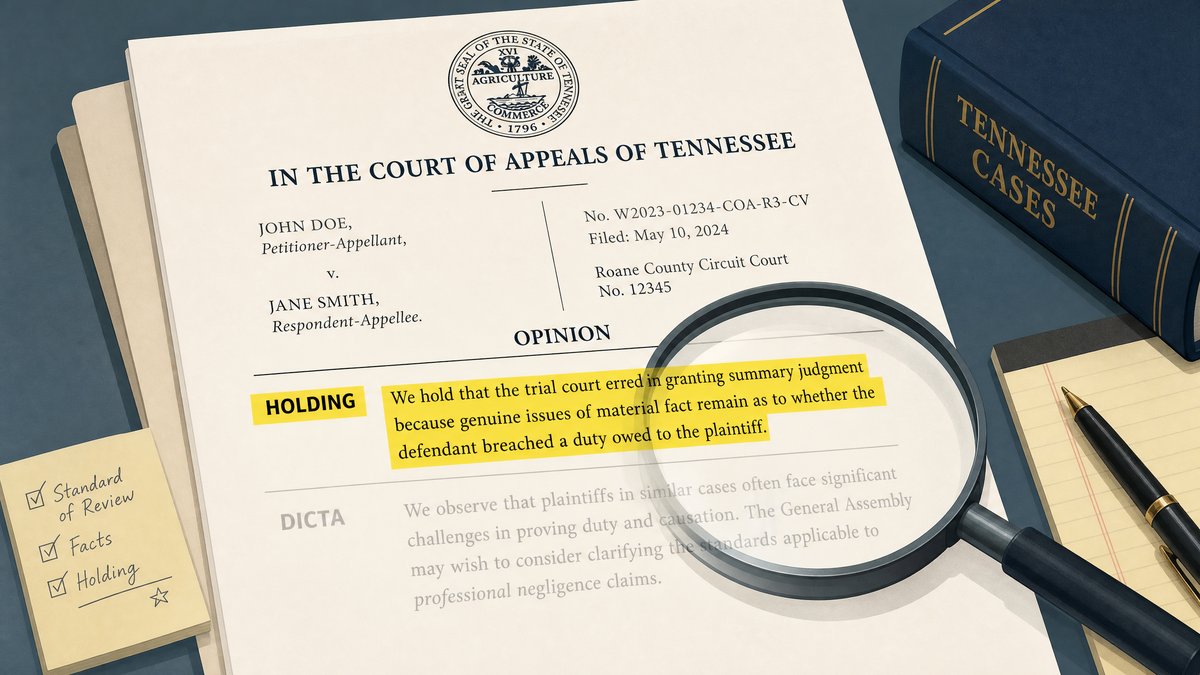
The holding is the legal rule or conclusion necessary to decide the case. It is not merely the final sentence stating “affirmed” or “reversed.” A careful reader should look for language such as “we hold,” “we conclude,” or a direct answer to the issue presented. The holding must be understood alongside the material facts and the procedural question before the court.

For public-interest reporting, a holding should be described narrowly and accurately. If an opinion resolves whether a particular claim survived a motion to dismiss, it does not necessarily decide what would happen after a trial. A story should explain what the court actually decided and avoid implying that the opinion establishes a broader rule than its text supports.
Recognize dicta
Dicta are statements that are not essential to the judgment. Courts may discuss background principles, possible future questions, or alternative reasoning. Such passages can be useful and persuasive, but they do not have the same precedential force as the holding. The line can be difficult to draw, which is one reason careful journalists should link the original opinion and attribute interpretations to the court’s language rather than overstate them.

Use the opinion’s structure
Most opinions have a predictable structure: a caption, background facts, procedural history, issues, standard of review, analysis, and conclusion. Begin with the conclusion, then return to the issue presented and analysis. Check whether the opinion is published, whether there are concurrences or dissents, and whether later decisions have affected it. Tennessee Courts publishes opinions and appellate materials on its official website.
Why this matters
Legal reporting becomes more reliable when it separates the court’s factual recitation, the parties’ allegations, the procedural ruling, and the court’s legal analysis. This approach respects the difference between a lawsuit’s claims and an adjudicated fact, and it gives readers a usable path back to the underlying public document.
Disclaimer
This article provides general information about reading Tennessee appellate opinions and is not legal advice. For advice about a particular case, consult a qualified attorney.

Sources
- Tennessee Supreme Court Opinions
- Tennessee Court of Appeals Opinions
- Tennessee Rules of Appellate Procedure
Related reading: how to read a Tennessee Supreme Court opinion.